

Feeling Overwhelmed Parenting an Anxious Child? A Guide to Finding Calm and Connection
What if the most effective way to quiet your child's anxiety isn't by fixing their fears, but by first tending to your own racing heart? It's deeply exhausting to find yourself feeling overwhelmed parenting an anxious child, especially when the constant cycle of managing triggers leads to chronic fatigue and a strained home life. You might feel a heavy sense of guilt as you try to balance the needs of your family, yet it's important to remember that you're navigating a universal human challenge. In fact, a 2026 survey by the Kids Mental Health Foundation revealed that 97% of parents reported feeling stressed about parenting in the past month. We understand that when you're in the middle of a meltdown, it can feel like you're failing, but this struggle is a reflection of how much you care, not a lack of capability.
We're here to help you shift from a state of survival to one of connection. In this guide, we'll explore how to stabilize your own nervous system through co-regulation so you can provide the steady presence your child needs. We'll provide a clear plan for handling difficult moments and show you where to find a child psychologist in St. Petersburg to support your family's growth. Together, we can transform the daily tension in your household into a shared journey toward healing and calm.
Key Takeaways
Understand why the cycle of anxiety accommodation often leads to parents feeling overwhelmed parenting an anxious child and how to break this pattern with self-compassion.
Explore the science of the shared nervous system to see how your internal calm acts as a stabilizing anchor for your child's emotional world.
Learn to distinguish between accommodating a fear and supporting a child, allowing you to set boundaries that foster resilience rather than avoidance.
Integrate simple, five-minute grounding rituals into your day to lower household tension and restore your own sense of balance.
Recognize the signs that it's time for professional guidance and learn how to access specialized child therapy and evaluations in the St. Pete area.
Table of Contents
Why Feeling Overwhelmed While Parenting an Anxious Child is a Universal Experience
Parenting is often described as a journey of joy, but for many of us, it feels more like a relentless marathon through a storm. If you're feeling overwhelmed parenting an anxious child, please know that your exhaustion isn't a sign of failure. It's the natural result of the "invisible labor" required to navigate a world that feels unsafe to your little one. You aren't just managing schedules; you're managing a nervous system that's constantly on high alert. This emotional labor is heavy, and it's something few people see from the outside.
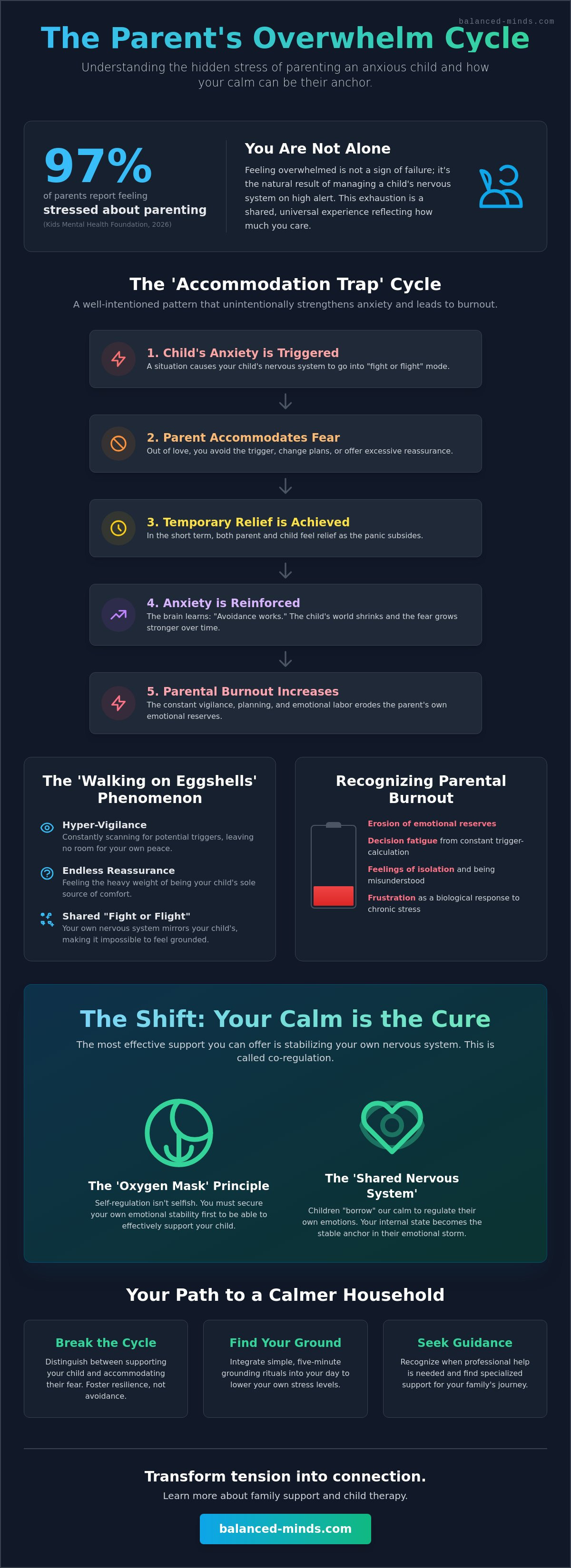
We often fall into what's known as the "Accommodation Trap" out of deep love. We change our driving routes, avoid certain social gatherings, or provide endless reassurance to keep our child's panic at bay. While these actions offer temporary relief, they often lead to a cycle of parental burnout. This isn't just about being "tired." It's about the erosion of your own emotional reserves as you try to shield your child from every possible discomfort. Anxiety impacts the entire family system, and when one person's world shrinks, everyone else's world tends to shrink along with it. Your frustration in these moments isn't a character flaw; it's a biological response to a system that has been pushed to its limit for too long.
The 'Walking on Eggshells' Phenomenon
Living with a child who struggles with an anxiety disorder often means the entire household exists in a state of hyper-vigilance. You might find yourself scanning every room for potential triggers before your child even enters. This anticipatory anxiety is incredibly taxing. When your child constantly seeks reassurance, it can feel like a heavy weight on your shoulders. It leaves you with little room for your own thoughts, needs, or even a moment of peace. You're essentially living in the same "fight or flight" mode as your child, which makes it nearly impossible to feel grounded.
Recognizing Parental Burnout in the Context of Anxiety
There's a distinct difference between the typical fatigue of parenting and being clinically overwhelmed. Many parents in St. Petersburg feel isolated, believing they're the only ones struggling to manage daily meltdowns or school refusal. Decision fatigue is a real part of this experience. Every choice, from what's for dinner to which park to visit, becomes a high-stakes calculation of potential triggers. We want you to understand that this level of stress is a shared human experience. Recognizing that you've reached your limit is the first step toward reclaiming your own sense of calm and building a more resilient family dynamic.
Understanding the Co-Regulation Connection: Why Your Calm Matters
When you're feeling overwhelmed parenting an anxious child, it's easy to believe that the solution lies solely in changing your child's behavior. However, science reveals that our nervous systems don't exist in isolation. We are biologically wired to influence one another through a phenomenon often called a "shared nervous system." Your internal weather directly dictates the safety levels of your home. If your own system is stuck in a state of fight or flight, your child’s developing brain literally lacks the biological anchor it needs to find peace. This isn't about blaming yourself; it's about recognizing the profound power of your presence.
Think of this as the "Oxygen Mask" principle. In clinical terms, self-regulation isn't a luxury or a selfish act of self-care. It's a fundamental requirement for therapeutic success. Research into parent-based treatments suggests that when we focus on stabilizing the parent's emotional response, we see significant improvements in the child's ability to manage their own anxiety. By tending to your own needs, you're actually providing the most effective form of support for your child.
The Vagus Nerve and the 'Nervous System Handshake'
Children are born with an unfinished nervous system, meaning they must "borrow" our calm to learn how to regulate their own emotions. This happens through the vagus nerve, which picks up on non-verbal cues like your tone of voice, the softness of your eyes, and your physical posture. These signals communicate safety much faster than any words of reassurance ever could. Co-regulation is a biological imperative for families, serving as the essential bridge that allows a child to move from a state of alarm to a state of security by mirroring a parent’s steady physiological rhythm.
Breaking the Cycle of Reactive Parenting
To move toward a more peaceful home, we must first identify our own anxiety triggers. When your child begins to spiral, does your heart race? Do you feel an urgent need to fix the situation immediately? Recognizing these internal shifts allows you to use the "Pause and Pivot" technique. This involves taking a conscious breath to settle your own system before responding to your child's distress. If these patterns feel deeply ingrained, seeking family therapy near me can provide a supportive environment to rebuild these connections. Working with a professional can help you deconstruct reactive habits and replace them with compassionate, intentional responses that foster long-term resilience for everyone involved.
Shifting from 'Walking on Eggshells' to Compassionate Boundaries
If you've been feeling overwhelmed parenting an anxious child, you likely know the quiet exhaustion of the "walking on eggshells" dynamic. We often find ourselves modifying every aspect of our lives to prevent a meltdown, but this constant adaptation can inadvertently signal to our children that the world is indeed as dangerous as they fear. Transitioning from accommodation to support is a delicate process. It requires us to move from removing the hurdle to holding our child's hand while they learn to jump over it. Boundaries in this context aren't about being "tough" or punitive; they're about providing a predictable, sturdy structure that makes a child feel safe.
When we set a boundary, such as refusing to check the door locks for a tenth time, our child's distress will likely spike. This often triggers a profound "guilt-response" in us. We might feel like we're being cruel or neglectful, but consistency is actually a gift of emotional security. Clinical studies, such as those featured in NIH MedlinePlus Magazine, suggest that we can often help their parents first by teaching them to reduce these accommodations. By changing our own responses, we empower our children to discover their own resilience. In the rhythmic life of a Florida household, maintaining these steady boundaries creates a sense of order that eventually lowers the overall baseline of anxiety for everyone.
Identifying the 'Accommodation Trap' in Your Daily Routine
The "Accommodation Trap" happens when we inadvertently feed the anxiety monster by helping our child avoid what scares them. Whether it's speaking for them when they're shy or letting them sleep in our bed every night to avoid "the dark," these short-term fixes have a long-term cost. They prevent the child from learning that they can survive discomfort. We can begin to break this cycle by slowly reintroducing "brave moments" into their routine. These are small, manageable challenges where the child faces a minor fear with your quiet, supportive presence nearby.
Scripts for Holding Boundaries with an Anxious Child
Having a plan for what to say can help you stay grounded when you're already tired. Instead of offering endless reassurance, try using scripts that acknowledge the feeling while still moving forward. You might say, "I can see that your worry is very loud right now, and I'm right here with you while we walk into the classroom." This validates the emotion without agreeing that the situation is a crisis. By explaining the "why" behind a boundary, such as "We're practicing being brave because I know you're strong enough to handle this," you help your child understand that your limit is based on love and belief in their capability rather than a desire to see them struggle.
Actionable Strategies to Manage Parental Burnout and Anxiety
When you're feeling overwhelmed parenting an anxious child, the idea of traditional self-care can feel like just another item on an impossible to-do list. We understand that your time is precious and your energy is often depleted by the constant vigilance that anxiety requires. Instead of grand gestures, we advocate for the "Oxygen Mask" strategy through micro-habits that fit into the small cracks of a busy Tampa day. Embracing the concept of "Good Enough" parenting allows you to release the heavy burden of perfectionism. It's about being present and responsive rather than perfectly composed. Finding ways to lower your stress is vital when you're feeling overwhelmed parenting an anxious child, as your well-being is the foundation of your child's security. Prioritizing your own psychology near me needs is a clinical necessity that ensures you have the emotional capacity to continue this vital work.
Building a support ecosystem is equally essential. You weren't meant to carry this weight alone. This involves identifying people in your life who can offer practical help, whether it's a partner taking over a specific routine or a trusted friend who listens without judgment. When the home environment feels heavy, remember that seeking professional support through individual therapy for children or family therapy can provide the external structure your family needs to find its footing again.
The Daily 'Micro-Break' Strategy
Finding restorative time doesn't require an hour of silence. It can be as simple as a sensory grounding exercise during a difficult moment. Try the "5-4-3-2-1" technique: name five things you see, four you can touch, three you hear, two you smell, and one you can taste. This pulls your brain out of the future-oriented "what-ifs" of anxiety and back into the safety of the present. These short, intentional bursts of nervous system regulation act as a circuit breaker to prevent total burnout and keep your internal weather stable.
Finding Your Local Village in St. Pete and Tampa
Isolation is one of the greatest challenges for parents in our community. Reaching out to local parenting near me resources can help you realize that your experiences are shared by many others in St. Pete and Tampa Bay. Whether it's a local support group or an educational workshop, connecting with other Florida parents provides a unique form of medicine that validates your struggle. Sharing your story helps dismantle the shame that often thrives in silence and reminds you that you're part of a larger, resilient community.
If you feel that your family's current ecosystem needs more specialized support, we invite you to explore our family therapy services to begin your collective journey toward healing and connection.
Finding Your Support System in St. Pete and Tampa Bay
There often comes a moment when the strategies we use at home, while grounded in love, simply aren't enough to quiet the storm. If you're still feeling overwhelmed parenting an anxious child despite your best efforts to co-regulate, it's a sign that your family system is ready for a deeper level of partnership. Moving from self-help to professional support isn't a white flag of surrender. Instead, it's a courageous step toward reclaiming the peace your household deserves. Working with a child psychologist st petersburg fl provides you with a clinical ally who can help untangle the complex threads of your child's distress while offering you a steady hand to hold.
At Balanced Minds, we believe that clarity is the first step toward connection. Sometimes, the path forward remains blurry because we don't yet have the full picture of a child's internal world. This is where our Comprehensive Psychological Evaluations and Mood and Anxiety Evaluations become invaluable. These assessments serve as a missing roadmap, allowing us to identify the specific nature of your child's challenges. Whether we're exploring giftedness, ADHD, or a specific learning disability, these insights ensure that our therapeutic approach is as unique as your child's own heart and mind.
Specialized Support for Anxious Children and Their Parents
Our practice offers Individual Therapy for Children that focuses on building resilience through evidence-based play and cognitive techniques. We also recognize that your schedule in the Tampa Bay area is often demanding. To support your family's needs, we utilize the well-established legal framework for telehealth in Florida, which has seen expanded support through 2025 and 2026 legislation. This allows for flexible access to care, ensuring that professional guidance fits seamlessly into your daily life. Through Family Therapy, we also address the specific fatigue you feel, helping you refine your responses so that you no longer carry the weight of being the sole regulator for your child.
Taking the First Step Toward a More Balanced Home
When you begin your journey with us, our intake session is designed to be a soft place to land. It's a collaborative conversation where we listen to your story without judgment and begin to weave a plan for healing. We also understand that your child's anxiety doesn't stop at your front door, which is why we often partner with St. Petersburg schools to ensure a consistent environment of support. You've been navigating this difficult terrain for a long time, but you don't have to carry this alone anymore. We're here to walk alongside you, helping your family move from a state of constant alarm into a season of lasting calm and connection.
Reclaiming Peace and Connection in Your Home
The journey of raising a child who struggles with anxiety is often paved with both deep love and profound exhaustion. We've explored how shifting from accommodation to co-regulation allows you to become the steady anchor your child needs, while compassionate boundaries provide the essential structure for their long-term growth. While feeling overwhelmed parenting an anxious child is a heavy burden to carry, it's a burden you don't have to bear in isolation. By prioritizing your own regulation and seeking a supportive village, you create a pathway for your entire family to move toward a more balanced and restorative life.
At Balanced Minds, led by Dr. Jennifer Katzenstein, a Board-Certified Pediatric Neuropsychologist, we provide evidence-based, heart-centered care for Tampa Bay families. Our practice offers comprehensive testing and therapy under one roof, ensuring that every step of your journey is guided by clinical expertise and genuine empathy. We invite you to connect with a compassionate child psychologist in St. Petersburg today to begin this new chapter. There is always hope for healing, and we're honored to walk this path with you toward a future filled with calm and connection.
Frequently Asked Questions
How do I know if my child's anxiety is 'normal' or requires professional help?
Anxiety requires professional help when it consistently interferes with your child's daily life, school attendance, or social development. While all children experience occasional fears, clinical anxiety is often characterized by its intensity and how long it lasts. If your child's distress prevents them from engaging in age-appropriate activities or causes significant family strain, a comprehensive psychological evaluation can provide the clarity you need to determine the next steps.
Why do I feel so angry when my child is anxious?
Feeling angry is a natural biological response to the "fight or flight" state triggered by your child's distress. When you are feeling overwhelmed parenting an anxious child, your own nervous system may misinterpret their panic as a threat, leading to frustration or irritability. This reaction is often a sign of emotional exhaustion rather than a lack of love, highlighting the vital importance of your own regulation and self-kindness.
Can I pass my own anxiety on to my child?
While there is a genetic component to anxiety, it's more helpful to think of it as a shared environment where nervous systems influence one another. Children often mirror the emotional responses they see in their caregivers through the process of observation. By focusing on your own well-being and practicing co-regulation, you can model resilience and create a sense of safety that helps buffer your child against developing similar patterns of worry.
What are the best child therapists in St. Petersburg, FL?
The best therapist for your child is one who specializes in evidence-based, pediatric-focused care and makes your family feel safe and understood. In the St. Petersburg and Tampa area, Balanced Minds offers a collective of experts grounded in science and heart-centered care. We provide a range of services, including individual therapy for children and adolescents, tailored to meet the unique developmental needs of families in our local community.
How can I help my anxious child at school in Pinellas County?
Supporting an anxious child in Pinellas County schools often begins with establishing a partnership with teachers and guidance counselors to create a 504 Plan or IEP. These documents can provide formal accommodations, such as extra time on tests or a designated "safe person" to visit when they feel panicked. We frequently collaborate with local schools to ensure that the therapeutic strategies used in our sessions are supported in the classroom environment.
What should I do if my partner and I disagree on how to handle our child's anxiety?
Disagreements between partners on how to manage anxiety are common and often stem from different upbringing styles or varying levels of understanding. Family therapy can be a restorative space to align your parenting approach and develop a unified plan for your home. When both parents use consistent language and boundaries, it reduces the child's confusion and significantly lowers the overall tension within the family system.
Does my child need a formal ADHD or anxiety diagnosis to start therapy?
No, your child does not need a formal diagnosis to begin individual or family therapy. While a comprehensive psychological evaluation can be helpful for school accommodations or targeted treatment, we can start supporting your family based on the symptoms and challenges you are currently facing. Our goal is to provide immediate relief and tools for connection while we work together toward a deeper understanding of your child's needs.
How long does it typically take to see improvement in an anxious child?
The timeline for improvement varies for every family, but many parents notice subtle shifts in household tension within the first few months of consistent support. Progress is rarely linear and involves building skills and confidence over time. When you're feeling overwhelmed parenting an anxious child, focusing on small "brave moments" and steady co-regulation will gradually help your child develop the resilience needed to navigate their world more independently.


