

What is Play Therapy For? A Compassionate Guide for St. Petersburg Families
Updated: 2 days ago
What if the very thing your child does most naturally is actually the most powerful tool for their healing? When you're facing another difficult phone call from a Pinellas County teacher, it's natural to feel a sense of helplessness or worry that traditional counseling will feel like a punishment for your little one. You might find yourself asking, what is play therapy for, and can it truly help my child process their big emotions? At Balanced Minds Psychology & Wellness, we believe that play is a child's first and most vital language. It provides a safe space to work through the "tricky brain" when words simply aren't enough.
We recognize the weight you carry when your child struggles to regulate their feelings in a world that often feels overwhelming. This guide promises to demystify how specialized play helps children in St. Petersburg and Tampa navigate behavioral challenges while building lasting resilience. We'll explore the clinical benefits of this heart-centered approach and provide practical tools for parenting your unique, neurodivergent, or anxious child with confidence and compassion. By bridging the gap between clinical expertise and human connection, we can help your family move toward a place of harmony and understanding.
Key Takeaways
Understand why toys like sand trays and puppets serve as a child's natural vocabulary for navigating complex emotions that words cannot yet reach.
Learn exactly what is play therapy for, including its effectiveness in helping children manage anxiety, ADHD, and the social aftershocks of a "tricky brain."
Discover the difference between directive and non-directive play styles and how we tailor these sessions to meet your child's unique developmental needs.
Gain insight into how structured play builds frustration tolerance and self-esteem, transforming overwhelming meltdowns into moments of calm regulation.
Prepare for your journey with a clear overview of what to expect during our compassionate intake process at our St. Petersburg and Tampa offices.
Table of Contents What is Play Therapy For? Understanding the Language of Childhood How Play Therapy Works: A Look Inside the Process Common Challenges: What Conditions is Play Therapy For? The Real-World Benefits: From the Playroom to the Classroom Starting Your Journey: Play Therapy in St. Petersburg, FL
What is Play Therapy For? Understanding the Language of Childhood
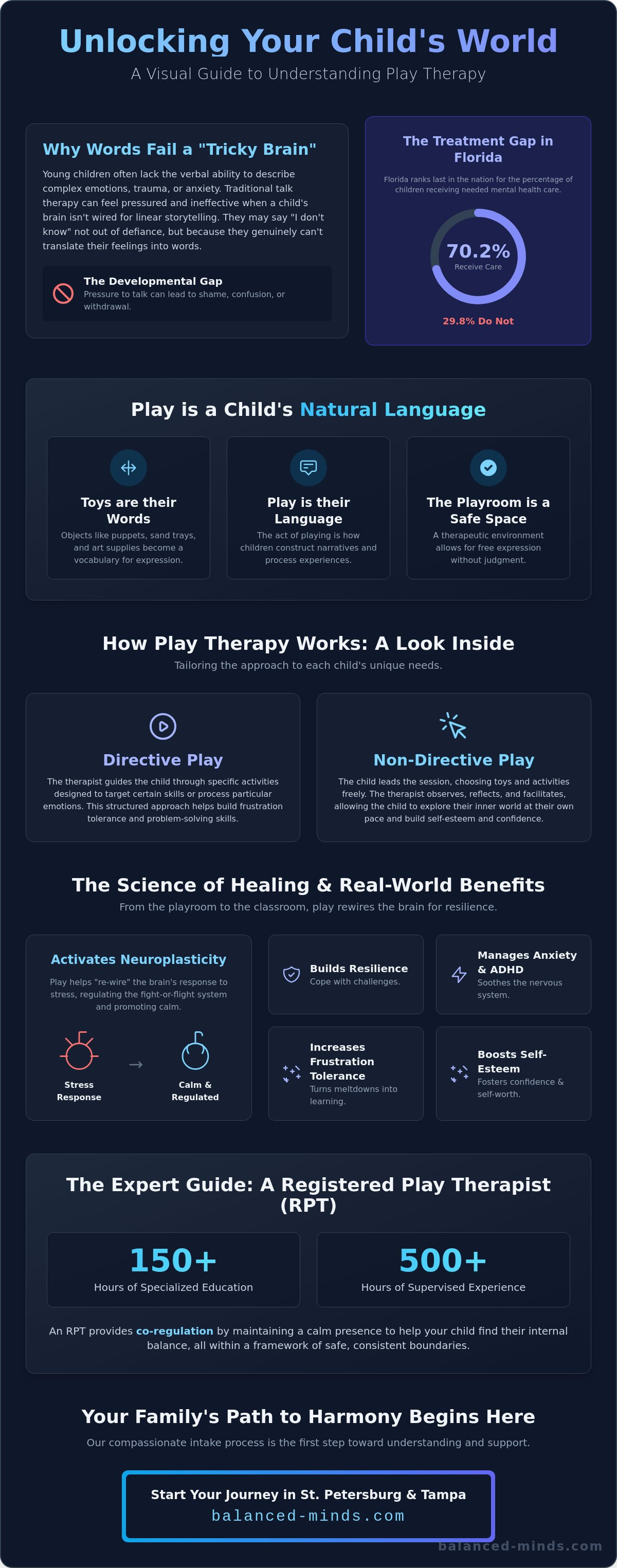
When you first begin to wonder, what is play therapy for, it's helpful to view it as a specialized form of counseling where play becomes the primary medium of communication. For children, toys function as their words and play serves as their natural language. Choosing to seek support for your child is a courageous step for any St. Pete family. We recognize that watching your child struggle with a "tricky brain" is difficult; however, play offers a compassionate way to soothe a developing nervous system in a safe, nurturing environment. With Florida currently ranking last in the nation for the percentage of children receiving needed mental health treatment at just 70.2%, your decision to prioritize your child's well-being is both vital and visionary.
Why Traditional Talk Therapy Often Fails Young Children
The developmental gap between a child's lived experience and their verbal ability is significant. When we ask a child "How was your day?" and they reply with "I don't know," it's not because they're being difficult. It's because their brains aren't yet wired to translate complex trauma or anxiety into a linear narrative. In our St. Petersburg playroom, we provide a safe container for big emotions that feel too scary to voice. This approach helps children move from a place of shame or confusion toward a sense of safeness through creative expression and movement. We've seen how this transition allows a child's true personality to flourish as they feel seen and understood without the pressure of finding the "right" words.
The Science of Play and the Developing Brain
Play isn't just about fun; it's a physiological necessity for healing. It activates neuroplasticity, which allows a child to "re-wire" their responses to stress and fear. By engaging the "soothing system," we help regulate the fight-or-flight response that often leads to outbursts or withdrawal. This process is backed by decades of clinical research and practice. For a comprehensive overview of play therapy, one can see how it has evolved into a rigorous clinical practice used by experts to foster resilience.
Play therapy is the bridge between a child's internal world and the outside world.
How Play Therapy Works: A Look Inside the Process
Inside our specialized playrooms in St. Petersburg, we create a sanctuary where a child's inner life can finally take shape. While parents often ask what is play therapy for, the answer becomes clear when you witness a child selecting a specific toy to express a feeling they can't quite name. We call this the "vocabulary of toys." For instance, a child might use a sand tray to build a world that feels chaotic, or select a puppet to act out a conflict they witnessed at school. These choices aren't random. They are meaningful communications that we observe with clinical precision, identifying patterns that signal a child's underlying struggles with their environment or their own "tricky brain."
The playroom acts as a mirror, reflecting the child's internal world in a way that makes it manageable and less frightening. When considering what is play therapy for, it's ultimately about giving a child the tools to master their own story. We build trust through shared activity rather than direct questioning, which lowers a child's defenses and encourages a more open, receptive state of mind. This gentle, therapeutic conversation allows us to interpret their needs without the pressure of a traditional interview, ensuring that the path to wellbeing feels attainable and safe.
The Role of the Registered Play Therapist
Healing happens through the therapeutic relationship, not just the activities themselves. A Registered Play Therapist (RPT) brings a sophisticated level of expertise to the room. To earn this credential through the Association for Play Therapy, a professional must complete 150 hours of specialized education and 500 hours of supervised experience. This training allows us to provide co-regulation. By maintaining a calm, steady presence, we help your child find their own internal balance when their nervous system feels overwhelmed. We establish clear boundaries within the playroom, which paradoxically creates a deeper sense of psychological safety and freedom for the child to explore. If you feel your child could benefit from this supportive environment, we invite you to explore our approach and see how we can partner together.
Directive vs. Non-Directive Approaches
We tailor our methods to the unique needs of each family. In non-directive sessions, we allow the child to lead. This builds autonomy and self-esteem as they realize their choices are respected and valid. Conversely, directive play involves specific games or activities designed to target certain conditions play therapy is used for, such as social cues or frustration tolerance. At Balanced Minds Psychology & Wellness, we often blend these approaches to nurture each child's specific growth, ensuring they have both the freedom to express themselves and the structure to develop new skills. This balanced blend of professional integrity and heart-centered care helps children flourish in their daily lives.
Common Challenges: What Conditions is Play Therapy For?
While we've discussed the mechanics of play, many families come to us wondering about specific symptoms or behaviors they see at home. When exploring what is play therapy for, it's helpful to look at the daily hurdles children face in the Tampa Bay area. From the "what-ifs" that keep a child awake at night to the frustration of school-day transitions, play provides a safe laboratory for testing new coping strategies. By addressing these challenges early, we help children build a foundation of emotional resilience that serves them long after they leave our St. Petersburg office.
Practicing social skills like turn-taking or reading non-verbal cues happens naturally in a low-stakes environment. This is especially important given that nearly 15% of Florida high school students reported being bullied on campus in 2019; early intervention helps foster the confidence needed to navigate social hierarchies. We also provide a steady presence for children navigating family transitions, such as moving to a new neighborhood or adjusting to life after a divorce, ensuring they have a space where their feelings are validated without question. This supportive environment helps reduce the shame often associated with feeling "different" or "difficult."
Supporting Neurodiversity and ADHD in Tampa Bay
For families managing neurodivergence, play therapy often serves as the practical follow-up to a formal evaluation from a psychologist for adhd diagnosis. At Balanced Minds Psychology & Wellness, we utilize sensory-rich play to help children with ADHD regulate their high energy levels and improve executive functioning. This approach specifically targets the internal sense of shame that can develop when a child struggles to meet traditional classroom expectations in Pinellas County. By celebrating their unique "tricky brain" while teaching regulation, we help them flourish in environments that might otherwise feel overwhelming.
Trauma, Grief, and Emotional Resilience
When a child experiences a significant loss or a frightening event, they don't always have the words to process the "big" emotions that follow. Through symbolic play, they can externalize these heavy feelings, allowing the healing process to begin without the pressure of a linear conversation. We focus on building a "resilience toolkit" filled with mindfulness and self-soothing techniques that the child can carry back to their home and school environments. Clinical research into the benefits of play therapy confirms that this method helps children develop stronger social skills and healthier coping mechanisms. Our team remains committed to showing parents what is play therapy for by demonstrating its power to transform grief into growth within a safe, heart-centered space.
The Real-World Benefits: From the Playroom to the Classroom
The progress we witness within the four walls of our playroom is heartening, but the true measure of success is how those changes ripple into your daily life. The transformation often begins quietly. You might notice fewer power struggles during morning routines or a child who finally has the words to say, "I feel frustrated," instead of throwing a toy. When families ask what is play therapy for, the answer lies in these small, profound shifts in emotional regulation. By providing a safe space to vent feelings through play, children learn to settle their nervous systems before a meltdown takes hold. This internal mastery leads to increased self-esteem as they move from feeling "broken" to recognizing they simply have a brain that needs a little extra care.
As children master new "games" and challenges in the presence of a supportive mentor, they develop a sense of agency that carries over into the home environment. We help them build the vocabulary necessary to identify and name complex feelings, which significantly enhances communication between you and your child. These sessions provide parents with new, creative ways to connect with their child's inner world, turning previously stressful interactions into opportunities for shared understanding and growth. This heart-centered approach ensures that the path to wellbeing feels attainable for the entire family unit.
Bridging the Gap to Home and School
Skills learned through play don't stay in the playroom; they translate directly to better behavior in St. Petersburg classrooms. We often collaborate with Pinellas County teachers and school counselors to ensure your child has a consistent support system across all environments. By sharing practical "take-home" strategies, we help you mirror the supportive environment of the playroom in your own living room. This consistency is vital for children with a "tricky brain" who thrive on predictability and safeness. When the school, the therapist, and the parents are all speaking the same language of compassion, the child's ability to flourish increases exponentially.
The Role of Family in the Healing Journey
We believe that healing is a collective journey, which is why we often suggest that family therapy near me is a vital component of the process. While we focus on the child's individual needs, we also prioritize parent consultations to keep you informed and empowered. Understanding what is play therapy for involves recognizing that the entire family's "soothing system" needs nurturing to promote lasting change. We work together to reduce shame and foster a sense of shared humanity, ensuring that every family member possesses the capacity for growth. If you are ready to see these changes in your own home, we encourage you to schedule a consultation with our St. Pete team and begin this restorative journey together.
Starting Your Journey: Play Therapy in St. Petersburg, FL
Taking the first step toward mental health support is an act of deep love and commitment to your child's future. When you begin this process, your initial evaluation appointment at our St. Petersburg office generally costs around $250. This first meeting is a dedicated time for us to listen to your concerns and understand your child's unique history. Following this, standard 50-60 minute sessions typically range from $125 to $200. To ensure transparency and peace of mind, the federal No Surprises Act protects you from unexpected medical bills. If you are not using insurance, you have the right to receive a Good Faith Estimate of the cost of services before your first session begins.
As you explore what is play therapy for, it is vital to find a child psychologist st petersburg fl who feels like a true partner in your child's care. We maintain rigorous clinical standards, ensuring our practitioners are either Registered Play Therapists or working toward that specialized credential. This requires 150 hours of play therapy education, with at least 75 of those hours being completed in-person as of April 1, 2025. For families across the Florida Bay area who may struggle with travel, we also offer telehealth options that bring the restorative power of play directly to your screen, ensuring that distance never stands in the way of a child's ability to flourish.
Finding the Right Fit for Your Family
The relationship between the therapist and your child is the most important factor in successful healing. We encourage parents to perform a "vibe check" during the first few interactions to ensure their child feels safe, seen, and non-judged. You might ask a potential therapist how they handle a "tricky brain" or how they involve parents in the process. At Balanced Minds, we prioritize a blend of clinical expertise and heart-centered care because we know that a child cannot learn to regulate their emotions until they first feel completely secure in their environment. We invite you to be curious and ask questions about how we tailor our 500 hours of supervised play therapy experience to meet your family's specific needs.
Taking the Next Step with Balanced Minds
Scheduling a consultation at our St. Petersburg location is a low-pressure way to discuss your child's challenges and discover how we can help. Whether you are worried about school calls from Pinellas County teachers or simply want to improve family harmony, we are here to provide a steady, guiding presence. Every child possesses the capacity for growth, and our team is profoundly committed to walking beside you on this collective journey. We offer a restorative environment where your child can finally find the vocabulary for their feelings through their most natural language. Reach out to us today to begin a compassionate partnership focused on your child's resilience and well-being.
Nurturing Your Child's Resilience Through Play
We've explored how play provides a restorative container for your child's "tricky brain" and helps them develop the emotional regulation needed for success in Pinellas County classrooms. Understanding what is play therapy for represents a vital shift from a place of parental worry toward a path of compassionate partnership. Whether you visit our convenient St. Petersburg or Tampa locations or utilize our telehealth options, we remain deeply committed to your family's unique journey toward harmony. You don't have to navigate these emotional or behavioral challenges alone; instead, you can lean on a team that values both clinical integrity and heart-centered care.
Every child possesses the innate capacity for growth and healing. We're here to provide the steady, guiding presence that allows that potential to unfold, helping your entire family find a sense of safeness and lasting peace.
Frequently Asked Questions
Is play therapy just expensive babysitting?
Play therapy is a clinical intervention guided by a professional who uses specific theoretical models to help children process trauma and build emotional resilience. Unlike babysitting, every interaction in the playroom is intentional; we observe patterns and facilitate co-regulation to soothe a child's nervous system. Our therapists are trained to identify the symbolic meaning in a child's play, turning a simple game into a powerful tool for psychological healing and growth.
What is the typical age range for play therapy?
Children between the ages of 3 and 12 benefit most from this modality because their cognitive development relies heavily on symbolic expression. While younger children use play to build basic social skills and trust, older children in this range might use it to work through complex family changes or school stress. It meets them exactly where they are developmentally, providing a safe bridge between their internal world and their external reality.
How long does it take to see results from play therapy?
Every child's journey is unique, but many families notice positive shifts in behavior within 12 to 20 sessions. Factors such as the severity of the challenge and the consistency of attendance play a significant role in the timeline. We focus on building a sustainable foundation for wellbeing rather than a quick fix, ensuring that these new coping skills flourish and remain effective long after the sessions conclude.
Can play therapy help with my child's ADHD symptoms?
Yes, play therapy is highly effective for children managing ADHD because it builds focus and frustration tolerance through structured, sensory-rich activities. When parents ask what is play therapy for, we often highlight its ability to improve executive functioning in a low-pressure environment. It helps children practice impulse control and transition between tasks without the shame often felt in traditional classrooms, promoting a sense of mastery and confidence.
Do I stay in the room with my child during play therapy?
Parents usually remain in the waiting area to allow the child to build a sense of autonomy and safety with the therapist. However, we may invite you into the session for specific family-centered models that focus on strengthening the parent-child bond and improving communication. We always keep you informed through regular parent consultations, ensuring that we're working together as a team to support your child's progress.
What happens if my child doesn't want to play during the session?
We respect each child's pace; if they don't want to play, we hold space for their silence or resistance without judgment. This "quiet time" is often a meaningful part of the process where we build trust and safety by showing the child that their boundaries are respected. We might sit together, draw, or simply observe, demonstrating that they are accepted exactly as they are, which is a vital step in reducing anxiety.
How do I know if my child needs play therapy vs. talk therapy?
If your child struggles to name their feelings or becomes overwhelmed when asked to talk about their day, play therapy is likely the better fit. Traditional talk therapy requires a level of abstract thinking that most children under age 12 haven't fully developed yet. Play provides the necessary vocabulary to explore what is play therapy for, allowing them to "show" us their world through toys instead of telling us with words.
Is play therapy covered by insurance in Florida?
Many providers in the St. Petersburg area accept major insurance plans such as Aetna, United Healthcare, Optum, and Tricare. Coverage varies widely based on your specific plan, deductible, and mental health benefits, so we recommend contacting your insurance company directly for a detailed explanation of your coverage. For families who are uninsured or not using insurance, we provide a Good Faith Estimate to ensure there are no surprises regarding the cost of care.


