

What Are the Signs of a Learning Disability? A Compassionate Guide for Parents
Updated: 1 day ago
You have spent the last hour at the kitchen table, watching your child stare at a single paragraph while their eyes fill with tears. It isn't a lack of effort or a stubborn refusal to work. Instead, it feels like an invisible barrier stands between their bright mind and the page. Many parents across Florida find themselves in this exact position, quietly wondering what are the signs of a learning disability and whether their child's struggle is a temporary hurdle or a signal for more specialized support.
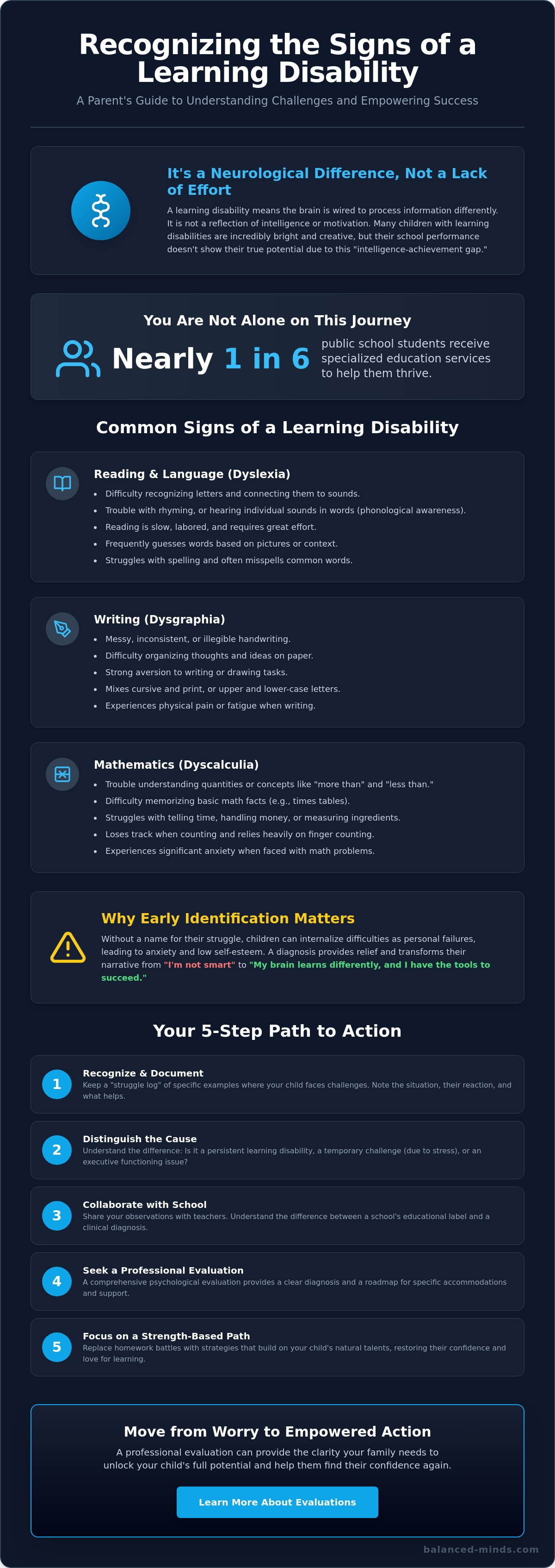
We know how heart-wrenching it is to watch your child's self-esteem drop while trying to decode confusing feedback from Pinellas or Hillsborough schools. You aren't alone in this journey; nearly one in six public school students currently receives specialized education services to help them thrive. This guide will help you move from a state of worry to a place of empowered action. We will help you recognize the subtle indicators of learning challenges and outline the clear steps to support your child's unique path to success. We'll explore common red flags, explain how to navigate the Florida school system, and show you how a professional evaluation can help your child find their confidence again.
Table of Contents
Understanding Learning Disabilities: Beyond the Achievement Gap
When we talk about learning differences, we aren't discussing a lack of effort or a deficit in intelligence. Instead, we're looking at a unique way the brain is wired to process information. This concept, often called neurodiversity, helps us understand that every child's mind works in its own rhythm. While it's natural to feel overwhelmed when you first ask yourself, "what are the signs of a learning disability," it's vital to remember that these challenges often exist alongside incredible strengths. These children aren't broken; their brains simply use a different operating system to navigate the world.
A learning disability is a permanent neurological difference, but it is one that we can manage with the right tools and compassionate support. Many children we see in our practice demonstrate a significant "intelligence-achievement gap." This means they are remarkably bright, creative, and capable, yet their school performance doesn't reflect their true potential. They might be brilliant storytellers who struggle to spell, or gifted problem solvers who find it impossible to memorize math facts. This gap is the hallmark of a learning disability, not a reflection of your child's worth or their capacity for future success.
The Difference Between a Learning Disability and a Learning Challenge
It's helpful to distinguish between a long-term disability and a temporary learning challenge. A child might struggle in school due to recent family stress, a change in environment, or even undiagnosed vision and hearing issues. These are external factors that we can often resolve with time and specific interventions. We also look closely at executive functioning, which acts like the brain's air traffic control system. When these skills are underdeveloped, a child may seem disorganized or forgetful, even without a specific LD. A learning disability is a specific processing gap that persists despite adequate instruction.
Why Early Identification Matters for Your Child’s Self-Esteem
We often see the "Matthew Effect" in education, where early success in reading leads to more reading, while early struggles cause a child to fall further behind over time. Identifying what are the signs of a learning disability early on allows us to break this cycle before it impacts a child's sense of self. Without a name for their struggle, children often internalize their difficulties, assuming they are "lazy" or "not as smart" as their peers. This often leads to school refusal and deep-seated anxiety. A diagnosis provides a profound sense of relief. It transforms a child's internal narrative from "I can't do this" to "My brain just learns this way, and now I have the tools to succeed."
Common Signs of a Learning Disability by Category
Identifying exactly what are the signs of a learning disability requires us to look beyond a single bad test grade or a difficult week at school. We look for a persistent pattern of struggle that seems out of step with your child's overall curiosity and intelligence. These indicators often shift as your child grows. In preschool, you might notice a child who struggles to learn nursery rhymes or mispronounces familiar words. By middle school, the same child might find it impossible to finish a timed test or summarize a chapter they just read. Recognizing these patterns is the first step toward providing the restorative support your child needs to regain their confidence.
It's helpful to remember that these challenges aren't a choice your child is making. They are physiological responses to how their brain processes specific types of data. According to the NICHD, there are several common signs that a person may have learning disabilities, and these often cluster into three primary pillars: reading, writing, and mathematics. If these patterns feel familiar, a comprehensive learning disability assessment can provide the clarity your family needs to move forward without the weight of shame or confusion.
Signs Related to Reading and Language (Dyslexia)
Reading challenges often begin with phonological awareness, which is the ability to hear and manipulate the individual sounds in words. You might notice your child struggles to rhyme or find it difficult to blend sounds together to form a word. As they grow, they may become slow, labored readers who rely heavily on guessing based on the pictures or the first letter of a word rather than decoding it. Even if they can read the words aloud, they might reach the end of a page with no memory of what happened, indicating a gap in reading comprehension.
Signs Related to Writing and Fine Motor Skills (Dysgraphia)
Writing involves an immense amount of cognitive energy. For a child with dysgraphia, the physical act of writing is often painful or exhausting. You may see a "cramped" grip on their pencil or notice their handwriting is consistently difficult to read. The most telling sign is often a disconnect between their verbal and written abilities. They might explain a complex scientific concept perfectly out loud but struggle to put two coherent sentences about it on paper. Frequent spelling errors and a total lack of punctuation are also common markers that their brain is working overtime just to form the letters.
Signs Related to Math and Numbers (Dyscalculia)
Math disabilities go beyond "not being a math person." These children often struggle with the very concept of number sense, such as understanding that the numeral "5" represents five objects. They may find it impossible to memorize basic addition or multiplication tables, even after weeks of practice. You might also notice challenges with sequences, such as telling time on an analog clock, managing a small amount of allowance, or following a multi-step set of directions in order.
Non-Verbal and Social Learning Indicators
Sometimes, the signs aren't found in a textbook. Some children struggle with non-verbal learning, which impacts how they interpret body language or social cues. They might miss the "unspoken rules" of the playground or struggle with spatial awareness, appearing clumsy or having trouble with puzzles and maps. When we understand what are the signs of a learning disability in these social contexts, we can better support the whole child, ensuring they feel secure both in and out of the classroom.
School Testing vs. Private Psychological Evaluations in Florida
Once you begin to recognize what are the signs of a learning disability, the next question usually involves where to turn for a formal answer. In Florida, parents often find themselves choosing between a school-based assessment and a private psychological evaluation. While both paths aim to support your child, they serve very different purposes. It's helpful to think of school testing as a search for eligibility, while a private evaluation is a search for understanding. We want to help you navigate these choices so you can feel confident that your child's unique cognitive profile is being seen clearly and compassionately.
The core difference lies in the outcome. A school district provides an "educational label" to determine if a child qualifies for specific services under state law. A private practitioner provides a "clinical diagnosis" that looks at the whole child, including their emotional wellbeing and cognitive potential. While school reports are necessary for accessing classroom support, they don't always capture the full picture of symptoms of learning disorders that might be impacting your child's life outside of the four walls of a classroom.
What to Expect from a School-Based Assessment
Public schools in districts like Pinellas and Hillsborough follow a process known as Response to Intervention (RTI). This tiered system provides increasingly intense academic support before a formal evaluation is even considered. To qualify for an Individualized Education Program (IEP) under the "Specific Learning Disability" (SLD) category, Florida Rule 6A-6.03018 requires evidence that a child isn't making adequate progress despite these interventions. It's a logistical process focused on what the school can legally provide. Because of this, school testing is often narrower in scope, focusing primarily on academic achievement rather than deep-seated cognitive or emotional hurdles.
The Benefits of a Comprehensive Private Evaluation
Choosing a private evaluation allows us to move beyond the constraints of school eligibility. We take a much deeper look at the intersections of IQ, memory, attention, and emotional health. This holistic view is essential because what looks like a reading struggle might actually be rooted in a working memory deficit or performance anxiety. By conducting Psychological Evaluations in St. Petersburg, FL, we provide families with a customized roadmap. These reports include specific, evidence-based recommendations that you can take back to the school to advocate for your child's needs. Having an independent advocate ensures that the focus remains entirely on your child's growth and confidence, rather than just their "fit" within a school's existing programs. When you know exactly what are the signs of a learning disability in your specific child, you can build a support system that truly honors their potential.
Practical Steps: What to Do If You See the Signs
Taking the first step toward a formal answer can feel like a heavy burden. We understand the mix of worry and hope that comes with this transition. Once you've started to recognize what are the signs of a learning disability, the path forward becomes clearer when we break it into manageable, compassionate actions. By moving from observation to advocacy, you're helping your child understand that their brain's unique wiring isn't a barrier to their success, but a part of their journey that simply requires a different set of tools.
Observe and document: Keep a record of consistent struggles in reading, math, or focus over several months.
Start a struggle log: Note how long homework takes and where the frustration peaks.
Speak with the teacher: Gather their observations from the classroom environment to see if they match what you see at home.
Request an evaluation in writing: Formalize your concerns to start the official timelines for school support.
Seek a clinical perspective: Consider a private evaluation for a more nuanced understanding of your child's cognitive profile.
A "struggle log" is a simple but powerful tool. For one week, write down the specific tasks that cause your child to shut down. Record the time spent on a single paragraph or the emotional reaction to a math worksheet. This data is invaluable when you meet with professionals. In Florida, it's also vital to maintain a "paper trail." Always send requests for meetings or evaluations via email or letter rather than just having a casual conversation. This ensures your child's needs are prioritized and that a timeline for support is established. If you're ready to gain this clarity, our team offers comprehensive learning disability assessments to help you build a roadmap for your child's future.
Communicating with Your Child’s Teacher
Your child's teacher is your most important ally. During a conference, ask specific questions like, "How does my child's phonics skill compare to their peers?" or "Do you notice a gap between what they say in class and what they produce on paper?" You can also request a Multi-Tiered System of Supports (MTSS) meeting. This is a collaborative process where the school team looks at data to decide on specific interventions. Approaching these meetings with a spirit of partnership helps everyone focus on the shared goal of your child's wellbeing.
Supporting Your Child’s Emotional Health at Home
Homework time doesn't have to be a battleground. Try using short timers with frequent breaks, or allow your child to dictate their ideas to you while you write them down. It's equally important to find "islands of competence." These are the areas where your child feels gifted and capable, whether it's art, sports, or building complex structures. Nurturing these strengths protects their self-esteem while they work through academic hurdles. If the weight of school struggle has led to persistent worry or low self-worth, individual therapy for children can provide a safe space for them to process these big emotions and rediscover their inner confidence.
How Balanced Minds Supports Your Family’s Journey
We understand that the path to seeking help is often paved with mixed emotions. You might feel a sense of relief that you are finally taking action, yet still carry a lingering worry about what the future holds for your child. At Balanced Minds, our collective of experts is here to walk beside you, transforming the uncertainty of what are the signs of a learning disability into a clear, heart-centered plan for growth. Our approach in St. Petersburg is rooted in the belief that an evaluation shouldn't feel like a cold clinical exercise. Instead, it is a restorative process designed to uncover the beautiful complexity of your child's mind and provide psychological safety for your entire family.
Our work doesn't stop at identifying areas of struggle. We are deeply committed to finding your child's unique strengths, the "islands of competence" that will serve as the foundation for their future confidence. Identifying what are the signs of a learning disability is a brave first step, but the true healing begins when we use that information to empower your child. We see ourselves as your partners in this journey, offering a steady, guiding presence that honors your child's humanity as much as the science behind their cognitive functions. Whether we are conducting Learning Disability Assessments or helping you navigate the complexities of the Florida school system, our goal is to provide a linguistic environment that feels safe and supportive.
Our Compassionate Testing Process
The journey begins with a thoughtful intake session where we listen to your story and your child's history. We don't just look at test scores; we look at the person behind them. On the day of the Comprehensive Psychological Evaluation, we create a calm, rhythmic environment to help your child feel at ease. Because learning challenges frequently overlap with other neurodivergent traits, we often incorporate ADHD evaluations into our process when appropriate. This ensures we aren't missing any pieces of the puzzle that could be impacting your child's success.
Once the assessment is complete, we provide you with more than just a report. You receive a comprehensive roadmap. We sit down with you to explain the results in plain language, linking psychological concepts directly to practical, human benefits. We offer post-evaluation support that may include school consultations or Executive Functioning Coaching to help your child implement the strategies we've identified together. This structural choice helps to demystify professional support and make the path to wellbeing feel attainable for everyone involved.
Ready to Find Answers? We are Here to Help
You don't have to navigate these confusing waters alone. We invite you to reach out for a low-pressure initial conversation where we can discuss your concerns and determine the best path forward for your family. Our commitment is to provide a non-judgmental space where your child's potential is recognized and celebrated. When you are ready to move from worry to clarity, we are here to support you. Schedule a consultation with our St. Pete team to begin building your child's unique path to success.
Empowering Your Child’s Unique Journey
Watching your child struggle is a deeply emotional experience, but you've already taken a brave first step by learning what are the signs of a learning disability. We have seen how a shift in perspective, moving from seeing a problem to understanding a neurological difference, can transform a family's daily life. Your child's intelligence and potential remain intact; they simply need a roadmap that honors the way their brain processes the world.
At Balanced Minds, we provide that roadmap through compassionate, evidence-based care in St. Petersburg and Tampa. We're here to help you move past the tears and frustration toward a place of shared hope and restorative growth. You don't have to navigate this path alone.
Request a Comprehensive Evaluation for Your Child
Your child's path to confidence and success is within reach, and we're honored to help you find it.
Frequently Asked Questions
Is a learning disability the same as ADHD?
ADHD and learning disabilities are distinct neurological conditions, though they frequently appear together in many children. While ADHD impacts the brain's management system, affecting things like attention, organization, and impulse control, a learning disability specifically affects how a child processes information in areas like reading, writing, or math. We look at both during our evaluations to ensure we provide a complete picture of your child's unique cognitive needs.
Can a child outgrow a learning disability?
A learning disability is a lifelong neurological difference, so a child does not outgrow it in the traditional sense. Instead, they develop sophisticated coping strategies and utilize specific tools that allow them to succeed in academic and professional settings. With the right support, the challenges that once felt overwhelming become manageable parts of their unique learning profile, allowing their natural strengths to shine through.
What is the most common sign of a learning disability in elementary school?
The most frequent indicator in elementary school is a persistent gap between a child's obvious intelligence and their actual academic performance. When parents ask what are the signs of a learning disability at this age, we often point to struggles with phonological awareness, such as difficulty rhyming or blending sounds. These early hurdles in reading or basic number sense often signal that the brain is processing information differently than its peers.
How do I tell my child they are being tested for a learning disability?
We recommend framing the testing as a way to understand their brain's super-secret manual. Tell your child that everyone's brain learns in its own way, and these games and puzzles will help the adults find the best tools to make school feel easier and more enjoyable. This approach reduces shame and helps them see the process as a supportive journey rather than a search for a problem or a deficit.
Will a learning disability diagnosis affect my child’s college prospects?
A diagnosis typically improves college prospects by allowing a student to access necessary accommodations, such as extended time on entrance exams and in university courses. Colleges look for students who understand their own learning needs and have the self-advocacy skills to use available resources effectively. It demonstrates resilience and a proactive commitment to their own educational growth, which is highly valued in higher education.
What is the difference between an IEP and a 504 plan in Florida?
In Florida, an Individualized Education Program (IEP) provides specialized instruction and services for students who meet specific state eligibility criteria under the Individuals with Disabilities Education Act. A 504 plan is broader, focusing on providing accommodations that ensure a student has equal access to the learning environment. While an IEP involves specific academic goals and progress tracking, a 504 plan might include simple changes like preferred seating or extra time on tests.
Can my child be gifted and still have a learning disability?
Yes, children can be both gifted and have a learning disability, a profile often referred to as twice-exceptional or 2e. These students may have superior verbal or reasoning skills while simultaneously struggling with written expression or processing speed. This duality often makes it harder to identify their needs because their high intelligence can temporarily mask their learning challenges, which is why a comprehensive evaluation is so vital for these bright students.
How long does a private psychological evaluation usually take?
A comprehensive private evaluation typically involves several hours of direct interaction, often split into two sessions to prevent fatigue and ensure accuracy. We usually spend between four and six hours on the testing itself, followed by several hours of scoring, interpretation, and report writing. This thoroughness allows us to create the personalized roadmap your family needs for long-term success and emotional wellbeing.


