

How to Support My Teen During Therapy: A Compassionate Guide for Parents
Updated: 3 days ago
What if the most effective way to help your child heal is to intentionally remain in the dark about the specifics of their weekly sessions? It's a heavy realization for any parent who has watched their child struggle with persistent sadness or anxiety. You want to fix the problem; yet, you're asked to wait outside a closed door. Learning how to support my teen during therapy often starts with accepting this delicate boundary. We understand the fear of saying the wrong thing or feeling disconnected from the very process meant to bring your family back together.
You aren't alone in these feelings. It's a testament to your deep love that you want to be involved in every step of their recovery. Our goal is to help you discover how to balance active support with respectful privacy to help your teenager thrive throughout their therapeutic journey. We'll explore practical ways to foster a stronger relationship, identify clear markers of progress, and build a meaningful partnership with your teen's therapist. By shifting your role from a fixer to a compassionate partner, you create the psychological safety your adolescent needs to truly flourish.
Table of Contents
Understanding Your Role: Shifting from 'Fixer' to Supportive Partner
Respecting the 'Cone of Silence': Why Confidentiality is a Healing Tool
Communication Strategies That Invite Connection (Not Conflict)
Collaborating with the Professional: Your Partnership with the Therapist
Navigating the Journey with Balanced Minds Psychology & Wellness in St. Petersburg
Understanding Your Role: Shifting from 'Fixer' to Supportive Partner
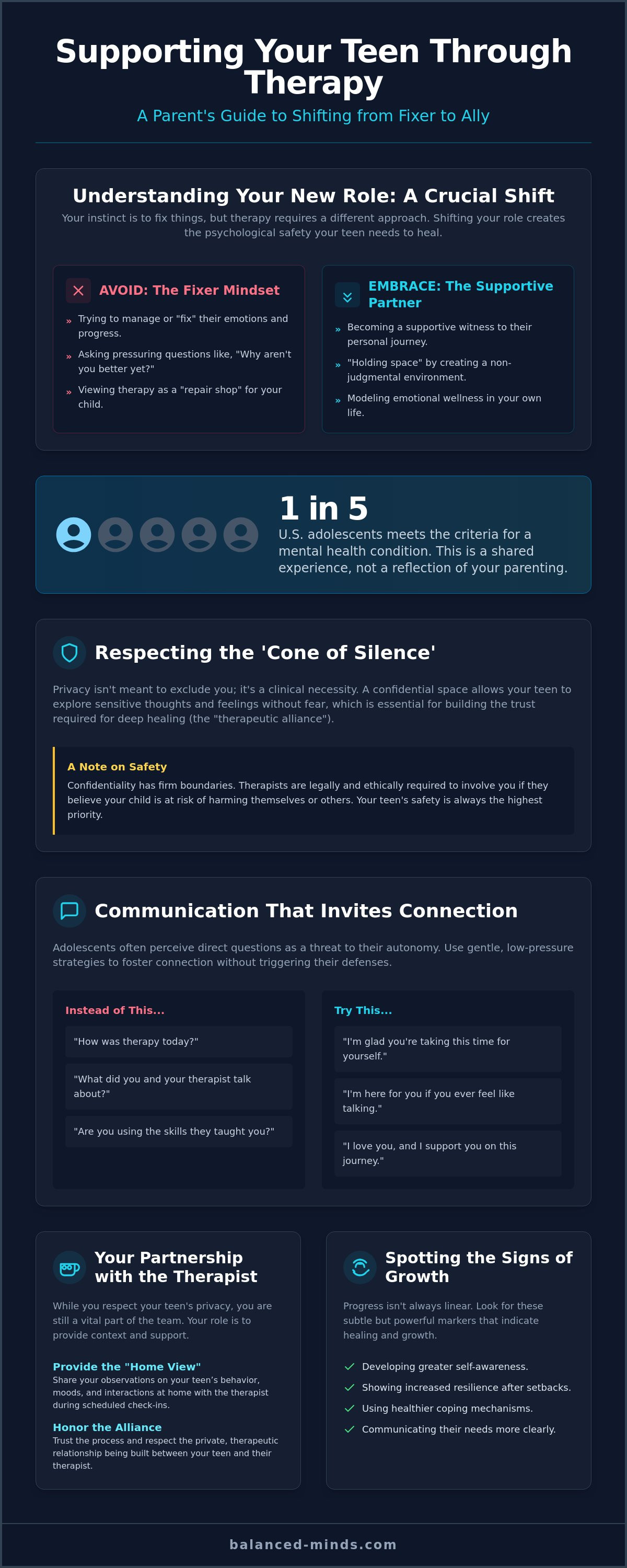
When we see our children struggling, our first instinct is often to step in and fix the problem. We want to mend the cracks and restore the peace. However, therapy isn't a repair shop where you drop off a "broken" child to be fixed by a professional. It's a deeply personal journey of self-discovery. Understanding child and adolescent psychotherapy reveals that the most powerful tool a parent possesses isn't a solution; it's their presence. With approximately 1 in 5 adolescents in the U.S. meeting the criteria for a mental health condition, it is vital to recognize that this is a shared human experience, not a reflection of your parenting. Shifting from a "manager" of symptoms to a "witness" of growth allows your teen to take ownership of their healing.
Learning how to support my teen during therapy means learning to "hold space." This involves creating a non-judgmental environment where your teenager feels safe to be imperfect. When we stop trying to manage their progress, we give them the room to breathe. They don't need another person telling them how to feel. They need a steady, calm partner who can sit with them in the discomfort without rushing to resolve it. This shift reduces the pressure on the teen, making the therapeutic process feel like a choice rather than a chore.
The Psychology of the Parent-Teen Dynamic
Adolescence is a time of intense neurological pruning and development. Because their brains are wired for independence, teens often perceive parental advice as a threat to their autonomy. When we ask, "Why aren't you better yet?" we inadvertently send a message of shame. We can choose a different path. By saying, "I'm here for you while you work through this," we validate their struggle. Recognizing our own emotional triggers is part of this process. If their sadness makes us feel like failures, we might accidentally pressure them to "get well" just to ease our own anxiety. Understanding this dynamic helps us stay patient during the inevitable ebbs and flows of recovery.
Modeling Emotional Regulation at Home
Our teens are constantly observing how we handle our own internal weather. If we want them to use the tools they learn in therapy, we must model those same skills. When we react to stress with volatility or avoidance, it becomes harder for them to trust their own regulation. We can bridge this gap by being transparent about our own wellness practices. Sharing that we're taking a walk to clear our heads or using a breathing exercise after a long day de-stigmatizes the work of mental health. It shows them that emotional health is a universal human journey, not a task they have to complete alone. Practicing self-compassion helps us break the shame cycle that often traps families, allowing everyone to move forward with grace and heart-centered care.
Respecting the 'Cone of Silence': Why Confidentiality is a Healing Tool
For many of us, the hardest part of this journey is the silence that follows a therapeutic session. We want to ask how it went, what they talked about, and if they’re feeling better. Yet, respecting this "cone of silence" is one of the most profound ways we can answer the question of how to support my teen during therapy. This privacy isn't meant to exclude you; rather, it’s a clinical necessity for building what we call a therapeutic alliance. Without a guaranteed private space, teenagers often feel they must "perform" or protect their parents' feelings, which prevents them from addressing the root causes of their distress.
We understand that silence can feel frightening. It’s helpful to remember that confidentiality has clear, ethical boundaries. If a therapist believes your child is at risk of harming themselves or others, they are legally and ethically required to break that silence and involve you immediately. In Florida, while parents generally have a right to access mental health records, many clinicians encourage a collaborative agreement where certain details remain private to protect the child’s growth. This safety net ensures that while the day-to-day details remain between the teen and their provider, your teen’s physical and emotional safety remains the highest priority.
The Benefits of a Private Space for Adolescents
A private room allows a teen to test out thoughts and feelings they aren’t yet ready to share with the family. They might discuss the pressures of social media, peer dynamics, or complex questions about their identity without the fear of immediate parental judgment. This autonomy is vital for development. By giving them ownership of their mental health, we help them move from being passive recipients of care to active participants in their own wellbeing. This sense of agency is often the first step toward lasting resilience and self-awareness.
Managing Your Own Anxiety About the Unknown
It’s natural to feel a bit left out when you aren't privy to every conversation. We encourage you to distinguish between "needing to know" for safety and "wanting to help" out of love. Trusting the expertise of a professional is a key part of this process. If you’re currently searching for a clinical psychologist near me, look for someone who values this balance and is willing to provide you with general progress updates without compromising your teen’s trust. Reframing your lack of information as a sign of a healthy, trusting therapeutic relationship can lower your own stress and create a more peaceful, supportive home environment for everyone.
Communication Strategies That Invite Connection (Not Conflict)
The way we approach our teenagers can often determine whether they open up or retreat further into their shells. When considering how to support my teen during therapy, we must look at the environment of our conversations. High-pressure environments, like the dinner table where eye contact is constant, can feel like an interrogation to a struggling adolescent. Instead, we recommend the "Low-Pressure Check-in." These are conversations that happen side-by-side, such as during a car ride or while washing dishes together. This physical positioning reduces the intensity of the exchange, making it easier for a teen to share their internal world without feeling under a microscope.
This approach is particularly helpful when navigating the unique stressors of our local community. For students within the Pinellas County or Hillsborough County school systems, academic pressure is a significant burden. In fact, 83% of teenagers cite school and the pressure to get good grades as a primary source of stress. When we discuss these challenges, using "I" statements helps us express our observations without sounding accusatory. Instead of saying, "You’re always moody after school," try, "I notice you seem a bit more tired lately, and I want to make sure you have what you need to recharge." This shifts the focus from their perceived "failure" to our shared desire for their wellbeing.
The "Post-Therapy" Conversation: What to Say
Many parents feel an understandable urge to ask, "How was therapy?" the moment their teen steps out of the office. For many adolescents, this question feels like a demand for a progress report. Therapy can be exhausting; it often leaves a teen with an "emotional hangover" as they process difficult realizations. We suggest giving them space to decompress first. A simple, supportive prompt like, "I’m glad you went today," or "Is there anything you need from me tonight, or would you like some quiet time?" acknowledges their hard work without invading their privacy. This creates a bridge of support that they can cross when they feel ready.
Validating Without Always Agreeing
One of the most powerful tools in our communication toolkit is validation. It’s a common misconception that validating a feeling means you endorse a specific behavior. You can validate the fact that your teen feels overwhelmed by a school project without agreeing that they should skip class. Using scripts like, "It makes sense that you feel overwhelmed by that," or "I can see why that situation felt unfair to you," reduces their defensiveness. When a teen feels heard, they are far more likely to engage in problem-solving. If these patterns of conflict feel too deeply rooted to shift alone, exploring family therapy near me can provide a structured, safe environment to rebuild these vital connections.
Collaborating with the Professional: Your Partnership with the Therapist
The therapeutic journey is most effective when it functions as a partnership between the clinician, the teenager, and the parents. While your teen’s sessions are private, your observations at home provide the "Home View" that a therapist cannot see during a weekly 50-minute appointment. We encourage parents to establish a consistent communication cadence with the provider. This doesn't mean checking in after every session; rather, it involves sharing significant shifts in behavior, sleep patterns, or academic engagement. By offering these insights, you help the therapist understand how the tools learned in the office are translating to real-world challenges.
Many families hit a plateau in the "middle phase" of treatment. This is a normal part of the process where initial crises have settled, but deep-rooted changes are still taking root. During this time, learning how to support my teen during therapy involves celebrating "micro-wins." Progress rarely looks like a total cure; instead, it looks like your teen choosing to take a breath before reacting or being slightly more communicative about a school stressor. We must also distinguish between emotional processing and skill-building. For example, if your teen struggles specifically with organization or time management, they might benefit from ADHD coaching alongside their traditional therapy to address executive functioning needs.
Essential Questions to Ask During Parent Check-ins
When you do meet with your teen's therapist, coming prepared with specific questions can make the collaboration feel more grounded. Consider asking: "What themes are you seeing that we can support through our household routines?" or "Are there specific coping skills my teen is practicing that I should be aware of?" It's also vital to ask about red flags. Knowing what signs might indicate a need to adjust the treatment plan helps you feel like a proactive partner rather than a worried bystander.
When to Consider Family Sessions
Sometimes, an individual’s struggle is actually a signal that the family system needs a tune-up. If you notice that the same conflicts keep arising despite individual progress, it might be time to bridge the gap through collective work. Family therapy allows everyone to practice new communication styles in a guided environment. This transition from individual support to collective healing often happens in our St. Petersburg office, where we help families integrate growth into their daily lives. If you feel your family could benefit from this shared approach, you can learn more about our family therapy services to see if it's the right next step for your household.
Navigating the Journey with Balanced Minds Psychology & Wellness in St. Petersburg
The path toward emotional wellness is rarely a straight line. It's a journey that requires patience, expertise, and a community that understands the unique pressures facing families in the Tampa Bay area. At Balanced Minds Psychology & Wellness, we pride ourselves on a heart-centered approach that marries rigorous clinical standards with a deeply empathetic delivery. We don't just see a set of symptoms; we see a young person with immense potential and a family looking for a way back to connection.
Every adolescent is different, and their therapeutic experience should reflect their unique personality. This is why we focus on creating an immediate sense of psychological safety for both the teen and the parent. We understand that you might feel a mix of hope and uncertainty as you transition from the initial crisis into the deeper work of healing. Our role is to demystify the process and make the path to wellbeing feel attainable. By grounding our work in science while maintaining our sense of humanity, we help bridge the gap between clinical expertise and the daily realities of family life in St. Petersburg and Tampa.
Comprehensive Support for Florida Teens
We believe that effective treatment begins with a clear understanding of the individual. Our practice offers comprehensive psychological evaluations and ADHD evaluations to ensure we are addressing the root causes of a teen's struggles rather than just the surface behaviors. Whether your student is navigating the academic rigors of a Pinellas County IB program or struggling with social anxiety in Hillsborough schools, we provide tailored support through both in-person sessions and flexible telehealth options. We also recognize that parents need their own set of tools, which is why parenting near me resources and guidance are a core part of our mission. We are here to support the entire family system as it evolves.
Your Invitation to Healing
If you're ready to take the next step, our first contact is designed to be low-pressure and restorative. We take the time to listen to your concerns and match your teen with the right specialist from our collective of experts. You'll receive a Good Faith Estimate as part of the "No Surprises Act," ensuring you have clear information about the expected costs of care before we begin. Finding a teenage therapist near me who truly connects with your child can change the trajectory of their life. You don't have to navigate this complex season alone; we're here to walk alongside you as you discover how to support my teen during therapy with confidence and heart-centered care.
Cultivating a Path of Shared Growth
The journey of supporting a teenager through their mental health recovery is less about finding immediate answers and more about building a lasting foundation of trust. By moving away from the instinctive role of a problem-solver and embracing the role of a supportive partner, you provide the emotional security your child needs to explore their own resilience. We've explored how respecting their private "cone of silence" and choosing low-pressure moments for side-by-side connection can transform your family dynamic from one of tension to one of quiet, steady partnership.
Learning how to support my teen during therapy is a skill that evolves with time and patience. At Balanced Minds Psychology & Wellness, we've been serving the St. Petersburg and Tampa Bay area since 2021, providing evidence-based care for anxiety, ADHD, and mood disorders. Reach out to our St. Petersburg team today to find the right support for your teen. You're doing the brave work of staying present during a difficult season, and we're here to ensure you don't have to walk this path alone.
Frequently Asked Questions
How do I know if my teen is actually making progress in therapy?
Progress in adolescence is often measured in subtle shifts rather than sudden transformations. You might notice your teen pausing before reacting to a frustration, a slight improvement in their sleep patterns, or a newfound willingness to share a small detail about their day. These "micro-wins" indicate that they are beginning to internalize the tools they’ve learned. Growth is rarely a straight line, so we look for these small, consistent markers of emotional resilience.
What should I do if my teen refuses to talk about their sessions?
It’s best to respect their silence as a sign that the therapeutic space is working. While your curiosity comes from a place of love, pushing for details can make your teen feel like their privacy is being invaded. Instead, offer a gentle, low-pressure environment. Let them know you’re glad they went and that you’re available if they ever want to talk. This approach builds the trust necessary for them to open up eventually.
Is it okay to call the therapist if I am worried about something my teen said at home?
Yes, sharing your "Home View" is a vital part of the partnership with the professional. If your teen expresses something concerning or you notice a significant change in their behavior, it’s appropriate to reach out. The therapist can use these insights to guide future sessions more effectively. While they may not be able to share the specifics of what your teen said in return, your input helps them provide the most accurate care.
How long does teen therapy usually last before we see real change?
Every journey is unique, but many families begin to notice subtle shifts within the first eight to twelve weeks of consistent sessions. Real change involves rewiring long-standing thought patterns and practicing new coping skills, which is a gradual process. Learning how to support my teen during therapy involves staying patient during the middle phases where progress might feel slow. We focus on building a foundation that supports long-term wellness rather than a quick fix.
What if my teen says they want to quit therapy after just a few sessions?
We suggest acknowledging their discomfort while encouraging them to stick with it for a set number of sessions. The initial phase of therapy can feel vulnerable and taxing, which sometimes triggers a desire to retreat. If the resistance persists, it may be a sign that the specific therapist or approach isn't the right fit for their personality. Discussing these feelings openly with the provider can often lead to a helpful adjustment in the treatment plan.
Can I suggest topics for the therapist to talk about with my teen?
You are welcome to share your observations about current stressors, such as academic pressure or social conflicts. While the therapist will take your concerns into account, they must also allow the teen to lead the session to maintain a sense of autonomy. Sharing your perspective during a scheduled parent check-in ensures that the therapist has a well-rounded view of the situation while still protecting the teen’s sense of ownership over their healing process.
How do I balance therapy with my teen’s busy school and extracurricular schedule in Tampa?
We recommend viewing therapy as a vital pillar of their overall health, similar to a doctor’s appointment or a sports practice. Many families in the Tampa Bay area find that telehealth options provide the flexibility needed to fit sessions into a packed schedule without the stress of a commute. Prioritizing this time sends a clear message to your teen that their mental wellbeing is a top priority, which can actually improve their performance in other areas.
Will the therapist tell me if my teen is doing something dangerous?
Yes, therapists are legally and ethically required to break confidentiality if they believe a teen is at risk of harming themselves or others. This safety exception is a fundamental part of the therapeutic agreement. Understanding how to support my teen during therapy includes having the peace of mind that you will be notified immediately if your child’s physical safety is in jeopardy. This allows the therapeutic space to remain private for daily struggles while maintaining a secure safety net.


