

Signs of Anxiety in 5-Year-Olds: A St. Petersburg Parent’s Guide to the Tricky Brain
Updated: 1 day ago
Imagine it's a humid Tuesday morning in St. Pete, and your little one is clinging to your leg outside the gates of North Shore Elementary, their eyes filled with a terror that feels far too big for a playground. You might find yourself searching for the signs of anxiety in 5 year old children while wondering if this is a passing phase or a signal that their tricky brain needs extra care. It's incredibly painful to watch your child suffer, and we understand the quiet voice in your head that asks if you've done something wrong. Please hear us when we say that your child's struggle isn't your failure; it's simply a part of our shared human experience.
We're here to help you move from a place of worry to a place of compassionate clarity. This guide offers a gentle roadmap to help you distinguish between typical developmental fears and clinical anxiety, ensuring you feel empowered rather than overwhelmed. We'll explore specific criteria for seeking professional support, actionable ways to soothe your child's nervous system, and local St. Petersburg resources like the Suncoast Center. Together, we can help your child find their sense of safeness so your whole family can begin to flourish once again.
Key Takeaways
Learn how to reframe your child’s struggles as a "tricky brain" response rather than a behavioral issue, helping you approach their big emotions with compassion and clarity.
Identify the common signs of anxiety in 5 year old children that often hide behind physical complaints, anger, or a sudden resistance to school and social activities.
Gain the tools to evaluate whether your child’s worries are a temporary developmental phase or if they require more focused support to help them flourish in their daily life.
Discover heart-centered strategies to create a sense of "safeness" at home, allowing you to validate your child’s fears without reinforcing the perceived danger.
Explore local St. Petersburg resources and evidence-based therapeutic paths, such as Play Therapy, to help your child navigate their world with newfound confidence.
Table of Contents Understanding Anxiety at Age 5: The "Tricky Brain" in St. Petersburg The Age 5 Anxiety Checklist: Physical, Emotional, and Behavioral Signs Is it a Phase or a Problem? Evaluating the Severity Nurturing Safeness: Practical Strategies for Home and School Professional Support: Therapeutic Options in St. Petersburg
Understanding Anxiety at Age 5: The "Tricky Brain" in St. Petersburg
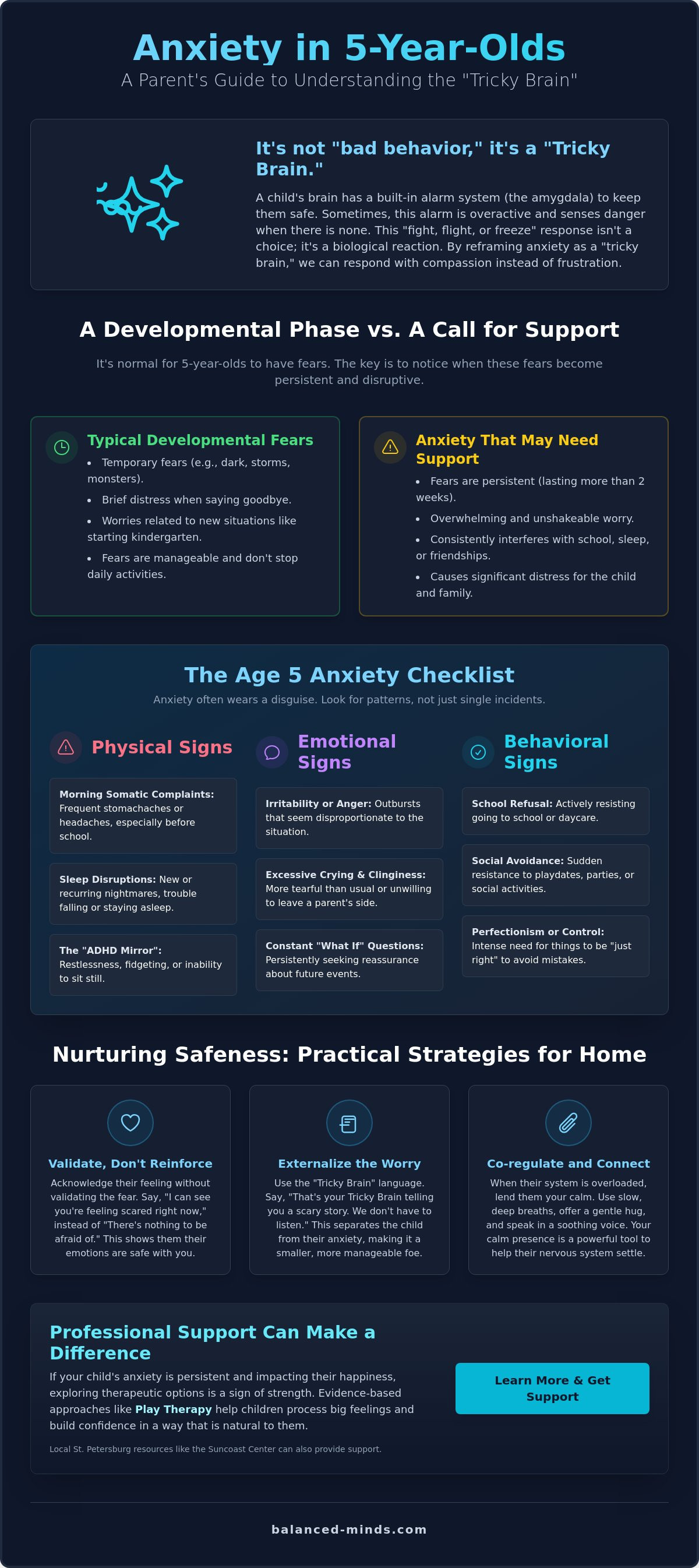
When we see a child struggling, our first instinct as parents is often to wonder what we are doing wrong or why our child is acting out. At Balanced Minds, we view these moments through a lens of compassion. Identifying the signs of anxiety in 5 year old children begins with a shift in perspective. We don't see "bad behavior" or a "difficult child." Instead, we see a "tricky brain" at work. This is a brain with an overactive threat system that's trying very hard to keep the child safe, even when no real danger is present.
Age 5 represents a major developmental milestone. It's a time of blossoming independence, yet it's also a period where the world suddenly feels much larger and more complex. It's entirely normal for children to experience temporary fears, such as being afraid of the dark or loud Florida thunderstorms. However, we look for patterns where these fears become persistent and interfere with daily life. While many children experience brief distress when saying goodbye, a clinical Separation anxiety disorder involves a level of worry that feels overwhelming and unshakeable for the child. We want to normalize this struggle for you. Anxiety is a universal human experience, and even our littlest neighbors in St. Pete have brains that sometimes get stuck in "protection mode."
The Kindergarten Transition in Pinellas County
The leap from Voluntary Pre-Kindergarten (VPK) to full-day Kindergarten in Pinellas County Schools is a significant life event. For many St. Petersburg families, this transition involves moving from a small, familiar preschool setting to a much larger campus like Campbell Park or Maximo Elementary. The signs of anxiety in 5 year old students often emerge during this shift. Your child might feel overwhelmed by the sensory input of a crowded cafeteria or the rumble of a yellow school bus. These "big school" fears are a natural response to a new environment where the routines are different and the expectations are higher. We often see children who were perfectly fine in VPK suddenly become tearful or clingy as they face the 6:00 AM wake-up calls and the long hours of the Kindergarten day.
The Biology of a 5-Year-Old’s Worry
To help our children, we must understand what's happening inside their bodies. Every human has an amygdala, a tiny part of the brain that acts like a smoke detector. When this detector goes off, it triggers a fight, flight, or freeze response. The tricky brain is a survival mechanism that sometimes works too hard, scanning for danger when the child is actually safe. Because 5-year-olds are still developing their language skills, they can't always say, "I feel like my threat system is activated." Instead, their anxiety shows up as tummy aches, refusal to go to school, or emotional outbursts. By recognizing that their biology is driving their behavior, we can respond with the soothing and safeness they need to flourish.
The Age 5 Anxiety Checklist: Physical, Emotional, and Behavioral Signs
We often think of anxiety as a quiet, internal worry, but for a 5-year-old, it frequently wears a disguise. Our tricky brains are designed to protect us; however, they sometimes trigger a false alarm that manifests as anger or physical pain. Identifying the signs of anxiety in 5 year old children requires us to look past the surface behavior to understand the underlying need for safeness. We must look for patterns that persist for more than two weeks rather than isolated incidents triggered by a skipped nap or a missed snack.
Physical Red Flags Parents Often Miss
Because children this age lack the vocabulary to describe "dread," their bodies do the talking. A 2022 report by the American Psychological Association suggests that nearly 20% of children experience somatic symptoms like stomachaches when facing emotional stress. These physical signals are real sensations, not "faking it" to avoid responsibilities.
Morning Somatic Complaints: Frequent stomachaches or headaches that magically disappear once the school drop-off window has passed.
Sleep Disruptions: New or recurring nightmares about losing a caregiver; this often reflects a fear of abandonment.
The ADHD Mirror: Restlessness or constant fidgeting that looks like hyperactivity but is actually a state of "high alert" in the nervous system.
When these physical symptoms become a daily hurdle, seeking expert advice on childhood anxiety can provide parents with the tools to soothe a child's overactive alarm system before it leads to total exhaustion.
Emotional and Behavioral Shifts
Anxiety often masks itself as "defiance" or "difficult" behavior. In our St. Petersburg community, we see this during transitions or social gatherings. For example, a child might experience an intense meltdown when it's time to leave the playground at North Shore Park. This isn't necessarily a lack of discipline; it's often a brain struggling to process the "threat" of a changing environment.
Local environmental factors play a significant role too. The sudden, booming Florida summer storms that roll in every afternoon can trigger specific phobias. If your child asks "What if it rains?" or "What if the power goes out?" more than 5 times a day, their brain is likely stuck in a loop of seeking reassurance to feel safe.
Extreme Clinginess: Refusing to move more than a few feet away from a parent in familiar social settings.
Anxious Avoidance: Declining to participate in activities they once enjoyed, like soccer practice or birthday parties, due to a fear of the unknown.
Transition Tension: High emotional volatility specifically when moving from one activity to another.
It's helpful to remember that "willful" defiance is usually about power, while "anxious" avoidance is about protection. If you feel your child is stuck in a cycle of fear, we invite you to explore how we can help you nurture your child's resilience through a lens of compassion and understanding.
Is it a Phase or a Problem? Evaluating the Severity
Every child experiences moments of hesitation, but we look for specific patterns to determine when a tricky brain needs extra support. Clinicians often look to the 6-month rule. If your child has shown consistent signs of anxiety in 5 year old development for more than 180 days, it often signals that these feelings have moved beyond a typical developmental milestone. We also consider temperament, specifically behavioral inhibition. This is a biological trait identified in research by psychologists like Jerome Kagan, where a child reacts with physiological arousal to new people or environments. While this isn't a flaw, it means their system is wired to scan for threats more intensely than their peers.
We also examine the concept of parental accommodation. It's our natural instinct to protect our children from distress, so we might start ordering for them at restaurants or avoiding the playground when it's crowded. While this creates immediate relief, it accidentally reinforces the tricky brain's belief that the world is unsafe. According to researchers at Yale University, high levels of accommodation can actually maintain or even increase a child's anxiety over time because it prevents them from learning they can survive discomfort.
When Anxiety Affects Daily Functioning
We evaluate severity by looking at how much the worry interferes with the joy of Tampa Bay life. If your child used to love the splash pads at the St. Pete Pier or birthday parties at Great Explorations but now refuses to go, the "interference" is high. In the classroom, this might look like a child who is too frozen to ask for a bathroom break or a student who cannot focus on their phonics because they're preoccupied with when you'll return. Seeking professional support in these moments is a profound act of nurturing, not a sign of failure or a reflection of your parenting skills.
Social Withdrawal: Avoiding playdates or extracurricular activities they previously enjoyed.
Academic Stalling: Difficulty completing simple tasks due to a fear of making mistakes.
Physical Toll: Frequent complaints of "tummy aches" specifically on school mornings or before social events.
Addressing the "It’s Just a Phase" Objection
It's tempting to wait for a child to outgrow these big feelings, but data from the CDC suggests that roughly 7.1 percent of children aged 3 to 17 have diagnosed anxiety. Early intervention is significantly more effective than a "wait and see" approach because a 5-year-old's brain is highly plastic. By teaching them soothing skills and mindfulness now, we help them build a foundation of resilience before the social pressures of middle childhood arrive. If you feel your child's distress is lingering, you can begin Finding the Right Child Psychologist in St. Petersburg, FL: A Parent’s Compassionate Guide to explore how we can support your family's journey toward safeness and connection.
Nurturing Safeness: Practical Strategies for Home and School
When we recognize the signs of anxiety in 5 year old children, our natural response is to provide immediate comfort. We want to help our little ones transition from a state of high alert to a state of internal safeness. This process begins by creating a "soothing" environment at home that actively calms their threat system. We can achieve this through soft lighting, predictable rhythms, and a physical presence that signals security. It's helpful to validate their fears without confirming that the danger is real. We might say, "I can see your tricky brain is feeling very worried about the dark, and we're going to stay right here until you feel calm." This acknowledges their emotional reality while holding the boundary of safety.
Mindfulness doesn't have to be a quiet, seated practice for a 5-year-old. We can use their vibrant imaginations to ground them. "Bubble breathing" is a wonderful tool where we ask the child to imagine they're blowing a giant, iridescent bubble that requires a very slow, steady breath to keep it from popping. This simple exercise physically slows their heart rate and brings their focus back to the present moment. According to data from the CDC, approximately 5.8 million children were diagnosed with anxiety between 2016 and 2019; these early interventions are vital for long-term resilience.
Tools for Soothing the Tricky Brain
One of the most effective ways to help a child is through "externalization." We give the anxiety a name, such as "The Worry Dragon" or "The Grumble." This helps the child understand that the anxiety isn't who they are, but rather something their brain is doing. It reduces shame and allows us to team up against the "Dragon" together. We also recommend using a "bravery ladder." This technique involves breaking down a scary task into five small, manageable steps. If a child is scared of a new playground, step one might be just looking at a photo of it, while step five is playing on the slide for ten minutes.
Predictable Routines: Research shows that 74% of children with anxiety benefit from visual schedules that outline the day.
Comfort Objects: Allowing a transitional object can provide a sense of "home base" in new environments.
Co-Regulation: Our own calm nervous system is the most powerful tool for settling their tricky brain.
Advocating for Your Child in Tampa Bay Schools
Collaborating with Pinellas County teachers is essential for creating a supportive classroom plan. When discussing signs of anxiety in 5 year old students with school counselors, focus on school refusal or physical symptoms like tummy aches. You can request simple accommodations, such as a "safe person" the child can check in with for two minutes if they feel overwhelmed. This person acts as an emotional anchor during the school day. For more localized resources, you can explore our Parenting Near Me: A 2026 Guide to Support in St. Petersburg and Tampa, FL.
If you feel your child needs more specialized support to manage their tricky brain, we invite you to connect with our compassionate team at Balanced Minds to discuss how we can help your family flourish.
Professional Support: Therapeutic Options in St. Petersburg
Recognizing the signs of anxiety in 5 year old children is a profound act of love, yet it's often only the first step in a larger journey toward family wellness. While home-based soothing techniques are essential, there are times when a child's "tricky brain" requires specialized support to find its balance again. We generally recommend transitioning to professional therapy if your child's distress persists for more than four weeks or if it significantly interferes with their ability to attend school, eat, or enjoy playdates. At Balanced Minds Psychology & Wellness, we view therapy not as a sign that something is "wrong," but as an opportunity to nurture resilience and psychological safeness within the family unit.
Our approach integrates evidence-based treatments that respect the unique developmental stage of a five-year-old. We utilize several compassionate modalities:
Play Therapy: This allows children to "speak" through their natural language of play, using toys and creative tools to process complex emotions they cannot yet put into words.
Cognitive Behavioral Therapy (CBT): We adapt CBT to be age-appropriate, helping children identify the physical sensations of anxiety and replacing scary thoughts with "brave" ones.
Compassion Focused Therapy (CFT): We teach children and parents how to activate the body's soothing system to counteract the threat-based responses of the tricky brain.
We believe that healing is a collective journey. Parents are never sidelined; instead, you're empowered as co-therapists who provide the consistent, nurturing environment your child needs to flourish. By working together, we ensure the signs of anxiety in 5 year old children are met with understanding rather than frustration.
What to Expect in Child Therapy
The first session is dedicated to building trust and a sense of absolute safeness. We don't rush into clinical assessments; we focus on making the therapy room a restorative space where your child feels seen and heard. This process makes the anxiety feel like something you can manage together, rather than an overwhelming part of the child's identity.
Connecting with Local Care
We understand that St. Petersburg families manage busy schedules between school and extracurriculars. To make care accessible, we offer telehealth services for families throughout the Tampa Bay area, ensuring support is available where you feel most comfortable. Taking the first step is often the hardest part, so we provide low-pressure phone consultations to discuss your concerns. This ensures we're the right fit for your family's unique path toward growth.
Moving Toward Confidence and Calm Together
Understanding the signs of anxiety in 5 year old children allows us to meet their "tricky brain" with warmth rather than worry. We've looked at how identifying physical and behavioral markers early helps separate a passing phase from a deeper struggle. Our journey through these strategies shows that creating a sense of safeness is a shared process between parent and child. It's about recognizing that these big feelings are a natural part of the human condition. When we provide the right tools, we help our children develop a resilient inner voice that will serve them for a lifetime.
At Balanced Minds, we're here to guide your family through these complexities with evidence-based care. Whether you visit our St. Petersburg office or utilize our secure Florida-wide telehealth services, you'll find a steady partner in your child's wellbeing. You don't have to navigate these early childhood challenges alone. We're ready to help your family find the soothing balance you deserve. Contact Balanced Minds to support your child’s emotional growth today.
Frequently Asked Questions
Is it normal for a 5-year-old to suddenly become clingy?
It's very common for children to seek extra safety during developmental transitions; research from the CDC shows that about 7.1% of children aged 3 to 17 are diagnosed with anxiety. At age 5, starting kindergarten or moving to a new neighborhood in St. Petersburg can trigger this tricky brain response. Providing a soothing, steady presence helps them feel secure while they learn to regulate these big emotions and navigate new social rules.
Can a 5-year-old have a panic attack?
Yes, children as young as 5 can experience panic attacks, though they often present as intense physical complaints or overwhelming meltdowns. The Anxiety and Depression Association of America notes that while panic disorder typically begins in adolescence, younger children can still experience the rapid heartbeat and shortness of breath associated with a panic response. If your child suddenly feels stuck or terrified without a clear trigger, it's often their nervous system trying to protect them from a perceived threat.
What is the most common cause of anxiety in young children?
A combination of genetic predisposition and environmental stressors typically causes anxiety, with about 30% of the risk linked to a child's innate temperament. Common triggers include major life changes, such as a new sibling or the start of the school year, which can overwhelm a 5-year-old's developing coping skills. When we understand that their tricky brain is simply over-monitoring for danger, we can respond with the compassion and nurturing they need to feel safe again.
How do I tell the difference between ADHD and anxiety in my child?
Distinguishing between the two requires looking at the root cause of the restlessness; for instance, a child with ADHD may struggle with focus due to brain chemistry, while an anxious child is distracted by worry. The primary signs of anxiety in 5 year old children often include physical symptoms like stomachaches or frequent trips to the nurse, whereas ADHD is more consistently about impulsivity across all settings. A 2020 study found that roughly 30% of children with ADHD also have a co-occurring anxiety disorder, making professional assessment vital.
Should I let my anxious child stay home from school?
We generally recommend keeping your child in school because avoidance often reinforces the tricky brain's belief that school is a dangerous place. Data suggests that school refusal affects between 2% and 5% of all school-aged children, often peaking during major transitions like kindergarten. Instead of staying home, we work on creating a soft landing at school through small, manageable steps. This builds their resilience and shows them they can handle difficult feelings with our support.
What can I do if my child is afraid of making mistakes?
You can help by modeling self-compassion when you make your own mistakes, showing them that errors are a natural part of being human. Perfectionism is one of the common signs of anxiety in 5 year old children, often leading to task paralysis where they refuse to try new things. Try setting a timer for 5 minutes of messy play where there's no right way to do an activity. This reduces the pressure and helps their nervous system stay in a state of safeness.
How long does child therapy usually take for anxiety?
Most evidence-based protocols, such as Cognitive Behavioral Therapy or Compassion Focused Therapy, typically span 12 to 20 weekly sessions to see lasting change. Every child's journey is unique, and some may flourish with fewer sessions while others benefit from ongoing, monthly check-ins. Our goal is to provide your family with a toolkit of soothing strategies that you can use long after the formal sessions end. We focus on progress rather than a quick fix to ensure deep, sustainable healing.
Is anxiety in children hereditary?
Research published in the Journal of the American Academy of Child and Adolescent Psychiatry indicates that children with an anxious parent are up to 7 times more likely to develop an anxiety disorder. This doesn't mean it's inevitable; it simply means their tricky brain might be more sensitive to the environment. Understanding this shared humanity allows us to approach the challenge with less shame and more collective nurturing. We work together to break these patterns and foster a household of resilience.


