

Is My Child Gifted or Just Smart? Understanding the Nuances of High Ability
Updated: May 15
Imagine sitting in a parent-teacher conference in Pinellas County, hearing that your child is ahead of the curriculum, yet feeling a quiet knot of worry because those same "smart" traits often lead to overwhelming emotional meltdowns at home. You might find yourself wondering, is my child gifted or just smart, as you try to reconcile their high academic performance with their profound sensitivity. We recognize that this journey often feels like a delicate balancing act. It is natural to feel a sense of confusion when a child who masters complex concepts also struggles with the rigid structure of a standard classroom.
In this guide, we will help you discover the qualitative differences between a bright student and a gifted child. You will learn how to nurture your child's unique neurodiversity and foster a sense of safeness where they can truly flourish. We will explore the nuances of the gifted brain, which Florida Rule 6A-6.03019 defines through superior intellectual development, and discuss why these children often experience the world with a unique intensity. We'll also provide clarity on navigating school requirements in St. Pete and explain when a comprehensive psychological evaluation is the most compassionate next step for your family's peace of mind.
Key Takeaways
We'll explore the qualitative differences between high academic achievement and the neurological experience of intensity to help you understand if your child is gifted or just smart.
Learn why a "tricky brain" often results in asynchronous development, where a child's profound intellect may temporarily outpace their emotional capacity for regulation.
Gain insight into the "twice-exceptional" experience, helping you distinguish between classroom boredom and the genuine support needs associated with ADHD or anxiety.
Discover how Florida's specific educational frameworks, including the Educational Plan (EP), can be leveraged to create a sense of safeness and academic challenge for your child.
Understand how comprehensive testing serves as a compassionate roadmap, allowing us to nurture your child's innate potential while supporting their unique emotional landscape.
Table of Contents
Defining the Difference: Is Your Child Highly Bright or Truly Gifted?
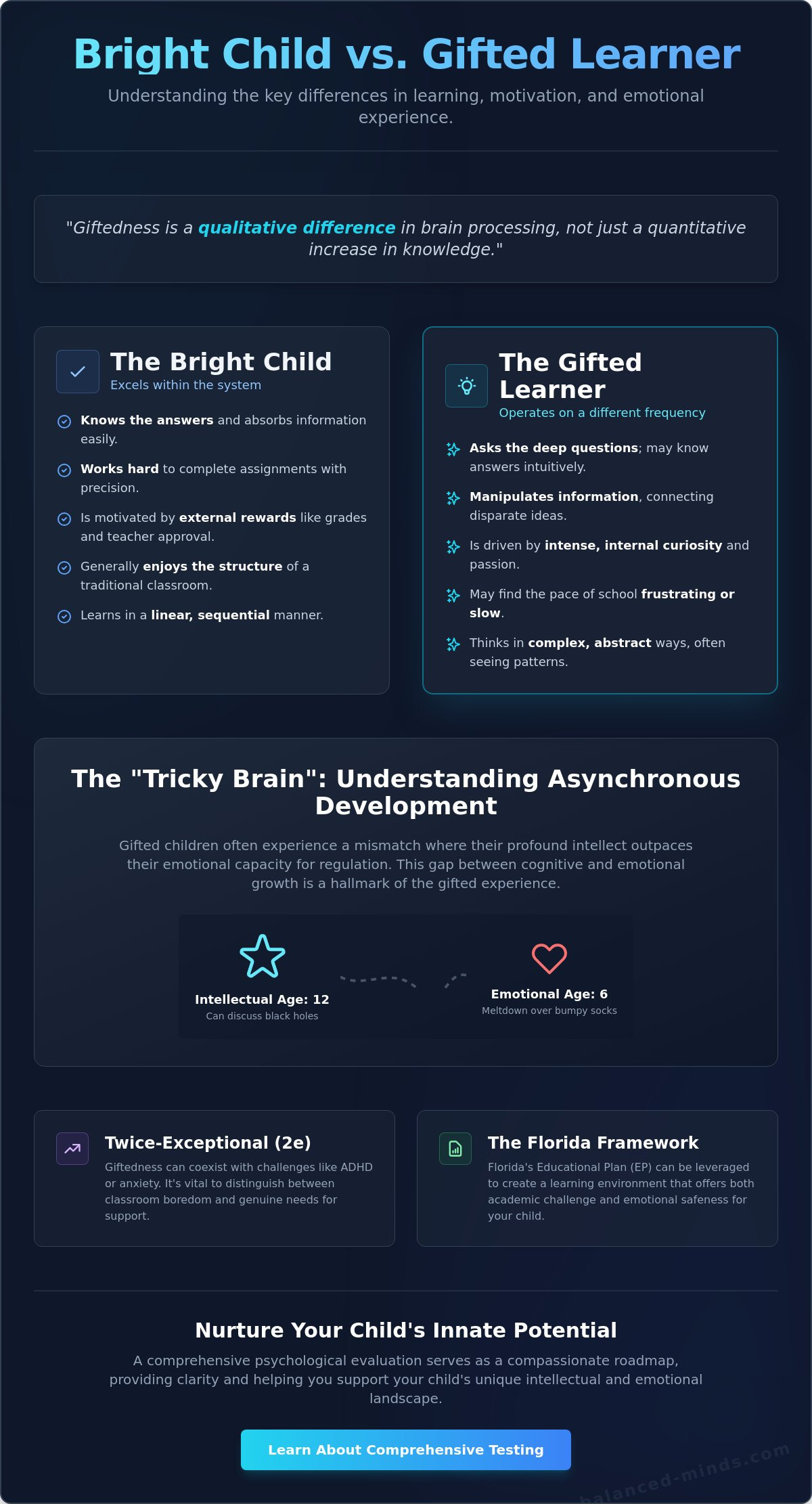
Many parents find themselves observing their child's rapid development and asking, "is my child gifted or just smart?" It's a question that stems from a deep desire to nurture their unique potential while seeking clarity on how to best support their growth. While both types of children demonstrate high ability, we must understand that giftedness is a qualitative difference in brain processing, not just a quantitative increase in knowledge. A smart child is often an expert at absorbing information and reproducing it accurately. In contrast, a gifted child is driven to manipulate that information, connecting disparate ideas in ways that feel surprising, intense, or even overwhelming to their "tricky brain."
The distinction often becomes clearest when we look at how a child interacts with challenges. A bright student typically works hard to achieve their goals and finds satisfaction in a job well done. They are the ones who follow the steps and show their work with pride. A gifted child, however, often knows the answer intuitively. They may reach the correct conclusion without being able to explain the intermediate steps, which can lead to friction in a traditional learning environment. While high achievers generally enjoy the rhythm and rewards of school, gifted learners frequently find the rigid structure and repetitive nature of a standard classroom frustrating or painfully slow.
The High Achiever vs. The Gifted Learner
In a classroom, "smarts" often look like a student who listens attentively, completes assignments with precision, and thrives on teacher approval. At home, however, Intellectual giftedness might present as an intense, self-driven inquiry into a specific topic that lasts for hours, sometimes at the expense of chores or sleep. While "just smart" kids often have an easier time in traditional Florida public schools because they are motivated by external structure, gifted children may struggle when their deep curiosity isn't met with sufficient complexity. We see this often in our work; the child who is "too much" for the classroom is often simply a child whose internal pace doesn't match the external curriculum.
The "Bright Child" Checklist
It's a common misconception that early milestones, such as walking at 10 months or talking in full sentences by age two, are definitive indicators of giftedness. A child can be significantly advanced for their age without possessing a fundamentally different cognitive structure. High intelligence traits, such as a large vocabulary, a quick memory, or a 95th percentile score on a standardized test, are wonderful assets. However, these don't always meet the criteria for giftedness. Giftedness involves a specific type of neurological intensity and asynchronous development that requires a different kind of emotional safeness to truly flourish.
Understanding these nuances helps us move away from labels and toward a more compassionate view of our children's needs. By recognizing whether a child is excelling within the system or operating on a different neurological frequency, we can better tailor our support. This ensures they feel seen, understood, and nurtured in their unique journey of discovery.
The "Gifted Brain" Architecture: Understanding Asynchronous Development
When parents ask us, "is my child gifted or just smart," they're often looking for a reason behind confusing contradictions in their child's behavior. It is common to see a child who can explain the complexities of black holes with adult-like precision, yet collapses into a tearful meltdown because their favorite socks feel "too bumpy." This gap between intellectual ability and emotional regulation is known as asynchronous development. In the world of high ability, development isn't a straight line; it's a jagged map where cognitive, physical, and emotional growth are often out of sync.
We often describe this experience through the lens of a "tricky brain." While a child's intelligence may be operating at a high frequency, their nervous system is still that of a young child. They possess the intellectual hardware to understand complex concepts, but they lack the emotional software to process the intensity of those thoughts. This often makes a gifted child feel like a 10-year-old in a 5-year-old’s body during a conflict. They understand the logic of a situation perfectly, but their internal "soothing system" isn't yet strong enough to manage the big feelings that follow.
According to the National Association for Gifted Children, these children often experience the world through "overexcitabilities." These are five areas where a child feels things with much more intensity than their peers. It isn't just that they are "smart"; it's that their entire sensory and emotional experience is amplified. Understanding these intensities helps us move away from viewing behaviors as "problems" and instead see them as part of a unique neurological makeup that needs a specific kind of nurture.
Intellectual and Emotional Overexcitabilities
Psychomotor intensity often leads parents to wonder if their child has ADHD, as the "smart" child simply cannot stop moving or talking. Their brain is moving so fast that their body struggles to keep up. Sensory sensitivity also plays a major role; a high IQ often comes with a heightened awareness of loud noises or itchy clothing tags. Most profoundly, their emotional depth allows them to worry about global issues like climate change or mortality at an age when their peers are only concerned with playground games. This deep empathy is beautiful, but it requires a steady, guiding presence to help them feel safe.
The Burden of Potential
Perfectionism often takes root early in gifted children because they are used to things coming easily. When they finally encounter a challenge they can't solve instantly, the fear of failure can be paralyzing. They may avoid new activities to protect their identity as the "smart one." We believe in nurturing the child’s spirit as much as their intellect to prevent early burnout. Providing a space for comprehensive psychological support can help your child develop the resilience needed to see their potential as a gift rather than a burden.
Giftedness vs. ADHD and Anxiety: Navigating the Overlap
One of the most frequent challenges we encounter in our practice is the diagnostic confusion that arises when a child's behavior doesn't fit a single, neat category. Parents often wonder is my child gifted or just smart when they see a student who fails to turn in simple homework but can spend four hours building a complex, self-designed robotics kit. This contradiction often points to a "tricky brain" that is simultaneously highly capable and deeply struggling. It's essential to recognize that a child can be both gifted and require behavioral support to manage their daily life.
The Florida Department of Education classifies giftedness within the Exceptional Student Education framework, acknowledging that these children have unique learning needs. However, when a child possesses both high intellectual potential and a learning disability or ADHD, they are referred to as "twice-exceptional" or 2e. These children often experience a "masking" effect. Their giftedness might allow them to compensate for ADHD symptoms in early grades, hiding the struggle, or their ADHD might cause them to underperform on tests, masking their true intellectual potential. This creates a cycle of frustration where the child feels "broken" because they can't meet expectations that seem easy for others.
Is it Inattention or Under-stimulation?
For a gifted child, boredom isn't just a lack of interest; it's a physiological state of under-stimulation. In a classroom where the pace is too slow, a gifted child's mind will naturally wander to more interesting internal thoughts, which looks exactly like the inattention seen in ADHD. A specialized psychologist for adhd diagnosis looks for the presence of "hyperfocus" in both giftedness and ADHD. While traditional behavioral charts often fail with these kids because they find the rewards "illogical" or the tasks too mundane, we focus on identifying the root cause of the behavior to provide the right kind of nurture.
Anxiety and the Gifted Mind
Gifted children are often prone to existential anxiety at a very young age. Because they can process complex concepts like death, war, or environmental change before they have the emotional maturity to handle them, they may become deeply overwhelmed. This can lead to social anxiety, as they feel like outsiders who don't share the same interests as their peers. When these big feelings become too heavy to carry alone, seeking child therapy in St. Petersburg can offer a restorative space for emotional regulation. We help children understand their unique wiring, reducing shame and helping them flourish in a world that doesn't always move at their speed.
Recognizing Giftedness in the Florida School System
Navigating the administrative side of a child's education can feel overwhelming, especially when you're already grappling with the question, is my child gifted or just smart. In Florida, the path to specialized support is governed by Rule 6A-6.03019 of the Florida Administrative Code. This rule establishes that gifted education is a mandate, meaning all 67 traditional school districts must provide specific instructional programs for students identified as gifted. However, for many families in St. Pete and Tampa, the process often feels more like a bureaucratic maze than a supportive journey toward understanding their child's "tricky brain."
It's helpful to understand that gifted services in Florida fall under the Exceptional Student Education (ESE) framework. Unlike an Individualized Education Program (IEP), which typically focuses on remediating learning deficits, a gifted student receives an Educational Plan (EP). This document serves as a collaborative roadmap designed to nurture their unique strengths and ensure they don't stagnate in a curriculum that moves too slowly. We also recognize the importance of Florida’s Plan B eligibility pathway. This alternative route is vital for identifying giftedness in underrepresented groups or students from low socioeconomic backgrounds, ensuring that intellectual potential is nurtured regardless of a child's circumstances.
The Gifted Testing Process in St. Pete & Tampa
The standard evaluation usually involves the WISC-V, a comprehensive tool that measures cognitive potential across various domains. While school-based screenings are provided free of charge, they often come with significant waiting lists that can stretch for several months. Additionally, these screenings might miss twice-exceptional children whose giftedness is masked by other challenges. Choosing private gifted testing in Pinellas County allows for a more nuanced, heart-centered look at your child's whole profile. This comprehensive approach ensures that their intellectual needs are identified quickly so they can begin to flourish in the right environment.
Advocating for Your Child’s Educational Needs
If you believe your child's needs aren't being met, you have the right to request an evaluation through your school district in writing. This advocacy is especially critical for "Highly Gifted" children, those with an IQ of 145 or above, who may require radical acceleration or specialized cluster programs to remain engaged. We offer dedicated parenting support in Tampa Bay to help you prepare for these school meetings. Our goal is to empower you to speak for your child's needs with clinical authority and compassionate clarity.
If you're ready to move past the uncertainty and secure the support your child deserves, we invite you to connect with us for a comprehensive psychological evaluation today.
The Path Forward: How Comprehensive Testing Nurtures Potential
When you finally move past the persistent question, "is my child gifted or just smart," you open a door to a much deeper understanding of your child's internal landscape. We believe that a formal evaluation is more than a collection of scores or a label to be filed away. It's a compassionate roadmap that creates a sense of safeness for the entire family. By identifying the specific gears of your child's "tricky brain," we help you replace daily frustration with a sense of shared humanity. This clarity is an investment in your child's long-term mental health, ensuring they feel seen and supported rather than simply "different."
Our approach at Balanced Minds Psychology & Wellness is rooted in the belief that every child possesses the capacity for growth when provided with the right environment. We deliver evidence-based testing with heart-centered care, focusing on the human being behind the data. When we understand the nuances of a child's cognitive architecture, we can significantly reduce family conflict. Many "behavioral outbursts" are actually the result of a nervous system that feels overwhelmed or under-stimulated. By demystifying these moments, we help reduce parental shame and foster a home environment where your child can truly flourish.
What to Expect During a Gifted Evaluation
The journey begins with a thoughtful intake process where we invite you to share your child's unique story and developmental history. We want to understand the moments of brilliance and the times of struggle. During the administration phase, we work diligently to make the testing environment feel soothing and low-pressure. We know that a child's "tricky brain" can sometimes be sensitive to performance anxiety, so we move at a pace that feels restorative rather than rushed. Finally, our feedback sessions focus on translating clinical data into actionable strategies that you can use at home and in the classroom immediately.
Nurturing the Whole Child
True wellbeing requires a balance between intellectual challenge and social-emotional support. It's vital for gifted children to find "their people," peer groups in Tampa Bay who share their intense interests and unique way of seeing the world. We focus on nurturing the whole child, ensuring that their emotional needs are met alongside their academic ones. This holistic view helps prevent burnout and encourages a lifelong love of learning. If you're ready to explore how we can support your family's journey, we invite you to connect with Dr. Jennifer Katzenstein and our team for a gentle conversation about your child's future.
Nurturing Your Child's Unique Brilliance
Moving from the initial question of is my child gifted or just smart to a place of deep understanding is a journey of compassion for both you and your child. We've explored how identifying asynchronous development and navigating the Florida Educational Plan (EP) process can transform your child’s experience from one of frustration to one of flourishing. This clarity doesn't just improve academic outcomes; it fosters a sense of internal safeness that allows their whole personality to shine. Understanding their unique wiring is the first step in reducing shame and building a supportive environment where they feel truly seen.
Our team, led by Board-Certified Pediatric Neuropsychologist Dr. Jennifer Katzenstein, specializes in supporting twice-exceptional (2e) learners across St. Petersburg, Tampa, and all of Florida through our secure telehealth services. We invite you to Schedule a Compassionate Gifted Evaluation for Your Child to begin building a roadmap tailored to their specific "tricky brain." You don't have to navigate these complex educational and emotional waters alone. We are here to provide a steady, guiding presence as you nurture your child’s incredible potential and help them grow into their most authentic self.
Frequently Asked Questions
How do I know if my child is gifted or just a high achiever?
High achievers are typically well organized, enjoy the structure of the classroom, and work hard to master the curriculum presented to them. In contrast, when you ask is my child gifted or just smart, you may notice that a gifted child intuitively understands complex concepts without being taught, yet they often feel frustrated by repetitive tasks or slow moving lessons. Giftedness is a neurological experience of intensity and depth that goes beyond simply getting high marks on a spelling test.
At what age can a child be tested for giftedness in Florida?
Children can technically be evaluated for high ability as early as age 3, though most Florida school districts begin formal screenings during kindergarten or first grade. Testing at age 5 or 6 often provides more stable results for long term educational planning. Our team uses age appropriate, soothing techniques to ensure that even the youngest children feel a sense of safeness during their evaluation process.
Can a child be gifted and have a learning disability like dyslexia?
Yes, these children are known as "twice-exceptional" or 2e learners. They possess high intellectual potential alongside a learning challenge such as dyslexia, dysgraphia, or ADHD. This unique combination often creates a "tricky brain" where the child’s brilliance can mask their struggle, or their disability can hide their true giftedness, making a comprehensive evaluation essential for their wellbeing.
What IQ score is required for the gifted program in Pinellas County?
Pinellas County schools generally require a standard score of 130 or higher on an individually administered intelligence test for Plan A eligibility. This score places a child in the top 2% of the population. For students who qualify under Plan B, which supports underrepresented groups, the district may use a more flexible criteria that considers a wider range of high ability markers beyond a single IQ number.
Does a gifted child always get good grades in school?
Gifted children do not always receive straight A's and may even struggle significantly in a traditional classroom setting. If the curriculum lacks sufficient depth or complexity, a gifted child may become disengaged, leading to underachievement or behavioral outbursts. We often see that these children need an Educational Plan (EP) that prioritizes intellectual challenge over rote memorization to help them truly flourish.
Is giftedness considered a type of neurodiversity?
Giftedness is a fundamental form of neurodiversity because it involves a brain that is wired to process information and sensory input with heightened intensity. Their cognitive architecture is qualitatively different, affecting how they learn, socialize, and regulate their emotions. Recognizing this as a natural variation of the human condition helps reduce shame and promotes a more nurturing approach to their development.
What happens if my child is gifted but the school says they don’t qualify for services?
If a child meets the IQ threshold but is denied services, parents have the right to request a meeting to discuss the "need for a special program" as outlined in Florida Rule 6A-6.03019. Sometimes, school based screenings miss the nuances of a child's profile. In these cases, a private evaluation can provide the detailed clinical data needed to advocate for your child’s right to an appropriate education.


