

Helping My Gifted Child with Social Anxiety: A Compassionate Guide for Parents
Updated: 3 days ago
What if your child’s brilliant mind is actually the very thing making the local playground feel like a source of profound distress? When you are focused on helping my gifted child with social anxiety, it often feels like you are caught between honoring their incredible intellect and watching them retreat from the very opportunities they deserve. You might feel like a misfit yourself as you search for answers, frustrated by generic parenting advice that simply does not account for the depth of a gifted child's perception.
We understand the quiet ache of watching your bright, sensitive child withdraw. It is a complex experience where high intelligence meets intense emotional sensitivity, often creating a mismatch between what they understand and what they can yet regulate. This guide offers a compassionate path forward. We will explore practical tools to lower social distress, discuss how comprehensive psychological evaluations can provide a roadmap for growth, and help you find a supportive community of experts in the Tampa Bay area. Together, we can help your child move from a place of isolation toward a life of confident, authentic connection.
Key Takeaways
Understand how asynchronous development creates a gap between your child's advanced intellect and their emotional maturity, which often leads to heightened social distress.
Explore the framework of overexcitabilities to see why your child’s intense reactions are a natural byproduct of their giftedness rather than a flaw to be fixed.
Learn to implement "social scaffolding" techniques that provide a gentle, structured path for your child to navigate new social groups without feeling overwhelmed.
Discover how to distinguish between a clinical disorder and an intellectual mismatch while helping my gifted child with social anxiety find a sense of belonging.
Recognize the specific red flags, such as school refusal or persistent sleep disruption, that signal it's time to seek specialized professional support.
Table of Contents
Understanding the Intersection: Giftedness and Social Anxiety
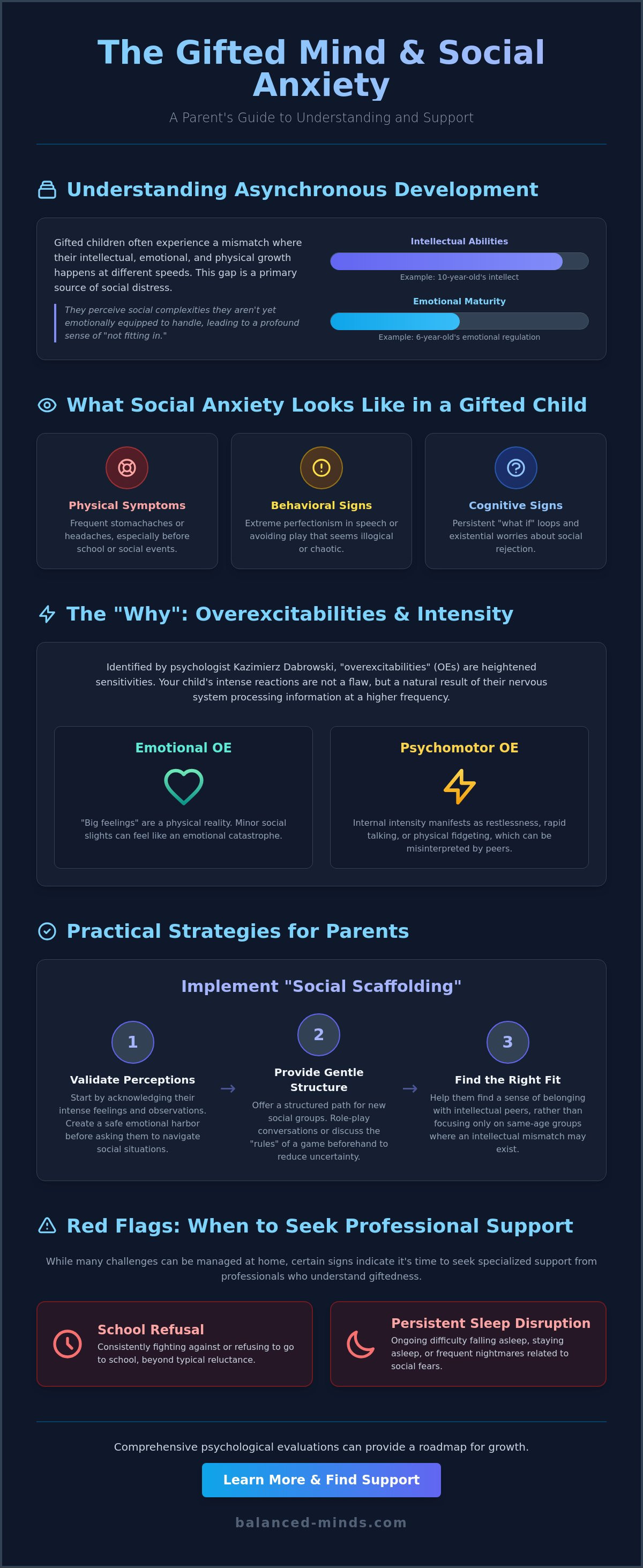
Giftedness is often misunderstood as simply a measure of high achievement or academic success. In our practice, we view it through the lens of asynchronous development. This means a child’s intellectual, emotional, and physical growth don't always move at the same pace. When a child’s cognitive abilities far outstrip their emotional maturity, they often perceive social complexities they aren't yet equipped to handle. Helping my gifted child with social anxiety begins with a shift in perspective, moving away from trying to "fix" a behavior and toward understanding a unique way of being in the world.
We see this frequently in families across St. Petersburg and Tampa, where parents feel caught between their child’s brilliance and their paralyzing fear of social judgment. This anxiety isn't a sign of weakness. Instead, it's often a byproduct of a highly tuned nervous system that processes every social cue, tone, and facial expression with intense depth. For these children, the world is often "too much" and "too loud," making the path to social confidence feel like an uphill climb.
What Does Social Anxiety Look Like in a Gifted Child?
Social anxiety in high-IQ children rarely looks like simple shyness. It often manifests as a paralyzing need for perfection in every interaction. You might notice your child rehearsing conversations in their head before they speak or avoiding "low-intellect" play because the rules seem illogical or chaotic. Common signs include:
Physical symptoms: Frequent stomachaches or headaches specifically before school or social gatherings.
Behavioral signs: Extreme perfectionism in speech, where a child refuses to speak unless they are certain they will be "right."
Cognitive signs: Persistent "what if" loops and existential worrying about social rejection that seems far beyond their chronological age.
The Role of Asynchronous Development
Imagine the internal conflict of a child who possesses a ten-year-old’s intellect but a six-year-old’s emotional regulation system. This gap creates a profound sense of "not fitting in." When a child can understand complex global issues but lacks the emotional tools to navigate a playground disagreement, they often feel like a stranger in their own peer group. This mismatch is a core driver of social fear, as the child becomes hyper-aware of their own differences.
Research into the social and emotional risks of giftedness suggests that without proper support, this sense of isolation can lead to long-term withdrawal. Generic social skills training often fails these children because it focuses on surface-level behaviors. Helping my gifted child with social anxiety requires a more nuanced approach that honors their depth. We must validate their intense perceptions first, creating a safe emotional harbor before we ask them to navigate the choppy waters of social interaction.
The "Why" Behind the Worry: Overexcitabilities and Intensity
To truly understand the gifted experience, we must look beyond IQ scores and into the heart of how these children process the world. Psychologist Kazimierz Dabrowski identified what he called "overexcitabilities" (OEs). These are essentially heightened physiological sensitivities in various domains. For many parents, helping my gifted child with social anxiety means recognizing that their child isn't just "being difficult" or "overly dramatic." Instead, their nervous system is simply receiving and processing information at a much higher frequency than their peers.
While Dabrowski identified five OEs, the Emotional and Psychomotor intensities often play the largest roles in social overwhelm. When a child has Emotional OE, their "big feelings" aren't just a choice; they are a physical reality. A minor social slight, like a friend not sharing a toy or a teacher using a slightly stern tone, can feel like an emotional catastrophe. When combined with Psychomotor OE, this internal intensity may manifest as restlessness or rapid talking, which the child might later overanalyze, leading to a cycle of social dread. Creating a safe, nurturing environment at home is the first step in helping them regulate these powerful internal waves.
Emotional Overexcitability and Social Perception
Gifted children often possess an uncanny ability to "read the room." They pick up on micro-expressions, subtle shifts in body language, and unspoken tensions that other children simply miss. This hyper-awareness can become a heavy burden of empathy. They don't just see another child’s sadness; they often feel it as if it were their own. This can make crowded, emotionally charged environments like school cafeterias feel exhausting. We often suggest "emotional shielding" techniques, where children learn to visualize a gentle boundary between their own feelings and the emotions of those around them. If these intensities feel like they are limiting your child's daily life, a comprehensive psychological evaluation can help clarify their unique sensory and emotional profile.
Perfectionism as a Social Barrier
For a child with high intellectual standards, the fear of being "wrong" or "weird" can be paralyzing. They may hold themselves to an impossible standard of self-expression, leading to selective mutism or total withdrawal from social groups. They would often rather stay silent than risk saying something that isn't "perfect." You can support them by exploring practical strategies for managing anxiety that focus on a growth mindset. We want to teach them that social interaction is a skill to be practiced, not a test to be passed. By celebrating the effort of reaching out rather than the "success" of the interaction, we help them lower the stakes and find their voice.
Is it Social Anxiety or an Intellectual Mismatch?
Sometimes what looks like a clinical disorder is actually a logical response to an environment that doesn't fit. When we talk about helping my gifted child with social anxiety, we have to ask if the child is actually afraid or if they are simply lonely in a room full of people who don't speak their language. We often call this the "Loneliness of the Long-Distance Thinker." It's a unique type of isolation where a child’s interests, humor, and vocabulary are years ahead of their classmates, making standard playground banter feel alien or even boring. This isn't a deficit in the child; it's a lack of intellectual resonance with their surroundings.
This complexity grows when a child is twice-exceptional (2e). This means they are both gifted and living with a challenge like ADHD or a learning disability. For these children, social interactions require double the effort. They must manage their high-speed thoughts while simultaneously navigating the social cues they might struggle to interpret or execute. If you feel your child is struggling to keep their head above water, comprehensive psychological evaluations can provide the clarity needed to distinguish between a social skill deficit and a simple mismatch of environment. Understanding this distinction helps us move from frustration to a place of targeted, compassionate support.
The Importance of True Peers
There is a significant difference between age peers and intellectual peers. You might notice your child is perfectly charming and social when talking to your adult friends but becomes paralyzed or irritable around children their own age. This happens because adults often provide the intellectual stimulation and predictable social structure that gifted children crave. Finding "your people" is vital for their development. In the Tampa Bay area, seeking out specialized gifted programs or interest-based clubs can help bridge this gap. These spaces allow your child to practice social skills with others who truly understand their complex jokes and niche references, reducing the pressure to "dumb down" their personality.
Social Fatigue vs. Social Anxiety
It is also helpful to distinguish between genuine fear and simple exhaustion. Many gifted children engage in "masking," where they suppress their natural intensities to try and blend in with their classmates. This is incredibly draining. If your child comes home and immediately needs a quiet room or a sensory break, they might be experiencing social fatigue rather than social anxiety. An introverted child might be perfectly happy being alone, whereas an anxious child wants to connect but feels stopped by fear. Helping my gifted child with social anxiety requires us to respect their need for downtime. We must allow them space to regulate their nervous system after a long day of performing for the world.
Practical Strategies for Helping Your Child at Home and School
Moving from understanding to action requires a gentle, structured approach. Helping my gifted child with social anxiety requires a blend of emotional validation and logical problem-solving that honors their unique cognitive architecture. We don't want to push them into the deep end of social interaction; instead, we want to build a series of sturdy steps that allow them to climb at their own pace. This process begins with five essential steps designed to foster resilience and social confidence.
Validate the feeling without confirming the fear. When your child says they are afraid to go to a birthday party, avoid saying "there's nothing to worry about." Instead, try, "I can see your mind is working hard to protect you, and that feeling of worry is very real."
Use Social Scaffolding. Scaffolding is a bridge between the safety of the known and the growth of the unknown. Start with low-stakes environments, like a quiet library visit, before moving to more complex settings.
Teach Cognitive Reframing. Use your child's logic to examine their fears. If they worry everyone is looking at them, help them "collect data" on what other children are actually doing.
Collaborate with local educators. Work with teachers in Pinellas County or Hillsborough schools to ensure your child has a "safe person" or a quiet place to retreat when social intensity peaks.
Prioritize parent self-compassion. You are doing a hard thing. Acknowledging your own frustration or exhaustion helps you remain the steady, guiding presence your child needs.
Communication Techniques for Bright Minds
Gifted children often respond better to metaphors than direct instructions. We often use the concept of "The Social Detective" to help children observe social cues as if they were gathering clues for a mystery. This removes the personal pressure and turns social interaction into an intellectual puzzle. You can also use role-playing centered on their favorite topics, like space or coding, to practice basic greetings. This allows them to focus on the social mechanic while staying within their intellectual comfort zone. If you find these moments at home are becoming too tense, individual therapy for children can provide a neutral space for your child to practice these skills with a supportive mentor.
Navigating the Florida School System
In Florida, gifted students are entitled to an Educational Plan (EP). This document shouldn't just focus on academic acceleration; it can also include social-emotional goals. When meeting with school teams in St. Pete or Tampa, advocate for accommodations like "preferential seating near a peer model" or "planned breaks during high-stimulus social times." You can find more advice on this in our parenting support resources in St. Pete. By positioning yourself as a partner with the school, you create a consistent support system that follows your child from the living room to the classroom.
When to Seek Professional Support in St. Petersburg and Tampa
While home-based strategies provide a vital foundation, there are times when the weight of social distress becomes too heavy for a family to carry alone. Recognizing when to transition from parental support to professional partnership is a courageous step toward your child's wellbeing. In our community, we often see families reach a tipping point where a child’s brilliance is overshadowed by their daily struggle to exist in social spaces. Helping my gifted child with social anxiety often involves acknowledging that specialized clinical insight can offer the clarity and relief that general advice cannot provide.
Certain red flags suggest that your child’s nervous system is stuck in a state of chronic overwhelm. If you notice persistent sleep disruptions, where your child’s racing mind prevents rest, or a growing pattern of school refusal, it may be time to seek a deeper level of care. When a child begins to withdraw from activities they once loved or expresses a deep sense of being "broken" or "different," child therapy in St. Petersburg can offer a restorative space to process these complex emotions. Our approach is grounded in the belief that every child possesses an innate capacity for growth; they simply need the right environment and tools to flourish.
The Value of Specialized Gifted Testing
Many parents believe that a standard IQ score is the final word on their child's needs. However, a simple number rarely explains why a brilliant child is terrified of a peer’s birthday party. Comprehensive gifted testing in Pinellas County goes beyond the score to look at the "why" behind the struggle. It helps us understand the intersection of cognitive processing, emotional regulation, and social perception. This data acts as a roadmap, allowing us to tailor interventions that respect your child’s high intellect while supporting their sensitive heart. It is about seeing the whole child, not just their academic potential.
Therapy as a Partnership
We view therapy not as a process of "fixing" a child, but as a collaborative journey toward a more balanced life. This often involves family therapy, where we work together to refine the home ecosystem so it supports everyone's mental health. When we treat the social challenge as a shared journey rather than an individual deficit, we reduce the shame that gifted children often carry. Helping my gifted child with social anxiety is about building a life where their intelligence is a source of joy rather than a barrier to connection. If you feel ready to explore how we can support your family, we invite you to reach out for a gentle, heart-centered conversation about your child's future.
Cultivating Confidence in Your Gifted Child
We've explored how the intersection of high intelligence and deep sensitivity can make social interactions feel like a daunting puzzle. By recognizing the role of overexcitabilities and the importance of finding true intellectual peers, you've already taken the first step in helping my gifted child with social anxiety. You don't have to navigate this path alone. We provide a warm, nurturing office in the heart of St. Petersburg where your child can feel safe to grow. Whether you need a comprehensive evaluation to understand their unique profile or individual therapy to build practical tools, we're here to partner with your family. Begin your journey toward social confidence with a compassionate consultation at Balanced Minds. Your child's bright mind is a gift; with the right support, their social world can be just as vibrant as their intellectual one.
Frequently Asked Questions
Is my child actually anxious, or just very gifted?
It's often a combination of both. Giftedness involves asynchronous development, where a child's intellect outpaces their emotional regulation. This gap can lead to a hyper-awareness of social nuances that they aren't yet equipped to handle. If their sensitivity causes persistent distress or prevents them from participating in activities they enjoy, it's likely that social anxiety has taken root alongside their high intelligence.
Can gifted children have social anxiety and ADHD at the same time?
Yes, many children are twice-exceptional, meaning they possess high cognitive ability while also navigating a challenge like ADHD. The racing thoughts and impulsivity associated with ADHD can often fuel the overthinking and perfectionism of social anxiety. Teasing these two apart is essential. Comprehensive psychological evaluations can help clarify how these conditions interact and provide a roadmap for integrated support.
How do I explain social anxiety to my gifted child without making them feel "broken"?
Try using a metaphor that honors their intellect, such as a "high-definition radar system" that's picking up too much signal. Explain that their brain is incredibly fast and powerful, which sometimes means it processes social cues with more intensity than others. Framing the struggle as a "mismatch of intensities" rather than a personal deficit helps preserve their self-esteem while acknowledging their very real feelings.
Should I force my anxious gifted child to attend social events?
Forcing a child into a high-stress situation often leads to increased trauma, but total avoidance can reinforce their fears. A better approach is using social scaffolding. This involves creating a bridge between safety and growth by attending events for a shorter, agreed-upon time. Giving your child a clear exit strategy and a "safe person" to stay near helps them build confidence without feeling trapped.
What is the best type of therapy for a gifted child with social anxiety?
A mentor-based approach that respects their logic and intellect is often most effective. Gifted children need to understand the "why" behind their physiological responses. Individual therapy for children that combines cognitive-behavioral tools with deep empathy allows them to analyze their fears logically. This helps them move from a place of being overwhelmed by their feelings to a place of active, thoughtful regulation.
How can I find intellectual peers for my child in the Tampa Bay area?
Finding "your people" is a vital part of helping my gifted child with social anxiety. Look for interest-based environments such as robotics clubs, coding camps, or specialized gifted programs within Pinellas and Hillsborough counties. These settings provide a natural resonance where your child can connect over shared passions rather than just age. This reduces the pressure to "mask" their intelligence to fit in.
Does gifted testing help with diagnosing social anxiety?
While gifted testing specifically measures cognitive potential, it's a foundational step in understanding social distress. Testing reveals if a child’s social struggle stems from a simple intellectual mismatch with their current environment. When we combine this data with mood and anxiety evaluations, we can determine if the anxiety is a standalone challenge or a byproduct of their unique cognitive profile.
What should I do if my child is being bullied because of their giftedness?
Start by providing a safe, non-judgmental space at home where they can express their hurt. It's important to work directly with school administrators to ensure a protective environment is maintained. Helping my gifted child with social anxiety in this context involves reinforcing the idea that their differences are strengths. We want to help them find communities where their unique way of thinking is celebrated rather than mocked.


