

Gifted Child Evaluation in Pinellas County: A Compassionate Guide for Parents
Updated: 21 hours ago
You've likely watched your child absorb new information with startling speed, yet you might also see them grow restless or disconnected during a typical school day. It's a common experience for parents in our community to feel a mix of pride and deep uncertainty when their child’s cognitive needs don't quite align with the standard curriculum. We understand the frustration of seeing your child's bright light dimmed by boredom or social friction. If you've been considering a gifted child evaluation pinellas county families often find that the path toward clarity feels heavy with administrative hurdles and long waiting lists. You aren't alone in wanting a faster, more holistic understanding of your child's inner world.
We believe that every child deserves to be seen for their whole self, beyond just a single test score. This guide is designed to offer you a steady hand as you explore the nuances of the Pinellas County Schools eligibility process and the depth of your child's cognitive profile. We'll walk through the specific steps for securing a gifted designation, discuss the unique needs of twice-exceptional learners, and provide actionable ways to support your child's growth at home and in the classroom. By the end of this article, you'll have a clear roadmap to help your child thrive and feel truly understood.
Key Takeaways
Understand how the Florida Department of Education defines giftedness and why superior intellectual development often looks different than simply earning high grades.
Discover how a private gifted child evaluation pinellas county families choose can provide a more comprehensive, child-centered view of your student's unique cognitive profile.
Learn how a professional psychological report helps you navigate the Pinellas County Schools eligibility process and can help expedite the creation of an Educational Plan (EP).
Identify the subtle signs of a twice-exceptional (2e) learner and understand how high intelligence can sometimes mask underlying challenges like ADHD or learning differences.
Explore a heart-centered, science-backed approach to testing that prioritizes your child's emotional security while unlocking their full academic potential.
Table of Contents
Understanding Giftedness: More Than High Grades in Pinellas County
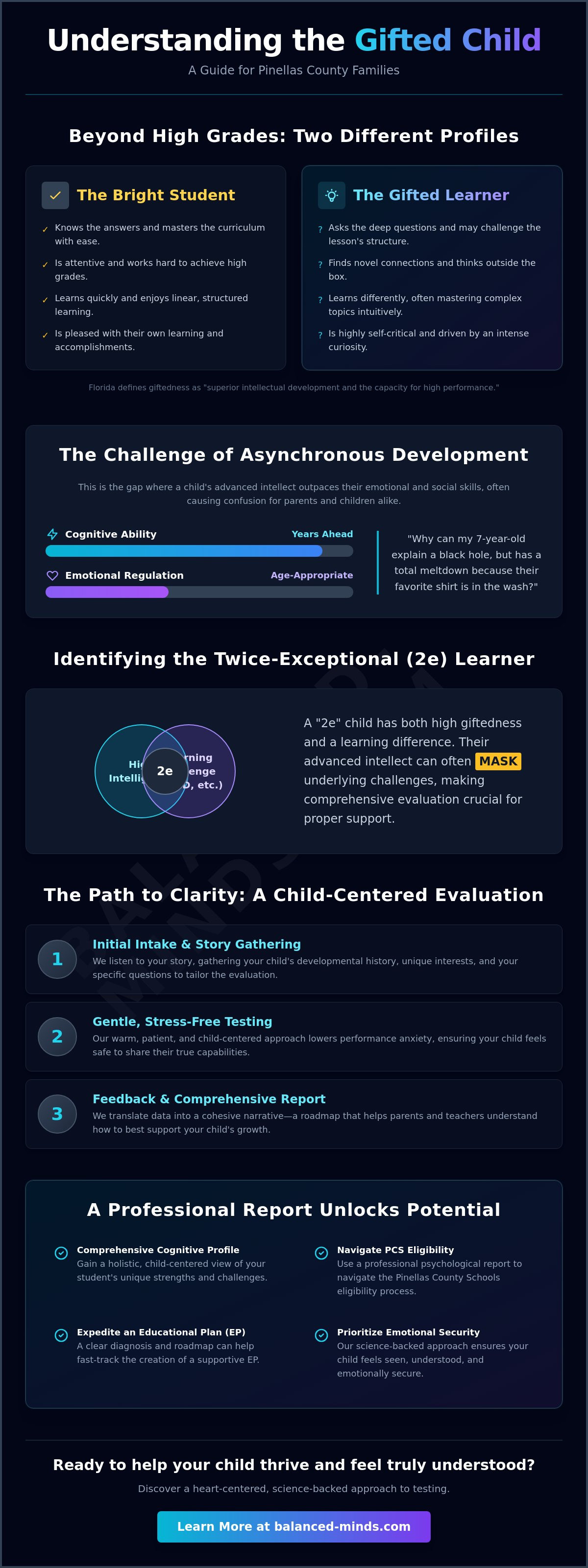
In Florida, the Department of Education describes giftedness as superior intellectual development and the capacity for high performance. While many families first notice their child's potential through academic success, we see giftedness as a unique neurobiological profile that colors every part of a child's life. It's a way of experiencing the world that goes far beyond a report card full of high marks. A bright student often masters the curriculum with ease, but a gifted learner might question the very structure of the lesson or find connections that others miss. They don't just learn quickly; they learn differently.
The signs are often visible early on through intense curiosity and a drive to master complex topics. You might notice your child has a sophisticated sense of humor or a deep sense of justice that seems advanced for their age. Standardized school screenings sometimes fail to capture this depth. These tests often prioritize speed and compliance, which can leave creative or deep-thinking children feeling overlooked. This is why a comprehensive gifted child evaluation pinellas county families choose can be so restorative; it looks past the surface to see the brilliant, complex mind beneath.
The Gifted Profile in St. Petersburg and Tampa
Our local school environments in St. Petersburg and Tampa require a specific understanding of how giftedness manifests in different developmental stages. In the early years, you might see a child who teaches themselves to read or shows an uncanny memory for facts. As they move into elementary school, this can shift into divergent thinking, where a child solves a math problem using a method the teacher hasn't taught yet. We look for this spark of creativity during our evaluations, recognizing that a child's ability to think outside the box is often their greatest strength, even if it doesn't always fit perfectly into a standard classroom box.
Asynchronous Development: When Intellect Outpaces Emotion
One of the most challenging aspects of raising a gifted child is managing asynchronous development. This is the "gap" where a child's cognitive abilities are years ahead of their emotional regulation. It's why a seven-year-old can explain the physics of a black hole but still have a total meltdown because their favorite shirt is in the wash. We understand how exhausting and confusing this can be for parents. Our evaluations identify these specific developmental gaps, providing a clearer picture of why your child might be struggling socially or emotionally despite their high IQ.
This complexity is even more pronounced for a Twice-Exceptional (2e) Learner, who possesses both high giftedness and a learning difference or ADHD. We validate your experience of raising a child who needs both high-level intellectual stimulation and extra support for their emotional or executive functioning needs. By mapping these peaks and valleys, we help you create a life where your child feels supported in their struggles and celebrated for their incredible gifts.
The Gifted Child Evaluation Process: What to Expect
We believe that a gifted child evaluation pinellas county families seek should feel like a journey of discovery rather than a stressful clinical hurdle. Our process is designed to be gentle and child-centered, ensuring your child feels safe enough to share their true capabilities. We start with an initial intake session where we listen to your story. This is our opportunity to gather the threads of your child's developmental history, their unique interests, and the specific questions you have about their learning style. By understanding the context of their daily life, we can tailor the evaluation to be as meaningful as possible.
The testing session itself is a dedicated block of time where your child is the focus of our care. We prioritize a stress-free environment, using a warm and patient approach to help lower any performance anxiety. Once the testing is complete, we move into the feedback session. We don't just deliver a stack of numbers; we translate the data into a cohesive narrative. This report serves as a bridge between your child's internal world and their external environment, helping both parents and teachers understand how to best support their growth. If you are looking for clarity, our team provides comprehensive gifted testing that honors your child's unique spirit.
Commonly Used Assessments (IQ and Beyond)
Our evaluations typically utilize the Wechsler Intelligence Scale for Children (WISC-V), which is the gold standard for measuring a child's intellectual potential. We don't stop at a single score. Depending on your child's needs, we may also incorporate the Woodcock-Johnson tests to measure academic achievement or specific tools to assess executive functioning. This holistic view helps us see how cognitive ability translates into real-world skills. When Navigating Pinellas County Schools (PCS) Eligibility, having this detailed data is vital for creating an effective Educational Plan.
Preparing Your Child for the Evaluation
We encourage you to use supportive, low-pressure language when explaining the evaluation to your child. Many parents find success by describing the session as "brain games" or a series of puzzles that help us learn how they think. On the morning of the evaluation, focus on the basics: a full night's sleep and a nutritious breakfast go a long way in helping a child feel their best. Our office is designed to feel like a comfortable, welcoming space, which helps reduce nerves from the moment you walk through the door. We want your child to leave feeling proud of their effort and their bright, curious mind.
Navigating Pinellas County Schools (PCS) Eligibility
We understand that waiting for a school-based screening can feel like standing in a long line while your child’s enthusiasm for learning slowly fades. In Pinellas County, the process from referral to an eligibility determination can take up to 90 school days. For families seeking a faster path, a private gifted child evaluation pinellas county experts provide can offer a significant head start. While the school district ultimately makes the final determination based on state criteria, a comprehensive private report provides the robust data needed to advocate for your child’s unique needs.
Most students qualify for gifted services by achieving an IQ score of 130 or higher on an individual intelligence test. This number is a standard benchmark, but it’s only one piece of the puzzle. Once eligibility is confirmed, the school develops an Educational Plan (EP). This document acts as a personalized roadmap for your child’s advanced instruction, outlining specific goals and the services they'll receive. Our reports are designed to be "school-ready," meaning we translate complex cognitive data into clear recommendations that teachers can use to build a more engaging classroom experience for your student.
The Private vs. School District Evaluation Debate
The choice between a school-based evaluation and a private one often comes down to timing and depth. School psychologists are talented professionals, but they're often spread thin across multiple campuses, leading to the lengthy 90-day wait. A private evaluation allows for a more intimate, one-on-one setting where your child isn't just another name on a list. We provide a whole-child perspective that looks at emotional and social factors alongside cognitive scores, offering a level of detail that standard school screenings might not reach. While there's a financial investment involved, many parents find the immediate clarity and comprehensive roadmap for their child’s future to be invaluable.
Understanding Gifted Plan B in Pinellas
Pinellas County also utilizes "Plan B" eligibility to ensure that gifted students from underrepresented groups or those who are English Language Learners (ELL) aren't overlooked. This alternative path is vital for equity; it considers a combination of factors, such as environmental indicators and a slightly different IQ threshold, to identify potential that might be masked by language or socio-economic barriers. We specialize in providing the nuanced documentation needed for these cases. We're committed to ensuring every bright child has a fair chance to access the enrichment they deserve, making sure no spark of potential goes unnoticed because of a rigid testing standard.
Identifying the Twice-Exceptional (2e) Learner
It's a profound irony that some of the brightest minds also face the most significant hurdles in a traditional classroom. We often meet families whose children are "Twice-Exceptional," or 2e, meaning they possess high intellectual potential alongside a learning difference or neurodivergence like ADHD. These children exist in a delicate balance. Their intelligence often allows them to compensate for their struggles, while their struggles can make their high potential invisible to teachers. This "masking effect" is one of the most common reasons parents seek a gifted child evaluation pinellas county families can trust to see the whole picture.
Without a comprehensive view, 2e children are frequently misunderstood. A child who can't stay focused on a repetitive worksheet might be labeled as "unmotivated" or "lazy," when in reality, their brain is simply starving for complexity while simultaneously struggling with executive function. We see the exhaustion in parents who know their child is capable of so much more but can't seem to bridge the gap between potential and performance. Our approach to ADHD testing for kids in Tampa Bay is designed to complement our gifted assessments, ensuring we don't just identify the gift, but also the specific support your child needs to use it.
Evaluating ADHD and Giftedness Together
Distinguishing between "gifted boredom" and ADHD-related inattention requires a nuanced, clinical eye. A gifted child might tune out because they mastered the material three weeks ago, while a child with ADHD might tune out because their brain struggles to filter out competing stimuli. Often, it's both. We focus on identifying these overlaps, frequently recommending executive function coaching to help 2e learners manage the "administrative" side of school. By creating a balanced support plan, we help your child honor their strengths while building practical tools for their challenges.
Social-Emotional Support for Gifted Kids
Giftedness often comes with a high volume of emotional intensity. We see many children who struggle with deep-seated perfectionism, where the fear of not being "the best" prevents them from even trying. This can lead to a fragile sense of confidence that wavers at the first sign of failure. Through our therapeutic support, we provide a safe space for high-intensity emotional processing. We help these children understand that their worth isn't tied to their IQ, allowing them to find "their people" and build a resilient sense of self. If you're ready to uncover the full story of your child's brilliance and their needs, we invite you to explore our comprehensive psychological evaluations.
A Partner in Your Child’s Growth at Balanced Minds
At Balanced Minds, we see ourselves as more than just a testing facility; we are your dedicated partners in nurturing your child’s unique potential. Our approach to a gifted child evaluation pinellas county families trust is rooted in a philosophy that combines rigorous, science-backed methodology with a deeply heart-centered delivery. We recognize that behind every percentile and data point is a vibrant child with their own dreams, fears, and individual quirks. Our mission is to create a restorative space where your child feels truly seen and where you, as a parent, feel supported through every step of the process.
We believe that a high-quality evaluation should serve as a lifelong resource rather than just a temporary means to an end. The reports we provide offer a foundational understanding of your child’s cognitive architecture, serving as a roadmap you can return to as they transition through various stages of their educational journey. We aim to demystify the science of the mind, making it grounded and relevant to your family's daily life.
Beyond the Evaluation: Ongoing Support
Our commitment to the St. Petersburg and Tampa Bay community extends far beyond the final feedback session. We often help families bridge the gap between diagnosis and action by linking assessment results to our other offerings, such as family therapy or executive functioning coaching. This continuity of care ensures that the insights we’ve gathered are translated into practical, restorative strategies at home and in the classroom. We also want to hold space for the parent experience; raising a gifted child is a complex, high-intensity journey that requires immense patience. We encourage self-kindness and offer a non-judgmental environment where your family's needs are always the priority.
Getting Started with Your Pinellas Gifted Evaluation
We’ve made our intake process simple and low-pressure because we know how much you already have on your plate. When you reach out to our team, we’ll walk you through the initial steps and help you prepare for your first appointment in our St. Petersburg office. You might find it helpful to gather previous school records or notes on your child’s developmental milestones to share during our first conversation. We are here to answer your questions with a calm, steady presence, ensuring you feel fully prepared for the road ahead. Schedule your gifted child evaluation with Balanced Minds today.
Empowering Your Child’s Bright Future
Choosing to pursue a gifted child evaluation pinellas county parents can rely on is a vital step toward aligning your child's education with their internal brilliance. We've explored how understanding the nuance of a gifted profile, navigating the school district's eligibility rules, and identifying the unique needs of twice-exceptional learners can transform a child's academic experience. Our goal is to replace confusion with clarity. We provide you with a roadmap that honors both your child's high potential and their emotional wellbeing.
We take pride in providing comprehensive reports that are widely accepted by Pinellas and Hillsborough County Schools, helping you advocate effectively for your child’s needs. Our warm, kid-friendly testing environment in St. Petersburg is specifically designed to make this process a positive, affirming experience for your family. We invite you to contact Balanced Minds to schedule your child’s gifted evaluation and begin this supportive journey together. Your child’s potential is a beautiful gift, and we're honored to help you unlock it.
Common Questions About Gifted Testing
What is the required IQ score for gifted placement in Pinellas County?
Pinellas County Schools generally requires a score of 130 or higher on an individually administered IQ test for standard eligibility. This benchmark aligns with Florida Department of Education standards for superior intellectual development. It's helpful to remember that while 130 is the standard goal, we look at the whole child to understand how that score translates into their daily learning experience and unique needs.
Can I use a private gifted evaluation for Pinellas County Schools eligibility?
Yes, you can submit a private report to Pinellas County Schools to initiate the eligibility process. A private gifted child evaluation pinellas county families choose often helps bypass long district wait times, which can sometimes stretch to 90 school days. While the school district's team will review the results to ensure they meet state criteria, a comprehensive report from a qualified psychologist is a powerful tool for your child's advocacy.
How long does a gifted child evaluation take at your St. Pete office?
A typical evaluation involves several steps, including a one hour parent intake, a two to three hour testing session with your child, and a one hour feedback meeting. We strive to make the testing session feel like a series of engaging puzzles rather than a long exam. This timeframe allows us to gather the necessary data while keeping your child's comfort and energy levels in mind throughout the process.
What is the difference between gifted testing and a full psychological evaluation?
Gifted testing primarily focuses on measuring cognitive potential through a standardized IQ assessment. A full psychological evaluation is much broader; it includes academic achievement, executive functioning, and social-emotional screenings. We often recommend a more comprehensive approach if you suspect your child has hidden challenges like ADHD or a learning difference that might be affecting their classroom performance.
My child has ADHD; can they still qualify for the gifted program?
Yes, children with ADHD can and do qualify for gifted programs. These students are known as twice-exceptional (2e) learners. Their high cognitive ability often exists alongside challenges with focus or organization. We specialize in identifying how these two profiles interact, ensuring your child receives the enrichment they need while also getting support for their ADHD through a balanced Educational Plan.
At what age should I consider gifted testing for my child?
Most psychologists recommend waiting until a child is at least six years old for the most reliable IQ results. By this age, children have typically developed the stamina and verbal skills needed for standardized assessments like the WISC-V. While testing can happen earlier, results in the early elementary years tend to be more stable and predictive of long-term academic needs and placement.
What happens if my child doesn’t meet the IQ 130 cut-off?
If your child doesn't hit the 130 mark, they may still be eligible through Plan B if they belong to an underrepresented group or are English Language Learners. For other students, we use the evaluation data to suggest alternative enrichment strategies or classroom accommodations. A score just below the cut-off still provides valuable insight into your child's strengths and how to keep them engaged in their education.
Is gifted testing covered by insurance in Florida?
Gifted testing is typically considered an educational service and is rarely covered by medical insurance in Florida. Most families pay out of pocket for these specific assessments. We recommend checking with your insurance provider directly to see if they cover psychological testing for diagnostic purposes if you're also seeking an evaluation for ADHD, learning disabilities, or other clinical concerns.


