

Learning Disability Testing in St. Petersburg: A Parent’s Compassionate Guide
Updated: 2 days ago
You've likely spent many evenings at the kitchen table, watching your child's bright spark dim behind a cloud of frustration as they struggle with a reading passage that should be within their reach. It's painful to watch your child lose confidence in the classroom, and it's just as exhausting to feel lost while searching for learning disability testing in St. Petersburg. You might even find yourself hesitant to seek answers, worrying that "labeling" your child could do more harm than good. We understand these fears because we walk this path with families every day.
We believe that a professional evaluation is not about identifying what's "wrong" with your child; it's about uncovering the unique way their brain processes the world. This guide will show you how comprehensive testing can transform your child’s academic journey and emotional well-being throughout the Tampa Bay area. We'll provide a clear roadmap for obtaining school accommodations, help you understand your child's specific cognitive profile, and ultimately help restore their natural love of learning.
Key Takeaways
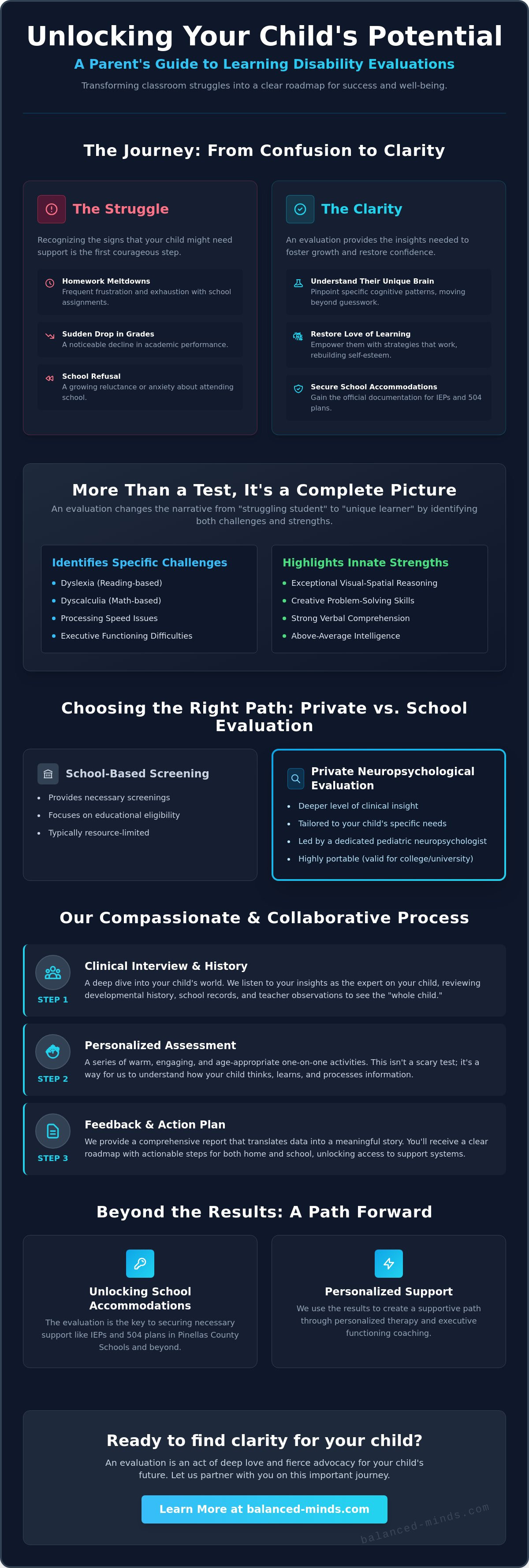
Gain a deeper understanding of how comprehensive evaluations identify specific cognitive patterns, such as dyslexia or processing speed issues, while highlighting your child’s innate strengths.
Learn why private learning disability testing st petersburg acts as a vital key for securing necessary classroom accommodations like IEPs and 504 plans within Pinellas County Schools.
Discover gentle, age-appropriate ways to explain the evaluation process to your child so they feel safe, curious, and empowered rather than intimidated.
Find out how we use your child’s unique results to create a supportive path forward through personalized therapy and executive functioning coaching.
Table of Contents
Understanding Learning Disability Testing in St. Petersburg
Choosing to explore learning disability testing in St. Petersburg is a courageous step. It's an act of deep love and fierce advocacy for your child's future. We view this process as a holistic neuropsychological evaluation of your child's cognitive landscape. It isn't just a series of tests; it's a way to map out how they think, learn, and experience the world. By understanding what is a learning disability in the context of your child's unique brain, we can identify why certain tasks feel like uphill battles while others come naturally. When you seek this support, you are giving your child the gift of being truly seen. You are moving from a place of confusion to a place of clarity, which is essential for their long term academic success and emotional resilience.
Our evaluations look for specific patterns that suggest dyslexia, dyscalculia, or challenges with processing speed. These aren't indicators of a lack of effort or potential. They are simply biological differences in how information is sorted and retrieved. A holistic evaluation doesn't just look at what a child can't do; it shines a light on their cognitive strengths. We might find that while a child struggles with phonemic awareness, their visual-spatial reasoning is exceptional. This balanced view changes the narrative from "struggling student" to "unique learner" and helps protect your child's self-esteem before they begin to internalize academic hurdles as personal failures.
Why Seek a Private Evaluation in Florida?
While Pinellas County Schools provide necessary screenings, a private evaluation offers a deeper level of clinical insight that school based testing may not cover. These comprehensive reports are also highly portable. They remain valid as your child transitions into Florida colleges and universities, ensuring they continue to receive the support they deserve as they grow into young adulthood. We work as your partners to ensure the results are translated into actionable steps for both home and school.
Identifying the Signs of a Struggle
You might see behaviors at home that seem unrelated to schoolwork at first, but they are often cries for help. Common red flags include frequent homework meltdowns, a sudden drop in grades, or a growing sense of school refusal. It's quite common for children with high intelligence to mask their struggles for years. They use their cleverness to compensate until the academic workload becomes too complex to manage without specific strategies. If you're wondering if these behaviors point toward a deeper issue, you can explore more about the Signs of a Learning Disability: When to Seek Testing in Tampa. Recognizing these signs early allows us to intervene before the weight of the struggle becomes overwhelming for your family.
The Process: What Happens During a Learning Disability Evaluation?
Understanding the "why" behind your child's struggle is a journey we take together. The clinical environment shouldn't feel sterile or scary; instead, we've designed our process to be a warm, engaging experience that honors your child's unique spirit. From the moment you walk through our doors for learning disability testing in St. Petersburg, you’re entering a partnership where your expertise as a parent is just as valued as our clinical data. We know that you are the primary expert on your child, and your insights are the foundation upon which we build our understanding. This collaborative approach ensures that the final results aren't just numbers on a page, but a meaningful reflection of your child's daily life and potential.
Step 1: The Clinical Interview and History
Our work begins with a deep dive into your child's world. We spend time discussing their developmental history, from early milestones to current classroom experiences. This is also the time when we review teacher observations and any previous school records or work samples you choose to share. We don't just look at academic markers; we look at the "whole child." This means we carefully consider how mood, anxiety, or social dynamics might be influencing their ability to learn. By gathering this rich context, we ensure that our evaluation captures the nuances of their personality and environment, rather than just their test performance. If you’re ready to begin this collaborative journey, exploring our comprehensive psychological evaluations can be your first step toward clarity.
Step 2: The Testing Administration
On testing day, we prioritize your child's comfort and confidence. The process is far more interactive than a typical school exam. We use a variety of tools, including hands-on puzzles, verbal storytelling tasks, and engaging computer-based activities. These tools allow us to assess several domains, including memory, attention, executive functioning, and specific academic skills. We follow official evaluation procedures to maintain the highest clinical standards while keeping the atmosphere light and encouraging. We provide frequent breaks for snacks, movement, and rest, ensuring that your child remains motivated and that we see their best effort throughout the day.
Step 3: The Results and Roadmap
The final phase is the feedback session, where we sit down together to translate the data into a clear, compassionate narrative. We explain what the scores mean in real-world terms, highlighting both the areas where your child needs support and the areas where they truly shine. Every family receives a comprehensive written report that includes specific, actionable recommendations for both home and school. These reports are meticulously designed to be shared with St. Pete and Tampa area schools, providing the evidence-based documentation needed to secure appropriate support. Our goal is to leave you with a concrete roadmap that empowers you to advocate for your child’s success with confidence and heart.
Navigating IEPs and 504 Plans in Pinellas County Schools
Securing the right support for your child within the Pinellas County school system often feels like learning a new language. Terms like IEP and 504 are frequently used, which can leave parents feeling overwhelmed and confused. Think of your private evaluation as the master key that unlocks these essential school doors. It provides the clinical evidence required by school boards to recognize and validate your child's specific needs. Under the Individuals with Disabilities Education Act (IDEA), Florida students have specific legal rights to a free and appropriate public education. When you arrive at a school meeting with a comprehensive report from your learning disability testing in St. Petersburg, you aren't just asking for help; you are presenting a professional roadmap that the school is legally and ethically encouraged to follow.
We encourage you to be an active, vocal participant in every meeting. Your role as a parent is to ensure the school sees the human being behind the data. When you request a meeting with your child's teacher or the school's 504 coordinator, start by sharing how the results of the evaluation align with what you see at home. This collaborative spirit helps bridge the gap between clinical findings and daily classroom reality. Understanding how learning disabilities are diagnosed through specialized assessments gives you the confidence to speak authoritatively about your child's learning profile during these vital discussions.
IEP vs. 504 Plan: Which Does Your Child Need?
It’s helpful to distinguish between these two common types of support. An Individualized Education Program (IEP) is designed for children who require specialized instruction or a modified curriculum. It’s a more intensive plan that often involves direct services from a special education teacher. In contrast, a 504 Plan focuses on accommodations that change the learning environment rather than the content of what is being taught. If your child is performing at grade level but struggles with the mechanics of learning, like reading speed or focus, a 504 Plan might be the more appropriate fit. Both paths are valid ways to support a child’s unique brain.
Common Accommodations for Learning Disabilities
Accommodations are tools, not crutches. They level the playing field so your child's true intelligence can shine without being hindered by their specific learning challenge. Common examples include:
Extended time on tests: This reduces the anxiety associated with processing speed challenges.
Preferred seating: Placing your child near the teacher helps minimize distractions.
Assistive technology: Using speech-to-text tools or audiobooks can bypass reading or writing hurdles.
Social-emotional goals: These ensure the school plan addresses the anxiety or confidence issues that often accompany learning struggles.
Implementing these strategies doesn't mean "lowering the bar" for your child. It means providing the ladder they need to reach it. When the right plan is in place, we often see a dramatic shift in a child's attitude toward school. The focus moves from what they can't do to how they can succeed. This shift is the ultimate goal of learning disability testing in St. Petersburg; it's about making the path to wellbeing feel attainable for your entire family.
Preparing Your Child for Testing Day: A Compassionate Approach
The night before learning disability testing in St. Petersburg can feel heavy for many parents. You want to provide your child with every possible advantage, yet your own nerves might be high as you anticipate the results. It’s vital to remember that children are often emotional sponges, picking up on the subtle cues of the adults around them. If they sense your worry, they may approach the day with a sense of dread rather than the curiosity it deserves. We encourage you to take a gentle breath and view this as a positive turning point for your family. Preparing for the day begins with simple, grounding logistics. Ensure your child gets a restful night's sleep and starts the morning with a protein-rich breakfast to keep their energy and focus steady. Pack plenty of their favorite snacks, as these small, familiar comforts provide necessary "brain breaks" between the different activities we'll explore together.
We believe that reducing the pressure on your child allows their true potential to shine through. When you talk about the upcoming appointment, emphasize that there are no "right" or "wrong" answers. Instead, explain that every task is designed to show us "how your brain works." This shift in perspective transforms the evaluation from a high-stakes exam into a collaborative exploration of their inner world. By managing your own anxiety and presenting the day with a sense of calm, you create a psychological safety net for your child, allowing them to engage fully without the fear of failure.
Reducing 'Test Anxiety' Before It Starts
If your child is already feeling the weight of academic struggles, the word "test" can trigger an immediate sense of shut-down or defense. To avoid this, try framing the experience as a "discovery day" where they get to work with a specialized "learning coach." Use accessible metaphors, like explaining that they will be doing "brain puzzles" and "thinking games" to help everyone understand the best ways to help them learn. This language de-stigmatizes the process and makes it feel like an adventure in self-discovery. Testing is a safe space for curiosity.
What to Bring to the St. Petersburg Office
We want our office to feel like a warm extension of your support system rather than a clinical space. To help your child feel settled and secure, we encourage them to bring a few comfort items from home. For younger children, a favorite stuffed animal can be a brave companion during the day. For adolescents or teens, a specific fidget tool or even a preferred playlist for their breaks can make a significant difference in their comfort level. It is also crucial to bring any daily essentials your child uses, such as glasses or hearing aids, to ensure the results are as accurate as possible. The Balanced Minds Psychology & Wellness environment is designed to be restorative and welcoming, providing a steady, guiding presence for both you and your child. If you’re ready to take this next step toward understanding your child’s needs, we invite you to explore our learning disability assessments and see how we can support your journey.
Beyond the Results: How Balanced Minds Psychology & Wellness Supports Your Child’s Growth
Receiving the final report from your child's learning disability testing in St. Petersburg is a significant milestone, yet we believe it's actually the beginning of a transformative journey. A diagnosis isn't a final destination or a static label; it's a dynamic starting point that allows us to build a customized support system. We don't simply hand you a document and send you on your way. Instead, the team at Balanced Minds Psychology & Wellness integrates these clinical insights into a living plan that evolves alongside your child's growth. We view our practice as your long term partner, committed to ensuring that the clarity gained during the evaluation translates into real world progress and a renewed sense of possibility for your family.
Our approach is grounded in the belief that every child possesses an innate capacity for growth when provided with the right environment and tools. By understanding the specific architecture of your child's brain, we can move away from trial and error and toward evidence based strategies. This partnership extends beyond the clinic walls as we help you advocate for your child's needs in the classroom and at home. We are here to walk this path with you, providing a steady, guiding presence as your child discovers their unique strengths and overcomes their challenges.
Therapeutic Support for Emotional Well-being
When a child has spent years struggling in the classroom, they often carry a heavy emotional burden. This frequently manifests as persistent anxiety, low self-esteem, or a deep seated belief that they are "not as smart" as their peers. We address these emotional layers through specialized therapeutic support that validates their experience and promotes self-kindness. Whether through individual sessions for your child or family therapy to support the whole household, Balanced Minds Psychology & Wellness helps reframe the narrative around their learning profile. If you feel your child needs a safe space to process these feelings, we can help you in Finding the Right Child Psychologist in St. Petersburg, FL.
Building Skills with Executive Function Coaching
Knowledge is the foundation, but skill-building is the structure that supports daily life. For many students, the primary hurdle isn't a lack of intelligence, but a challenge with organization, time management, or task initiation. We offer ADHD and Executive Functioning Coaching to help students develop the practical habits they need to thrive. This support is especially beneficial for teens transitioning to the increased demands of high school or college, where independence becomes vital. We teach them how to work with their brain rather than against it, fostering a sense of mastery that lasts a lifetime. If you’re ready to gain this level of insight and support, we invite you to Schedule a consultation for learning disability testing today and take the first step toward your child's bright future.
Embracing a Brighter Path for Your Child’s Learning
We believe that every child deserves to feel capable and confident in their ability to grow. By seeking learning disability testing in St. Petersburg, you’ve taken a vital step toward replacing academic frustration with a clear, science-backed roadmap. We've explored how a comprehensive evaluation identifies your child's unique cognitive profile and serves as the essential key for securing IEP or 504 support within Florida schools. This process isn't just about identifying challenges; it’s about celebrating the way your child’s brain works and providing the specific tools they need to thrive.
We invite you to visit our warm, child-centered office where your family’s emotional safety is our highest priority. If you're ready to move beyond the struggle and toward a future of mastery and joy, we are here to walk with you every step of the way. Schedule a Compassionate Evaluation for Your Child today. Your child’s potential is waiting to be uncovered, and we’re honored to help you find the way forward.
Frequently Asked Questions
How do I know if my child needs learning disability testing or just a tutor?
Testing identifies the underlying root cause of a struggle, while tutoring typically focuses on helping a child master specific classroom content. If your child is working hard with a tutor but isn't making meaningful progress, an evaluation can reveal if there's a processing or memory challenge that requires a different approach. Learning disability testing provides the "why" behind the struggle, allowing any future tutoring to be far more targeted and effective for your child's unique brain.
What is the difference between a school evaluation and a private neuropsychological evaluation?
School evaluations are primarily designed to determine if a child meets the legal criteria for special education services within the district. A private neuropsychological evaluation is much more comprehensive, offering a deep dive into your child's cognitive, emotional, and behavioral landscape. These private reports provide a portable, detailed roadmap that follows your child through different grade levels and even into college, ensuring they have consistent support as they grow.
Will my child be 'labeled' for life if they are diagnosed with a learning disability?
We believe a diagnosis is a tool for empowerment and understanding rather than a restrictive label. Most families find that identifying a specific challenge actually reduces shame, as it replaces hurtful self-labels like "lazy" or "not smart" with a clear clinical explanation. This understanding helps your child advocate for themselves and allows them to access the legal protections and classroom accommodations they deserve to reach their full potential.
How long does the learning disability testing st petersburg process take?
The process typically unfolds over three distinct phases to ensure we capture a complete and accurate picture of your child. This includes an initial intake meeting to discuss history, a full day of engaging testing activities, and a final feedback session to review the results. We generally provide your comprehensive written report within two to three weeks of the testing day, giving you the documentation you need to begin working with your child's school.
Does insurance cover learning disability testing in Florida?
Insurance coverage for psychological evaluations varies widely depending on your specific plan and the reason for the referral. Some Florida providers may cover portions of an evaluation if there's a clear medical necessity, while others may categorize educational testing as an out-of-pocket expense. We always encourage families to contact their insurance carrier directly to discuss their benefits and ask about potential reimbursement for out-of-network services.
Can testing help my child get extra time on the SAT or ACT?
Professional testing is the essential requirement for securing accommodations on high-stakes college entrance exams. Testing boards like the College Board and ACT require current, comprehensive documentation of a disability before they will grant modifications like extended time or a quiet testing environment. Having a high-quality, clinical report ensures that your child’s true abilities are measured, rather than their speed or anxiety levels.
What should I do if the school disagrees with the private testing results?
You have specific legal rights under the Individuals with Disabilities Education Act (IDEA) to advocate for your child’s needs. If a school is hesitant to accept private results, you can request a formal meeting to discuss how our clinical findings align with your child's daily classroom performance. We often help parents prepare for these discussions, ensuring that the evidence-based recommendations in our reports are used to create the most supportive environment possible.
How old should a child be for their first learning disability evaluation?
Children can be evaluated as early as age five or six, particularly if they are showing significant delays in early reading, writing, or math skills. Early identification is incredibly beneficial because it allows us to implement interventions during the years when the brain is most adaptable and responsive to new strategies. However, it is never too late to seek an evaluation; we frequently support older children and teens who are encountering new challenges as their academic workload increases.


