

ADHD Diagnosis: What Next for Parents? A Compassionate Guide to Your First Steps
Updated: 3 days ago
You might find yourself sitting in a quiet car, gripping a folder of evaluation results while a whirlwind of questions circles your mind. It's a heavy moment where relief that you finally have answers meets a sudden, sharp fear about what the future holds for your child. When you receive an adhd diagnosis what next for parents becomes the only question that matters, yet the path forward often feels hidden behind a thicket of clinical jargon and school paperwork. We understand that this transition can feel overwhelming. We want you to know that these feelings aren't a sign of failure, but a reflection of your deep love and commitment to your child's wellbeing.
We recognize the exhaustion that comes from trying to support a child whose brain simply works differently, especially when you're worried about labels or the confusing alphabet soup of school accommodations. This guide offers a gentle, clear roadmap to help you move from a state of uncertainty to a place of confident advocacy and calm at home. We'll walk through the essential steps for your first 30 days, including how to partner with teachers for IEPs and 504 plans and how to create supportive routines that honor your child's unique wiring.
Key Takeaways
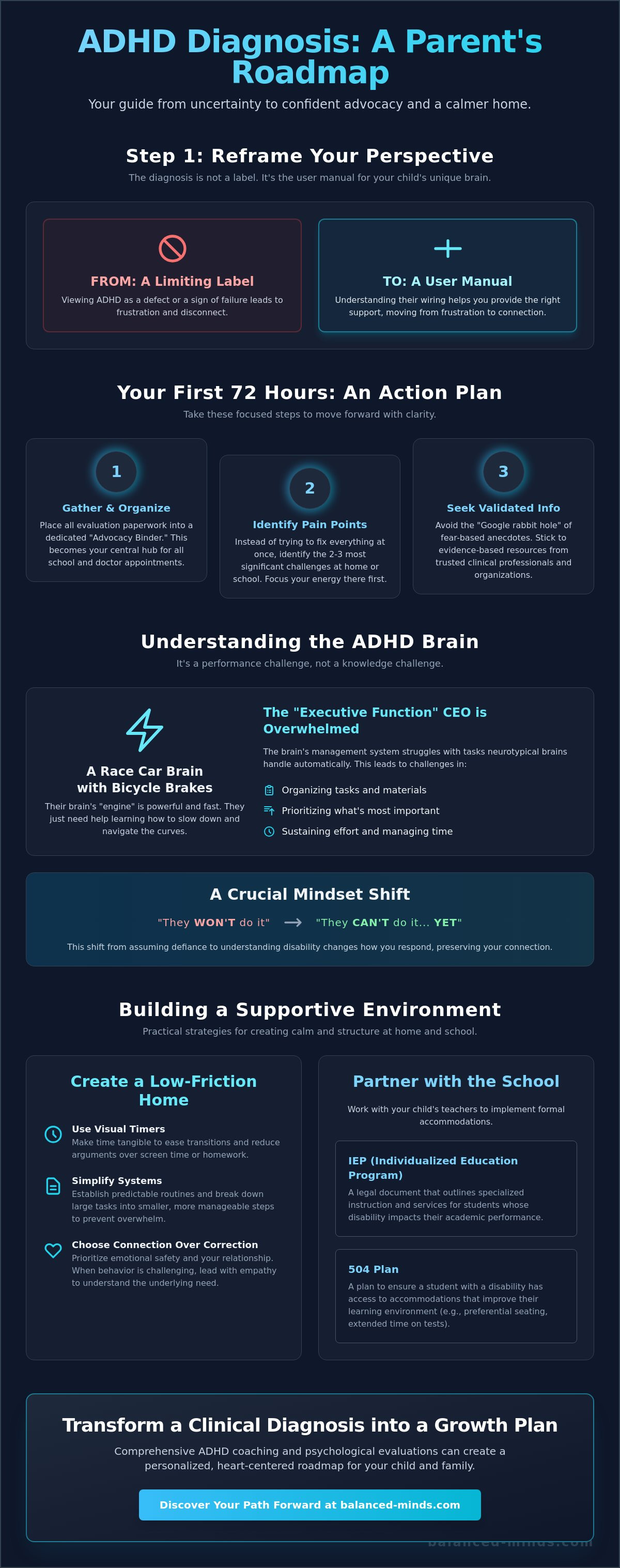
Reframe your child's diagnosis as a user manual for their unique brain rather than a limiting label, allowing you to move from frustration to deeper connection.
Discover the essential first steps for an adhd diagnosis what next for parents, including how to navigate the complex world of IEPs and 504 plans within Florida schools.
Understand the "Executive Function" umbrella and why traditional discipline often fails, so you can implement strategies that actually work for your child's CEO brain.
Create a low-friction home environment using visual timers and simplified systems to reduce daily power struggles and lower stress for the whole family.
Explore how comprehensive ADHD coaching and psychological evaluations can transform a clinical diagnosis into a personalized, heart-centered growth plan.
Table of Contents
The ADHD Diagnosis: Navigating the 'Now What?' Moment
Hearing those words from a clinical professional often triggers a complex symphony of emotions. You might feel a sudden wave of relief that your intuition was right, followed quickly by a sharp sense of grief for the path you originally envisioned for your child. This whirlwind is entirely normal and valid. When you receive an adhd diagnosis what next for parents often becomes a search for immediate fixes, yet the most vital first step is realizing that this diagnosis is a "user manual" for your child’s brain rather than a limiting label. It's a map that helps us understand why certain tasks feel like climbing a mountain while others spark brilliant creativity.
Before you dive into the logistics of school meetings or therapy schedules, we invite you to start with self-compassion. You cannot support your child’s regulation from a place of personal depletion. Embracing your own feelings allows you to show up as the steady, guiding presence your child needs. It's also helpful to reframe how you view their daily struggles. ADHD is primarily a performance challenge, not a knowledge challenge. Your child usually knows exactly what they are supposed to do; their brain simply lacks the consistent "wiring" to execute that knowledge in the moment. Shifting your perspective from "won't do" to "can't do yet" changes everything about how you respond to their behavior.
Processing the News as a Family
When you sit down to talk with your child, keep the conversation focused on their unique strengths and the way their mind processes the world. We recommend using accessible metaphors to de-stigmatize the experience. You might tell them that they have a brain that works like a race car with bicycle brakes. This helps them understand that their "engine" is powerful and fast, but they just need a little extra help learning how to slow down when they reach a curve. As you move forward, allow space for the "grief" of the life you imagined. Acknowledging that things might look different than you expected doesn't mean you love your child any less; it means you're making room for the beautiful, neurodiverse reality of who they actually are.
Your First 72 Hours: The Information Gathering Phase
The first few days are about containment and organization. Start by gathering every piece of evaluation paperwork and placing it into a dedicated "advocacy binder" that you can bring to future appointments. As you begin this journey, looking into a reliable summary for Understanding ADHD can provide the clinical grounding you need to feel more secure in your knowledge. Rather than trying to fix everything at once, identify the two or three most significant "pain points" occurring at home or school. Focus your energy there first. Avoid the temptation of the "Google rabbit hole" which often leads to fear-based anecdotes. Instead, stick to evidence-based resources and professional guidance that validates your experience while offering practical, heart-centered steps forward.
Understanding the ADHD Brain: Moving from Correction to Connection
We often think of the brain as a sophisticated computer, but for a child with ADHD, it is more like a bustling office where the CEO is frequently unavailable or overwhelmed. This set of mental skills, known as executive function, acts as the brain's management system. After an adhd diagnosis what next for parents often involves a steep learning curve to realize that their child isn't being "difficult" or "lazy" on purpose. Their management system simply struggles to organize, prioritize, and sustain effort in the same way neurotypical brains do. Telling a child with ADHD to "just try harder" is like asking someone who is near-sighted to "just see better." It doesn't provide the actual tools they need to succeed.
Our goal shifts from seeking simple compliance to fostering skill-building and mutual understanding. When we focus on connection over correction, we protect the parent-child bond during the most challenging transitions. While exploring various ADHD Treatment Options, you'll find that clinical support is most effective when it's paired with a home environment that prioritizes emotional safety. If you find yourself stuck in a cycle of evening power struggles, our team provides nurturing parenting support to help you bridge the gap between frustration and harmony.
The Reality of Executive Dysfunction
Executive dysfunction manifests in several ways that can feel like personal slights if we don't understand the underlying biology. Working memory is like a mental sticky note that has lost its adhesive. You might give a three-step instruction, but by the time your child reaches the hallway, the note has fallen off. It isn't a lack of respect; it's a lack of storage capacity in that moment. Similarly, emotional regulation acts like the brain's volume knob. For many children, a small disappointment is a "two" on the dial, but for a child with ADHD, that same event can instantly crank the volume to an "eleven." Impulse control is the final piece; it's the "brakes" of the brain. When these brakes are thin, your child may act before the thinking part of their brain can catch up.
Reframing Behavior as Communication
When we look beneath the surface of what looks like defiance, we often find a lagging skill. Behavior is a form of communication, and "explosive" moments are usually a signal that the environment's demands have exceeded the child's current ability to cope. We can reduce shame and increase cooperation by using "I notice" statements. Instead of saying, "Why is your room a mess again?", try saying, "I notice there are a lot of toys on the floor, and it looks like it might be hard to know where to start." This validates their experience and invites partnership. We also encourage the "five to one" rule: aim to catch your child being "good" five times for every one time you offer a correction. This positive reinforcement builds the emotional capital needed to handle the tougher moments of growth.
Building Your Child’s Support Team in the Tampa Bay Area
Creating a supportive circle around your child is the most effective way to ensure they feel seen and understood in every environment they inhabit. When you receive an adhd diagnosis what next for parents often involves moving from a single point of contact to a multidisciplinary team. This "wraparound" approach typically includes your child's pediatrician, a specialized therapist, and school professionals who work in harmony. By integrating clinical expertise with educational support, we create a safety net that catches your child before they fall into patterns of frustration. Research indicates that 77.9% of children with ADHD have at least one co-occurring condition, such as anxiety or a learning disability, which makes having a diverse team of experts even more vital for holistic care.
Your journey might begin with your pediatrician, but collaborating with a psychologist for ADHD diagnosis ensures that the nuances of your child's specific profile are fully captured. These professionals help translate complex test results into actionable steps for daily life. While you gather these initial insights, exploring Next Steps After an ADHD Diagnosis can provide a structured framework for your early conversations with medical providers. We view this phase as building a bridge between clinical understanding and the lived experience of your family.
Therapy vs. Coaching: Which Does Your Child Need?
We often find that families benefit from a hybrid approach to professional support. Individual therapy for children focuses on the internal landscape, helping them manage the "big feelings" and anxiety that frequently accompany neurodiversity. Conversely, ADHD coaching and executive functioning coaching provide the external scaffolding. These sessions focus on practical, "boots on the ground" skills like organization, breaking down school projects, and managing time. While therapy heals the heart and builds emotional regulation, coaching builds the habits that help a child navigate their day with less friction.
Advocating Within Florida Schools
In Florida, specifically within Pinellas and Hillsborough County schools, parents have clear pathways to secure classroom support. You'll primarily encounter two types of support: the 504 Plan and the Individualized Education Program (IEP). A 504 Plan focuses on removing barriers through accommodations, such as preferred seating or extended time on tests. An IEP is more intensive, providing specialized instruction tailored to your child's unique learning needs. We always recommend making any request for an evaluation or meeting in writing. This "paper trail" is a powerful tool that ensures school timelines are met and your child’s right to an education remains a priority. Maintaining a collaborative, non-adversarial relationship with teachers allows you to work as partners in your child's success.
Practical Strategies for Home: Creating a Calm and Structured Environment
The home should be a sanctuary where your child feels safe to be themselves, yet we know that for families living with neurodiversity, daily life can sometimes feel like a series of hurdles. When you've received an adhd diagnosis what next for parents involves transforming the physical and emotional environment into a space that scaffolds their child's executive functions. By making small, intentional changes to how we organize our space and our time, we can significantly reduce the "friction" that leads to meltdowns and power struggles. This process isn't about achieving a perfect, magazine-ready home; it's about creating a functional flow that honors how your child's brain actually processes information.
One of the most transformative shifts we can make is externalizing time. Most children with ADHD experience "time blindness," a physiological difficulty in sensing the passage of minutes or hours. Using visual timers, analog clocks with colored sections, or even sand timers allows time to become a visible, tangible resource. When a child can see the "red" disappearing on a timer, they can better prepare for the end of an activity. We also recommend designing a "low-friction" environment by simplifying storage. Clear bins without lids for toys, hooks instead of hangers for clothes, and a single "launching pad" near the door for school backpacks can prevent the morning scramble from becoming a source of chronic stress.
We must also recognize that "Brain Breaks" are neurological necessities, not just rewards for good behavior. These short bursts of movement or sensory regulation help reset the nervous system, making it easier for a child to return to a focused task. If you're feeling overwhelmed by the daily demands of managing these transitions, our team offers specialized parenting support to help you implement these routines with more ease and less exhaustion.
The Power of Visual Scaffolding
Picture-based checklists provide a permanent visual anchor that verbal instructions simply cannot match. When we give a verbal command, the information often "evaporates" before the child can act on it. A checklist on the bathroom mirror or the fridge stays put, acting as an external memory. We also encourage creating a "Calm Down Corner" filled with sensory tools like weighted blankets or fidgets. Unlike a "Time Out" chair, which can feel like a shameful exile, a regulation space is a sanctuary where a child learns to soothe their own big feelings. Using "When/Then" phrasing, such as "When your shoes are on, then we can head to the park," provides a clear, logical sequence that reduces the need for constant nagging.
Consistency Without Rigidity
Predictable routines provide a sense of safety, but we must leave room for "bad brain days" when focus is naturally lower. Consistency doesn't mean being a drill sergeant; it means providing a reliable rhythm while allowing for grace when things don't go as planned. Prioritizing sleep hygiene and consistent nutrition can stabilize the foundations of focus and mood. We've found that involving children in creating the house rules significantly increases their "buy-in." When they help decide where the "launching pad" should be or what goes into their "Calm Down Corner," they move from being passive recipients of rules to active partners in their own growth and wellbeing.
How Balanced Minds Psychology & Wellness Supports St. Petersburg and Tampa Families
At Balanced Minds Psychology & Wellness, we recognize that after an adhd diagnosis what next for parents involves finding a team that sees their child's potential, not just their symptoms. We're here to help. Our approach bridges the gap between clinical data and the heart of your home life. We believe that a diagnosis is a beginning, not a destination. Our services are designed to provide the restorative support your family needs to move from a state of overwhelm to one of empowered growth. Whether you're seeking to understand your child's unique wiring through comprehensive ADHD evaluations or looking for ways to heal the stress that often gathers in a neurodiverse household, we offer a steady, guiding presence.
Our work is deeply grounded in the belief that every child possesses the capacity for success when given the right scaffolding. We offer ADHD coaching and executive functioning coaching to empower students with tangible tools for independence. These sessions don't just focus on grades; they focus on building the self-awareness and confidence your child needs to navigate the world. For the family as a whole, our individual and family therapy sessions provide a safe, non-judgmental space to process the complexities of this journey. If you've been searching for parenting near me, you'll find that our support extends beyond the child to include the caregivers who hold it all together.
A Partnership for Your Child’s Growth
We don't just look at a checklist of behaviors; we look at the emotional, social, and academic threads that make up your child's life. To make support as attainable as possible, we offer both in-person sessions at our St. Petersburg and Tampa offices and secure telehealth options for families across Florida. This flexibility ensures that your path to wellbeing fits into the actual rhythm of your life. We view ourselves as your partners in this collective journeying, working alongside you to demystify professional support and make progress feel within reach.
Taking the Next Step with Confidence
When you're ready to move forward, scheduling an initial consultation at our St. Petersburg office is a simple, low-pressure process. During your first session with a child psychologist st petersburg fl, you can expect a gentle, therapeutic conversation focused on your family's specific needs and goals. We'll listen to your story, validate your experiences, and begin drafting a personalized roadmap. As you consider an adhd diagnosis what next for parents, remember that you don't have to carry the weight of advocacy alone. We want to leave you with a final word of encouragement: you've already taken the hardest step by seeking answers. Your dedication is the most powerful tool your child has, and you're exactly the parent they need for this journey.
Embracing a New Path Forward for Your Family
Moving from the initial shock of discovery toward a place of calm, sustainable advocacy is a journey that requires both patience and the right specialized tools. We have explored how shifting your perspective from behavior correction to emotional connection can transform your relationship with your child. By building a dedicated support team in the Tampa Bay area and externalizing time through visual routines, you're creating an environment where your child's unique brain can truly flourish. When navigating an adhd diagnosis what next for parents involves recognizing that you don't have to carry the heavy weight of advocacy in isolation.
Balanced Minds Psychology & Wellness has been serving the Tampa Bay community since 2021, providing a sanctuary for families seeking evidence-based ADHD coaching and therapy. We invite you to Schedule a consultation with our ADHD specialists in St. Pete today to begin this restorative next chapter. You have already shown incredible strength by seeking the best for your child, and we're here to help you turn these first steps into a lifetime of success.
Common Questions About Navigating Your Child’s ADHD
What is the very first thing I should do after my child gets an ADHD diagnosis?
The most important first step is to pause and prioritize self-compassion for yourself and your child. When you receive an adhd diagnosis what next for parents usually starts with emotional processing before jumping into logistics. We recommend taking a few days to sit with the news and organize your evaluation paperwork into a single binder so you feel prepared for future conversations with teachers and specialists.
Should I tell my child’s school about the ADHD diagnosis right away?
Yes, we generally suggest sharing this information with the school as soon as you feel ready to advocate for your child’s needs. By providing the diagnosis in writing, you trigger a timeline for the school to evaluate your child for support services. This transparency helps teachers understand that your child’s challenges are neurological rather than a lack of effort, which often leads to more empathy in the classroom.
Is medication the only treatment for ADHD in children?
No, medication is only one of several evidence-based tools available to support your child’s growth. Many families find success through a combination of behavioral therapy, ADHD coaching, and environmental changes at home. In 2022, data showed that 44.4% of children with ADHD received behavior therapy, highlighting that non-medical interventions are a mainstream and vital part of a comprehensive support plan.
How do I explain ADHD to my child without making them feel bad?
We encourage using strengths-based metaphors that focus on how their brain is uniquely "wired" rather than "broken." You can explain that they have a brain with a very powerful engine that just needs a little extra help with the brakes. By focusing on their creativity and fast-thinking skills, you help them understand that the adhd diagnosis what next for parents and children alike is about learning how to drive their amazing brain effectively.
What is the difference between an IEP and a 504 plan in Florida?
A 504 plan provides simple accommodations, such as extra time on tests, to ensure your child has equal access to learning. An Individualized Education Program (IEP) is more intensive and provides specialized instruction for students who need direct support to meet educational goals. In Pinellas and Hillsborough counties, the choice between the two depends on whether your child needs changes to how they learn or what they are learning.
Can ADHD coaching help my child if they are already in therapy?
Yes, coaching and therapy are complementary services that address different aspects of your child's life. Therapy often focuses on the "inside," helping with emotional regulation and the anxiety that can stem from feeling misunderstood. ADHD coaching focuses on the "outside," providing practical skills for managing homework, organizing their room, and keeping track of their belongings. Using both can provide a truly holistic support system.
How long does it take to see improvements after starting ADHD support?
You might notice small shifts in your child’s frustration levels within the first few weeks of consistent support and routine changes. However, building lasting executive function skills is a gradual process that often takes several months of practice. We view this as a marathon of steady growth rather than a sprint, where the goal is to build long-term confidence and independence through small, daily victories.
Are there local support groups for parents of children with ADHD in St. Pete?
Yes, the Tampa Bay area has several resources, including local chapters of organizations like CHADD and parent workshops hosted by community clinics. Connecting with other parents who truly understand your daily experience can significantly lower your stress levels and reduce feelings of isolation. We often suggest checking with your school counselor or local library for peer-led groups that meet in St. Pete or Tampa.


