

Stay in School: Family Therapy for School Avoidance in St. Petersburg, FL
Updated: 3 days ago
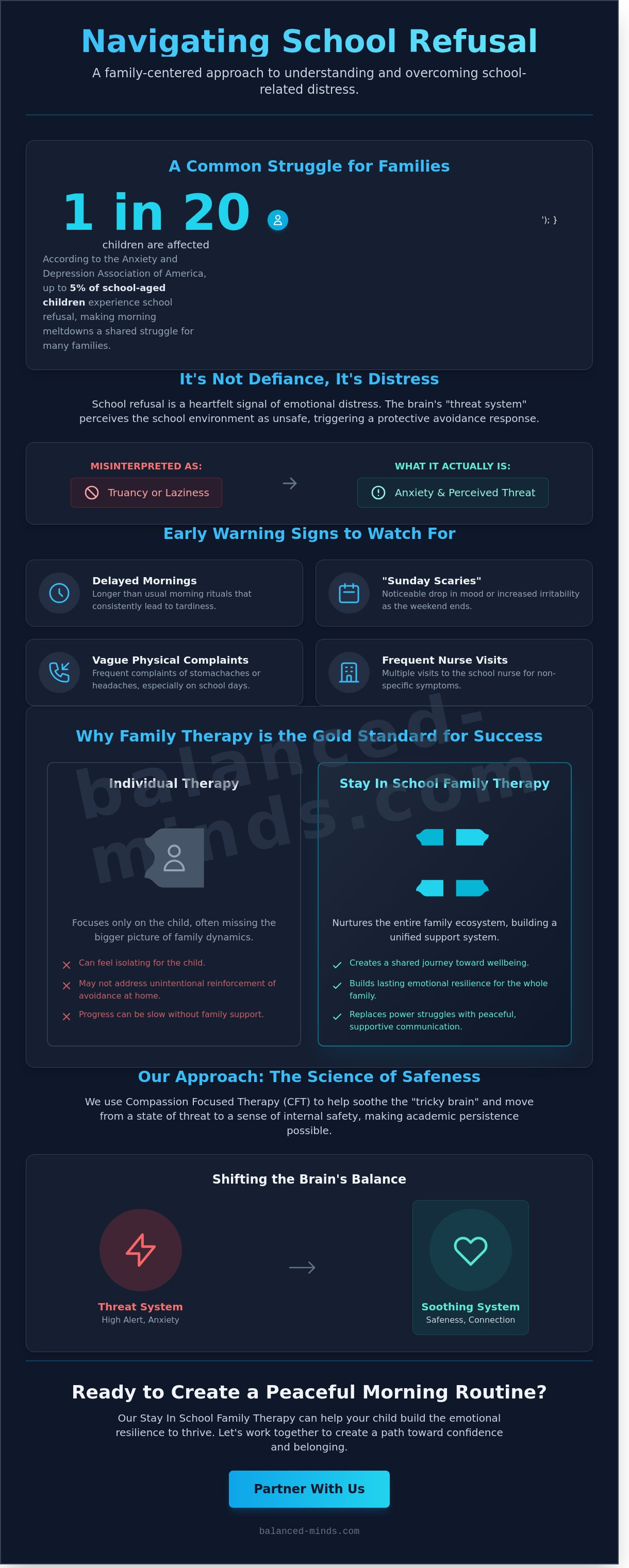
Imagine it's 7:15 AM on a Tuesday in St. Petersburg, and instead of the smell of breakfast, the house is filled with the heavy weight of a child's tears and a parent's growing desperation. According to the Anxiety and Depression Association of America, school refusal affects up to 5% of all school-aged children, making these morning meltdowns a shared struggle for many families in our community. We know you want nothing more than for your child to feel safe and capable, yet the fear of them falling behind or the sting of being judged by other parents can feel overwhelming. Our stay in school family therapy approach is designed to help you navigate these complexities with compassion rather than shame.
We believe that school refusal is often the result of a tricky brain trying to protect itself from perceived threats. By choosing a family-centered path, you'll discover how to help your child overcome avoidance and build the emotional resilience needed to thrive academically. This article explores how we can work together to replace power struggles with a peaceful morning routine and clear, supportive communication. You'll learn exactly how to create a sense of safeness that allows your child to return to the classroom with confidence and a renewed sense of belonging.
Key Takeaways
Learn to recognize school refusal as a heartfelt signal of emotional distress rather than simple truancy, shifting the focus toward a nurturing and supportive environment.
Discover how we use Compassion Focused Therapy to soothe the "tricky brain," helping your child transition from a state of threat to a sense of internal safeness.
Explore why stay in school family therapy provides a more sustainable path to success than individual sessions by involving the whole family in building lasting emotional resilience.
Gain actionable strategies for collaborating with Pinellas and Hillsborough County administrators to secure the specialized school accommodations your child needs to feel secure.
Understand how a partnership with pediatric experts can help your family move beyond the cycle of avoidance and toward a future where your child can truly flourish.
Table of Contents Understanding School Refusal and the Role of Stay in School Family Therapy The Science of Safeness: How Compassion Focused Therapy Supports School Attendance Comparing Individual vs. Family Therapy for Keeping Kids in School Actionable Strategies for Tampa Bay Parents: Navigating the School System Healing Together: Why Balanced Minds is Your Partner in St. Pete
Understanding School Refusal and the Role of Stay in School Family Therapy
Morning routines in St. Petersburg shouldn't feel like a battleground, yet for many households, the sound of an alarm clock triggers a wave of profound distress. When a child resists going to campus, it's easy to misinterpret the behavior as simple defiance or laziness. We view these moments through a different lens. Understanding School Refusal requires us to see it as a functional emotional distress signal rather than a disciplinary issue. It is often the "tricky brain" attempting to protect the child from a perceived threat, even when that threat is an environment intended for growth.
Our approach to stay in school family therapy shifts the focus away from "fixing" the child and toward nurturing the entire family ecosystem. We recognize that school is the first major developmental hurdle where the family unit meets the outside world. If a child feels overwhelmed, the ripples are felt by everyone. In St. Pete schools, we often see "soft signs" of avoidance before a full crisis hits. These include:
Frequent complaints of stomachaches or headaches on Sunday nights.
Longer than usual morning rituals that lead to tardiness.
A noticeable drop in mood or increased irritability as the weekend ends.
Multiple visits to the school nurse for vague physical symptoms.
By identifying these patterns early, we can intervene before academic disengagement becomes a permanent fixture in a student's life.
Refusal vs. Truancy: What St. Pete Parents Need to Know
It's vital to distinguish between refusal and truancy because the underlying motivations require different responses. Truancy is typically driven by a desire for social reward or external stimulation, often involving hidden absences. In contrast, school refusal is rooted in severe anxiety or fear. The child often stays home with the parent's knowledge, struggling with a genuine inability to cope with the school environment. Our stay in school family therapy aims to provide a sense of safeness, helping children move from a state of survival back into a state where they can flourish academically and socially.
Why Family Therapy is the Gold Standard for School Success
The American Association for Marriage and Family Therapy (AAMFT) emphasizes that treating a child in isolation often misses the bigger picture. Family dynamics can unintentionally reinforce avoidance behaviors; for example, a parent's own anxiety about their child's wellbeing might inadvertently signal that the school is indeed unsafe. We work collaboratively with parents and St. Petersburg educators to create a soothing, consistent response to school-related stress. This partnership ensures that the path to wellbeing is a shared journey, demystifying the therapeutic process and making long-term stability feel attainable for every family member involved.
The Science of Safeness: How Compassion Focused Therapy Supports School Attendance
At Balanced Minds, we utilize Compassion Focused Therapy (CFT) to help families navigate the emotional hurdles of education. This approach acknowledges that we all live with a "tricky brain" that evolved for survival rather than for the complexities of modern academic life. When a child refuses to attend classes, it's rarely a matter of simple defiance. Instead, it's often a sign that their internal alarm system is stuck in a loop of high alert. Our stay in school family therapy helps families understand that the brain's primary job is to keep us safe, even when those safety measures interfere with long-term goals like graduation.
By focusing on the "soothing system," we help students move out of a state of constant mobilization. This biological system, when activated, releases oxytocin and endorphins, which are essential for creative thinking and social connection. Without a functioning soothing system, the pressure of a classroom becomes physically unbearable. We work with parents to cultivate this sense of internal safeness, providing a foundation that makes academic persistence possible.
Understanding the Threat System in the Classroom
For many students in St. Petersburg, the school day is a gauntlet of social anxiety, performance pressure, and sensory overwhelm. These factors aren't just inconveniences; they're perceived by the brain as genuine threats to survival. The threat system is an ancient biological survival mechanism that prioritizes immediate safety by overriding logic and long-term planning. When this system is overactive, a child cannot simply "think" their way into a calmer state. Research shows that Understanding School Refusal requires looking at the physiological distress a child feels when they approach the school gates. Through stay in school family therapy, we create a "safe harbor" where children can process these threats without the added weight of shame or expectation.
Building Resilience Through Shared Family Compassion
Shifting the family dynamic from one of punishment to one of collaborative problem-solving is the first step toward recovery. When parents react to school avoidance with high levels of stress or anger, it inadvertently reinforces the child's threat system. We teach families practical exercises to lower this collective tension, such as:
Rhythmic Breathing: Practicing slow, diaphragmatic breathing together to signal safety to the nervous system.
Compassionate Letter Writing: Helping children express their school-related fears to parents in a non-confrontational way.
Mindful Grounding: Using the five senses to stay present during the morning routine, reducing anticipatory anxiety.
A compassionate home environment serves as a powerful buffer against the stressors of the outside world. When a child feels truly understood, their willingness to face challenges increases. Our nurturing therapeutic programs help parents regulate their own emotional responses, ensuring they can be the steady, guiding presence their student needs to return to the classroom with confidence.
Comparing Individual vs. Family Therapy for Keeping Kids in School
Individual therapy provides a beautiful, safe space for a child to explore their inner world, but it often operates in a vacuum. When a child leaves a session and returns to the same environment where their anxiety first took root, they may find it difficult to apply new skills. We see this frequently in St. Petersburg; a child might feel empowered in the therapist's office but feels overwhelmed the moment the morning school bell rings. By shifting our focus to stay in school family therapy, we address the entire ecosystem rather than just one part of it. This systemic approach recognizes that the child's struggle is often a signal of distress within the family's shared emotional field.
This collaborative model helps dismantle the "identified patient" stigma. When a child is labeled as the only one with a problem, it often increases their sense of shame and isolation, which further fuels the desire to withdraw from school. By involving everyone, we send a powerful message of shared humanity: "We are in this together." Our family therapy associates work to bridge the gap between home life and the classroom, creating a unified front that supports the child's return to learning. Data from the Journal of Family Psychology indicates that family-based interventions result in a 25% higher rate of long-term school attendance compared to individual cognitive-behavioral therapy alone. This synergy occurs because the family learns to recognize and soften the emotional triggers that lead to school refusal together.
When Individual Therapy is Not Enough
Traditional individual sessions can sometimes fail to resolve school refusal because they don't account for the environmental stressors that trigger a child's "tricky brain." While a child may learn breathing techniques, those tools can feel insufficient when faced with a complex social dynamic at school or a high-stress morning routine at home. We encourage parents to view family therapy near me as a holistic investment in the family's collective peace. It's about nurturing a landscape where the child can flourish, rather than just treating the symptoms of their distress in isolation. When we adjust the system, the child's need to avoid school often diminishes naturally.
The Family Therapy Advantage
In family sessions, we work to transform the morning "battleground" into a space of safeness and connection. Having a child psychologist guide the entire family allows for real-time adjustments to communication patterns that might be unintentionally reinforcing school avoidance. We empower parents to act as "co-therapists" at home, providing them with the soothing strategies needed to de-escalate anxiety before it peaks. This collaborative effort ensures that stay in school family therapy creates lasting change, as the child feels supported by a system that has grown and adapted alongside them. This shared growth fosters resilience that lasts far beyond the school years.
Actionable Strategies for Tampa Bay Parents: Navigating the School System
We understand the heavy weight you carry when your child's morning starts with tears or a refusal to leave the house. It's common to feel a sense of guilt or worry that you're failing as a parent, especially when school administrators in Pinellas or Hillsborough County send home formal attendance letters. We want to shift that perspective. These challenges aren't a sign of failure; they're a signal that your child's nervous system is overwhelmed. By focusing on stay in school family therapy, we can move away from shame and toward a collaborative partnership with the school system.
Collaborating with St. Petersburg and Tampa Schools
Approaching teachers and administrators requires a shift from defensiveness to a "team-based" mindset. When we meet with staff at schools like St. Petersburg High or Shorecrest Preparatory, we lead with the reality of the child's anxiety rather than focusing solely on the missed assignments. The school counselor serves as an essential ally within the stay in school family therapy framework by facilitating communication between your family and the classroom teachers. To reduce student confusion, we help you create a consistent message. If the child hears the same compassionate, firm, and supportive language at home and in the principal's office, their internal sense of safeness begins to flourish.
Legal and Administrative Support in Florida
Florida Statute 1003.24 defines the legal responsibility of parents regarding school attendance, but it also provides pathways for medical necessity. Documented anxiety-related school refusal is a legitimate health concern. Therapy provides the clinical documentation needed to ensure absences are marked as "excused" rather than "truant," which protects your family and lowers the collective stress level. We often help parents understand the vital differences between administrative supports:
504 Plan: Provides specific accommodations, such as a "cool-down" pass or extra time on tests, for students with documented anxiety.
IEP (Individualized Education Program): Offers more intensive specialized instruction and related services for students whose anxiety significantly impacts their ability to learn.
Re-entry Plan: A structured, gradual schedule that might include half-days or starting with just one favorite class to rebuild the student's confidence.
When meetings feel daunting, involving family therapy associates can provide a steadying presence. Our clinicians can join these discussions to explain the psychological needs of the student, ensuring that the academic plan nurtures their mental health rather than just checking a box for attendance. In the 2023-2024 school year alone, we've seen how a well-timed clinical intervention can prevent a child from falling through the cracks of the Pinellas County Schools system.
If you're feeling overwhelmed by school board meetings or attendance hearings, reach out to our team to explore how we can advocate for your child’s needs and restore peace to your mornings.
Healing Together: Why Balanced Minds is Your Partner in St. Pete
Moving from the morning's tears and the heavy weight of school refusal toward a place of confidence is a journey no family should walk alone. We understand that school avoidance isn't a sign of a "bad student" or a parenting failure. Instead, it's often a signal from a child's tricky brain that they need more tools for safeness and emotional regulation. Through stay in school family therapy, we help parents and children bridge the gap between fear and the classroom, turning a cycle of avoidance into a path toward resilience. Our goal is to ensure your child doesn't just attend school, but truly thrives there.
We've designed our practice to be a steady, guiding presence for the St. Petersburg community. With convenient offices in both St. Pete and Tampa, we provide a local anchor for families who are tired of feeling adrift in the school system. School avoidance is a significant hurdle, but it's never a dead end for your child's future.
Our Compassionate Approach to Family Wellness
We believe therapy should feel like a partnership where every voice is heard. We blend our clinical expertise with a warm, human accessibility that honors your family's unique story. This balance helps to demystify the therapeutic process, making the path to wellbeing feel attainable rather than abstract. For those navigating the busy schedules of the Tampa Bay area, we offer flexible telehealth options to ensure support is always within reach, regardless of traffic or timing. We also invite you to explore our parenting near me resources, which are designed to help you flourish as a caregiver while we work together to soothe your child's anxieties. Our stay in school family therapy sessions focus on creating a restorative environment where everyone can heal.
Take the First Step Toward a Brighter School Year
Taking that first step toward professional support can feel daunting, but we've made the process as gentle as possible. When you schedule an initial consultation, you're opening the door to a team that values your child's growth as much as you do. In your first session, you won't find cold clinical judgments or high-pressure tactics. Instead, you'll experience a soothing, non-judgmental space where we listen to your specific concerns and begin building a roadmap for success. We'll discuss your child's history, identify the roots of their school refusal, and start the process of reclaiming their education. Your family possesses the capacity for growth, and we're here to nurture it. Connect with our St. Petersburg team today to begin this transformative work together.
Healing the Heart of School Refusal Together
Navigating school avoidance is a journey that requires more than just a firm hand; it requires a compassionate bridge between home and the classroom. We've explored how understanding the tricky brain and utilizing Compassion Focused Therapy can transform fear into a sense of internal safeness. Evidence shows that involving the entire household through stay in school family therapy significantly improves attendance outcomes compared to individual sessions alone. By focusing on the science of soothing the nervous system, your child can begin to flourish in their educational environment once again.
We specialize in evidence-based care across our St. Petersburg and Tampa locations, and we offer flexible telehealth options to meet your family's needs. We're here to help you move past the shame of school refusal and toward a future of shared resilience. Start your family’s journey to school success; Book a consultation today. You don't have to navigate this path alone; we're ready to walk beside you every step of the way.
Frequently Asked Questions
What is the "Stay in School" initiative in family therapy?
The "Stay in School" initiative is a collaborative therapeutic approach designed to bridge the gap between a child's emotional distress and their educational environment. We focus on creating a sense of safeness within the family unit so that the "tricky brain" doesn't view the classroom as a threat. Our stay in school family therapy sessions in St. Petersburg integrate mindfulness and compassion to help children flourish while addressing the systemic roots of school avoidance.
How long does it take for family therapy to help with school refusal?
Most families begin to see a measurable reduction in school refusal behaviors within 8 to 12 weekly sessions. While every child's journey is unique, research published in the Journal of Family Psychology indicates that structured interventions show positive outcomes for 70 percent of students within this timeframe. We work steadily to nurture resilience, ensuring that the return to the classroom feels like a sustainable step rather than a forced transition for the student.
Can family therapy help if my child has ADHD and hates school?
Yes, family therapy provides essential tools for children with ADHD who feel overwhelmed by the sensory and executive functioning demands of school. Approximately 30 percent of students with ADHD experience co-occurring anxiety that contributes to school avoidance. We use compassionate strategies to help your child regulate their nervous system and develop a soothing internal dialogue. This partnership helps parents understand how to support their child's unique brain while fostering a genuine love for learning.
Is school avoidance considered a mental health emergency?
School avoidance is typically categorized as a clinical crisis rather than an acute medical emergency, though it requires immediate professional attention. According to the American Academy of Pediatrics, chronic absenteeism can lead to a 25 percent higher risk of long-term social isolation if left untreated. If your child expresses thoughts of self-harm or experiences total catatonia, please contact the Pinellas County 211 crisis line or go to the nearest emergency room for immediate safeness.
What should I do if my child has a panic attack before school in the morning?
When a panic attack occurs, your first priority is to act as a soothing anchor for your child's dysregulated nervous system. Use rhythmic, deep breathing and remind them that it's just their "tricky brain" trying to protect them from a perceived danger. Avoid high-pressure demands during the peak of the attack. Instead, focus on grounding exercises for 15 minutes to restore a sense of calm before discussing the next steps for the day.
Does Florida law require therapy for chronic school absences?
Florida Statute 1003.26 does not explicitly mandate therapy, but it does require school districts to implement interventions after 5 unexcused absences within a 30-day period. These interventions often include a child study team meeting where stay in school family therapy may be recommended as a formal part of an attendance improvement plan. Proactively engaging in support can prevent the 15-day threshold that triggers a referral to the State Attorney’s office for truancy.
How much does family therapy cost in St. Petersburg, FL?
The cost of family therapy in St. Petersburg varies based on the provider's experience and the length of the session. According to 2023 data from FAIR Health Consumer, the average out-of-network rate for a 45-minute family therapy session in the 33701 zip code ranges from 150 to 250 dollars. Please don't hesitate to contact your insurance provider to discuss potential reimbursement for behavioral health services to make this vital support more accessible for your family.


