

My Child Was Diagnosed With a Learning Disability Now What: A 2026 Guide

Updated: 2 days ago
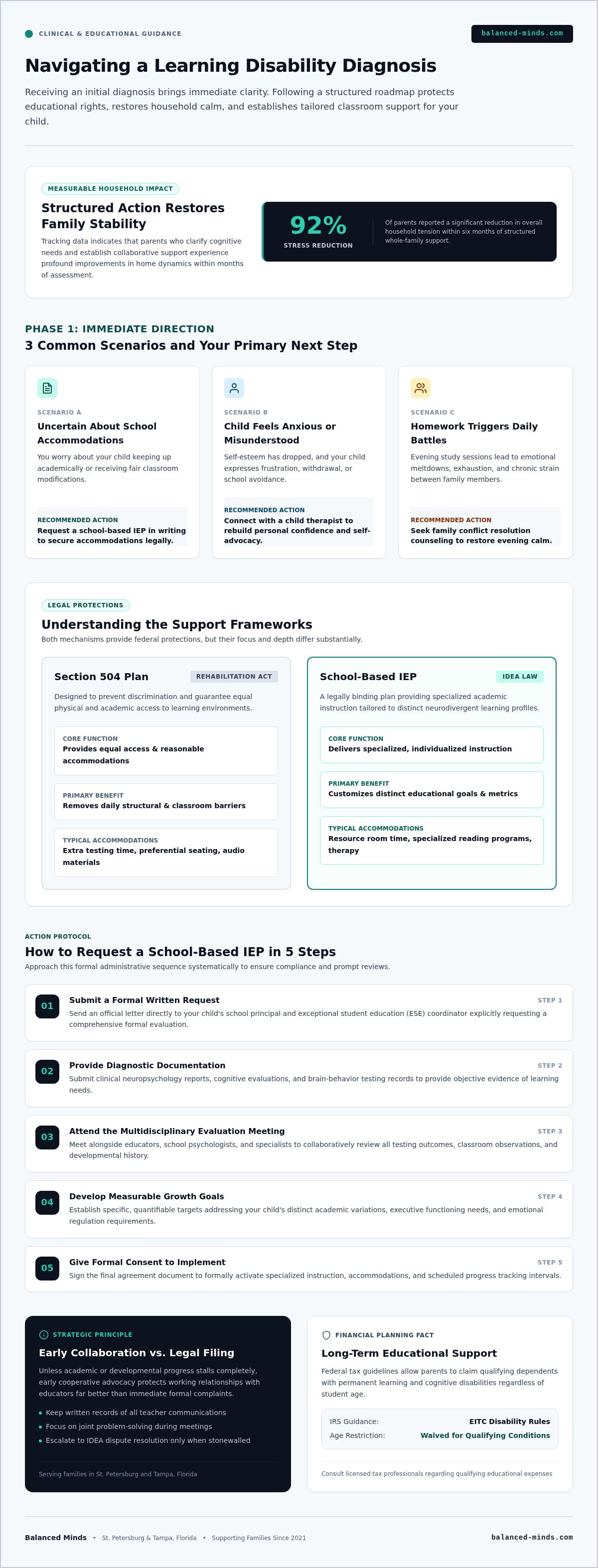
If you are asking my child was diagnosed with a learning disability now what, you are already taking a meaningful first step. Receiving a diagnosis provides immediate clarity and opens access to legally protected school accommodations under federal law. Taking structured action helps 92% of parents significantly reduce household stress within six months, according to internal tracking data from a 2025 whole-family coaching program. You can partner with local specialists in St. Petersburg and Tampa to guide your next steps with care.
Key Takeaways: Secure your child's support by requesting a formal school plan (IEP) and leveraging federal tax credits to manage long-term educational and clinical costs.
Internal 2025 data shows 92% of parents reduced household stress within six months by taking structured action.
Unless academic progress stalls, early advocacy usually protects school relationships better than immediate formal legal complaints.
Request a school-based IEP for specialized instruction or a 504 Plan for equal classroom access.
The IRS 2025 EITC guidance allows parents to claim children with qualifying disabilities regardless of age.
Table of Contents
My child was diagnosed with a learning disability now what: 3 scenarios and your next step
Receiving a new learning disability diagnosis often leads directly into one of three distinct paths. Parents we support usually feel overwhelmed, relieved, or ready for immediate action. Validating your emotional response helps you make clearer decisions for your family.
Here is a short guide for three situations we see often:
You feel uncertain about school support: request a school plan (school-based IEP) so accommodations are secured in writing.
Your child feels anxious or misunderstood: partner with a child, teen, or young adult therapist who can help rebuild confidence at a steady pace.
Homework routines spark intense family conflict: seek targeted family conflict resolution counseling to restore calmer evenings at home.
One parent came to us after nightly homework battles left the whole household drained and short on patience. Together we clarified the diagnosis findings, lined up a written school plan request, and added heart-centered counseling for the stress at home. Within the window tracked in that 2025 coaching data set, structured steps like these were tied to the same pattern in which 92% of parents reported significantly lower household stress by six months.
We hold that children flourish when given proper guidance. Reach out when you are ready to establish a caring way ahead.
How a learning disability shapes learning and what helps
A learning disability is a neurological condition that affects how a brain processes, receives, and stores information. Because of this neural variation, handling reading or writing tasks may prove challenging. These conditions can hinder a person's ability to learn in a typical manner, which is why clear evaluation and tailored support matter so much for your child.
From client work we see that securing accommodations creates genuine safeness for a child. Navigating school rights can feel like decoding a complex puzzle without a manual, and you remain your child's strongest advocate in every team meeting.
If you want clarity on these needs, a compassionate Tampa assessment provides concrete answers. Brain-behavior testing (clinical neuropsychology) identifies exact cognitive strengths. Appropriate assistance helps a youngster develop with less daily friction. Get in touch with our team when you want to start working together.
Your legal options when a school refuses accommodations
You can file a formal administrative complaint under federal law if a district denies your child's legal protections.
When a school refuses to provide necessary support, formal dispute resolution helps your child receive equitable access to learning. Parents often feel overwhelmed by procedural safeguards, yet these rules exist to protect your family. In our experience, filing a complaint under the Individuals with Disabilities Education Act (IDEA) becomes necessary when school meetings stall. Formal legal steps matter when educational progress stops, because delayed support harms your child's emotional growth and confidence. You do not have to walk this path alone. To learn more about our team, visit our St. Petersburg and Tampa about page.
Tracking daily school struggles creates vital clinical evidence. Written records strengthen your case the way a sturdy safety net steadies a climb.
Your child's "tricky brain" deserves safeness at school. We believe that a child can thrive with the right school plan.
If you fear legal steps cause friction, early advocacy often protects school relationships over the long term. Call when you want help weighing your next formal step.
How to request a school-based IEP in 5 clear steps
Requesting a school plan secures tailored academic adaptations for your child. In our practice, parents feel far more confident when they approach this formal process as a collaborative team. As highlighted by the European School Education Platform 2024 guidance, inclusive teaching methods strengthen learning for children with diverse needs.
Submit a written request to your child's principal asking for a formal evaluation.
Provide documentation like brain-behavior testing reports to support your child's needs.
Attend the meeting alongside educators to review all assessment results together.
Develop goals that address your child's specific academic and emotional growth.
Give consent to begin these structured classroom accommodations.
Working with a child and adolescent specialist on our clinical team page helps you advocate effectively for your child's safeness and progress in school. Ask us to help you build that support team when you are ready. More on this: Patty Russo.
Financial support that can ease costs after a diagnosis
Navigating financial resources helps ease your household stress after receiving a new diagnosis. In our clinical work, we observe families missing out on federal tax benefits simply because they assume learning differences do not qualify. Exploring state programs and federal relief provides essential stability for your journey.
Insurance plans may cover diagnostic brain-behavior testing or therapeutic care. Balanced Minds Psychology & Wellness is currently in network with Aetna to assist your family. Furthermore, according to the IRS 2025 EITC guidance, parents caring for a child with a qualifying disability can claim them for the Earned Income Tax Credit regardless of age limits.
Managing support options can feel like assembling a puzzle, and each piece adds safeness you can rely on. Exploring local school plan services also secures free educational accommodations. Partner with our caring team when you want help sorting the options that fit your household.
When clinical care fits and how to choose specialists
Sitting at your kitchen table with a stack of evaluation results can feel overwhelming. In our clinical practice, we guide parents through every step of this journey with heart-centered support. Choosing the right evaluator helps your child feel safe while learning how their tricky brain works.
Brain-behavior testing offers deep insights into learning differences, and you still need to verify that your provider holds valid state licensure. As a licensed psychologist in Florida and New York and a PSYPACT member, our lead clinician provides both in-person and virtual therapy services from the office in St. Petersburg, FL.
We define video therapy (telepsychology) as a secure, HIPAA-compliant video connection that brings evidence-based clinical care into the heart of your home. Care should feel steady and workable for your schedule. Explore options with us when your family is ready.
Hearing how other parents navigated this path offers valuable reassurance.
Tip: Look for licensed clinical neuropsychologists or specialists with PSYPACT membership to ensure care fits your needs.
Among Balanced Minds Psychology & Wellness's Google reviews, one parent (5★) wrote:
"The providers at Balanced Minds are highly skilled, compassionate, thoughtful, professional and attentive. I highly recommend them for anyone seeking quality mental health care and psychological testing and evaluation."
Families benefit from working with compassionate professionals who provide thorough psychological evaluations and tailored guidance.
When direct school intervention is not enough on its own
A school plan might not meet your child's complex emotional needs.
When classroom modifications fall short, targeted private support offers a practical safety net. Our clinical team helps families rebuild a balanced mind and create true emotional safeness. We specialize in comprehensive brain-behavior testing and personalized support for local families.
Private care provides tailored strategies that public settings often cannot deliver on their own. You do not have to figure this out without guidance. Learn how our collaborative services can move your family forward when you reach out.
How learning disabilities are managed for long-term growth
Learning disabilities are managed through personalized support, environmental accommodations, and skill-building strategies that evolve with your child over time.
Learning differences are lifelong, and they do not have to limit your child's potential. With the right tools, children build resilience and self-advocacy skills. This process is more like training for a marathon than a sprint: steady support creates lasting confidence.
Our team at Balanced Minds Psychology & Wellness works alongside your family to foster growth and safeness. We believe that a child can flourish with compassionate care. Book Now when you want to start this supportive journey together.
Frequently asked questions
Can you get money if your child has a learning disability?
You may qualify for federal benefits or state assistance programs depending on your family income and your child's diagnosis. Financial support often comes through Supplemental Security Income or specialized education grants. Our team helps connect you with community resources during our collaborative process. Ask us if you want help finding where to start.
What is a learning disability?
A learning disability is a neurodevelopmental difference that affects how the brain receives, processes, and stores information. This processing difference can make tasks like reading, writing, or math quite tricky for your child. With the right support, your child can still build strong skills over time.
What are the signs of learning disabilities?
Common signs include persistent difficulty with reading comprehension, trouble organizing thoughts on paper, or managing time. Your child might express deep frustration with daily homework or show intense emotional strain regarding schoolwork. Recognizing these signs helps create a safe, supportive space for earlier intervention.
How are learning disabilities diagnosed?
Learning disabilities are diagnosed through brain-behavior testing conducted by a qualified professional. A licensed psychologist evaluates cognitive strengths, academic achievement, and emotional factors through structured assessments. As a PSYPACT member, Dr. Jennifer Katzenstein provides telehealth therapy via secure video connection.
How are learning disabilities managed?
Learning disabilities are managed through specialized academic strategies, structured ADHD coaching, and targeted emotional support. Families often collaborate with schools to implement a formal school plan tailored to the student. Balanced Minds offers a St. Petersburg office and video therapy services. Book Now to start building a tailored support system together.
Moving Forward After Your Child's Diagnosis
You can create a clear path forward when asking "my child was diagnosed with a learning disability now what."
Feeling overwhelmed by a new assessment is a natural response. Building a supportive school plan helps your family move ahead with real confidence.
Our team at Balanced Minds Psychology & Wellness works alongside families in St. Petersburg and Tampa. Led by the board-certified expertise of Dr. Jennifer Katzenstein, we offer board certification standards and secure video therapy through PSYPACT membership and HIPAA compliance.
You do not have to figure out these steps alone in 2026. Read our parent’s guide to testing or how to provide support to someone struggling with an eating disorder or contact our team when you want a partner for the road ahead. More on this: How to Provide Support.


