

Signs Your Child Needs ADHD Testing: 2026 Parent Guide
Updated: 3 days ago
Imagine sitting at the kitchen table for the third hour of a single math worksheet, watching your child's eyes drift toward the window while your own heart sinks with a heavy mix of frustration and worry. You aren't alone in these nightly battles, and we want you to know that you aren't failing as a parent. It's deeply exhausting to receive school reports that mention "untapped potential" while you're left wondering if these daily struggles are just a phase or specific signs your child needs adhd testing. We understand the anxiety that comes with these quiet questions and the desire to see your child feel successful and understood.
We've created this 2026 guide to help you recognize the subtle indicators of neurodivergence and understand how a professional evaluation in Tampa Bay can provide the clarity your family deserves. We'll walk through the latest DSM-5-TR diagnostic standards, explain the multi-step evaluation roadmap, and show you how the right support can help your child finally thrive. By moving toward a deeper understanding of how your child's unique brain works, we can replace confusion with a clear path forward that honors their natural strengths and restores peace to your home.
Table of Contents
Understanding ADHD in 2026: Moving Beyond the Stereotypes
ADHD is often misunderstood as a simple lack of discipline or a refusal to focus. In reality, it is a neurodevelopmental condition where the brain processes information and regulates attention differently than its peers. As we move through 2026, our children are surrounded by more digital noise than ever before. Between high-speed social media feeds and gamified learning apps, it's becoming increasingly difficult for families to distinguish between typical childhood distractibility and the specific signs your child needs adhd testing. We see you, and we want you to know that noticing these struggles isn't a sign that you've failed as a parent. Your observation is a powerful act of advocacy.
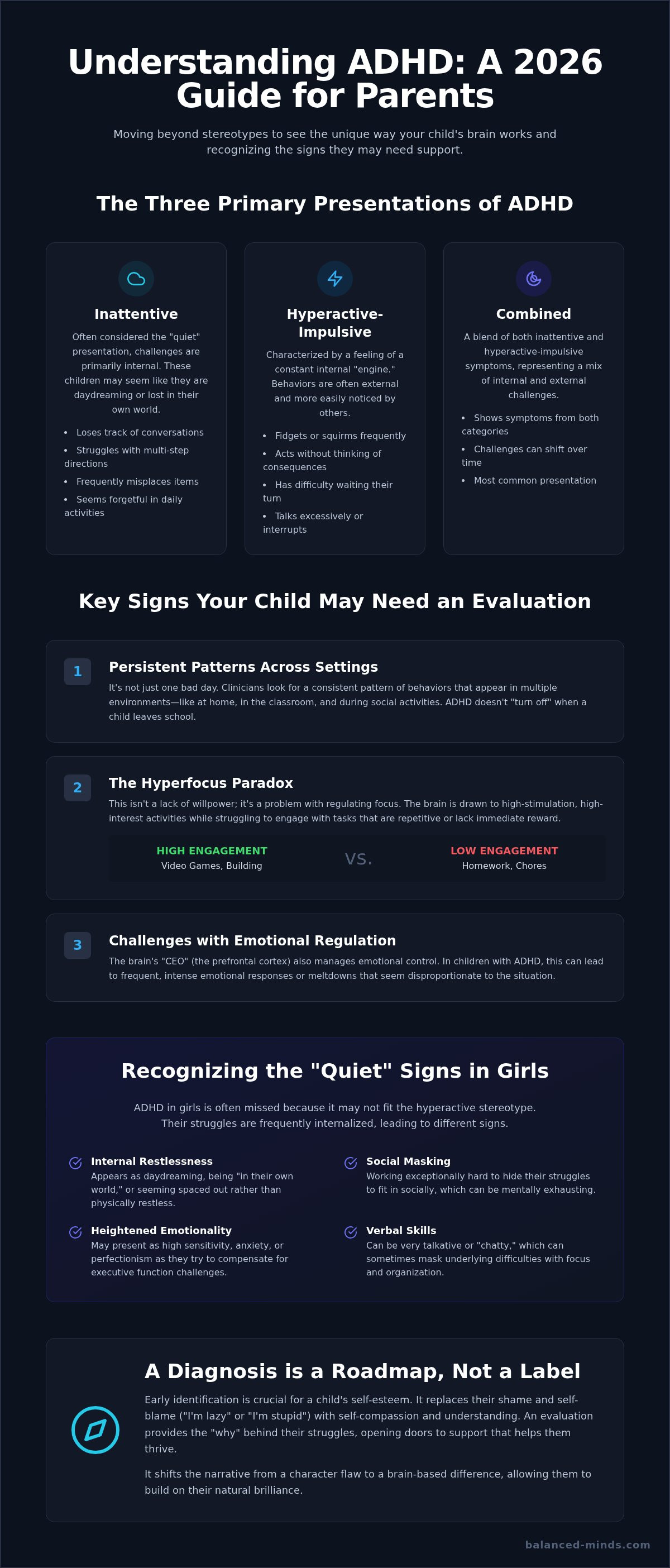
You're looking beneath the surface of a messy room or a forgotten assignment to see a child who might be working twice as hard just to stay at baseline. Clinically, we recognize three primary presentations of this condition:
Inattentive: Often missed because it's "quiet," these children might daydream, lose track of conversations, or struggle to follow multi-step directions.
Hyperactive-Impulsive: These children feel a constant internal engine running, often acting before they can process the consequences.
Combined: This is a blend of both inattention and hyperactivity, representing a mix of internal and external challenges.
The Neuropsychology of ADHD
Inside the brain, the prefrontal cortex acts like a CEO, managing executive functions like planning, organization, and emotional control. In children with ADHD, this "CEO" is often under-stimulated because of how the brain regulates dopamine, a chemical messenger tied to reward and motivation. This is why a child can focus intensely on a complex video game but shut down during a simple spelling test. We call this a performance gap. It isn't that they don't know the information; it's that their brain struggles to show what it knows in a consistent way. Understanding this biological reality helps us move away from blame and toward effective support.
Why Early Identification Matters for Your Child’s Self-Esteem
When a child's struggles remain unnamed, they often fill in the blanks with painful labels like "stupid" or "lazy." This leads to a secondary layer of anxiety and low self-worth that can be harder to treat than the ADHD itself. Recognizing the signs your child needs adhd testing is the first step in replacing their shame with self-compassion. Testing provides a compassionate "why" for their experience, shifting the narrative from a character flaw to a brain-based difference. If you've been searching for Psychology Near Me to find local expertise, you're already taking the most important step toward protecting your child’s emotional well-being. Knowing their brain type allows them to stop apologizing for how they learn and start building on their natural brilliance.
Key Signs Your Child Needs ADHD Testing: A Developmental Checklist
Identifying the signs your child needs adhd testing often begins with a feeling that something is slightly out of sync. It isn't just about a single afternoon of high energy or a forgotten jacket. Clinicians look for a persistent pattern of behaviors that appear in multiple settings. If your child struggles with focus at the dinner table, during soccer practice, and in the classroom, these consistent threads suggest their brain is processing the world in a unique way. We look for these patterns because ADHD doesn't just "turn off" when a child leaves school; it's a constant companion in their social and home lives too.
One of the most confusing indicators for parents is the phenomenon of hyperfocus. You might wonder how a child can spend four hours building a complex digital world in a video game but cannot spend ten minutes on a basic math worksheet. This isn't a lack of willpower. It's a regulation issue. Their brain is naturally drawn to high-interest, high-stimulation activities that provide immediate feedback. When a task is repetitive or lacks that "spark," their internal engine struggles to engage. This gap between what they can do when interested and what they struggle to do when required is a hallmark of the ADHD experience.
We also pay close attention to emotional regulation and working memory. If your child experiences frequent, intense meltdowns over seemingly small transitions, it may be because their brain is working overtime to manage sensory input. Similarly, a gap in working memory often looks like a child who forgets a three-step instruction by the time they reach the second step. They aren't ignoring you. The "mental sticky note" where they stored your request simply lost its stickiness. If these daily hurdles are creating tension in your home, considering comprehensive psychological evaluations can provide the roadmap you need to support their growth.
Academic and School-Based Warning Signs
In the classroom, ADHD often manifests as a "start strong, finish weak" pattern. Your child might have a backpack full of half-finished assignments or high-quality work that never quite makes it into the teacher's hands. Common school-based indicators include:
Frequent loss of essential supplies like pencils, planners, or tablets.
Teacher feedback describing them as a "daydreamer" or someone who "doesn't reach their full potential."
Difficulty following along during group reading or long lectures.
Executive Functioning: The Hidden ADHD Indicators
Executive functioning acts as the brain's CEO, and when this system is taxed, we see "time blindness." Children with ADHD often have a different perception of time; five minutes can feel like an hour, or an hour can slip by like five minutes. This makes transitions from one task to another feel jarring and frustrating. They aren't being defiant when they refuse to stop playing to get in the shower. They are likely struggling to shift their cognitive gears, a process that requires more mental effort for them than it does for their neurotypical peers.
ADHD in Girls vs. Boys: Recognizing the "Quiet" Signs
Historically, the image of ADHD has been a young boy who cannot sit still in his chair. While this presentation is valid, it often leads parents to overlook the signs your child needs adhd testing when their daughter appears calm on the surface. Girls are frequently diagnosed much later than boys because their symptoms tend to be less disruptive to the classroom environment. Instead of physical impulsivity, girls often experience internal restlessness or excessive talking. They might be the social butterfly who struggles to stop chatting or the student who seems perfectly behaved but hasn't heard a word of the lesson.
This quiet presentation often falls under the Inattentive ADHD profile. These children are frequently labeled as daydreamers or shy. Because they aren't causing a scene, their struggle with focus goes unnoticed until the academic or social demands of middle school become overwhelming. Socially, girls with ADHD may find complex peer dynamics particularly draining. They might miss subtle social cues or feel constantly out of step with their friends, leading to a deep sense of isolation that they don't know how to explain.
Masking and the Toll of "Trying Harder"
Many children, particularly girls, develop a sophisticated set of coping behaviors known as masking. They exert an immense amount of mental energy to mimic the organization and focus of their neurotypical peers. This often leads to the after-school collapse, where a child who was a pleasure to have in class returns home and immediately melts down because they have no emotional reserves left. Masking is a survival-based coping mechanism where a child hides their true struggles to fit in, eventually leading to profound exhaustion and burnout.
Internalized Symptoms: Anxiety and Daydreaming
When a child's internal world is a whirlwind of distraction, it can manifest outwardly as shyness or a lack of interest. Over time, the pressure of undiagnosed ADHD often transforms into chronic anxiety as the child realizes they are missing information but doesn't know why. For older children, this can become a heavy burden to carry alone. If you notice your daughter's light beginning to dim under the weight of these secret struggles, connecting with a Teenage Therapist Near Me can provide the specialized support she needs to navigate this transition. Recognizing these signs your child needs adhd testing early can prevent years of self-doubt and help her reclaim her confidence.
The Evaluation Journey: What to Expect in Tampa Bay
Once you've recognized the signs your child needs adhd testing, the next step is often the most daunting: the evaluation itself. We believe this process should feel like a supportive discovery rather than a sterile clinical trial. Our journey together begins with a comprehensive intake interview, where we gather the unique story of your child’s development. This is your time to share the nuances of their daily life, from their early milestones to the specific challenges they face at the kitchen table. We listen deeply to your experiences, ensuring that the clinical data we collect is grounded in the reality of your family's world.
The core of the evaluation involves standardized testing, which often looks like a series of puzzles, games, and computer-based tasks. While these activities feel engaging for the child, they are actually sophisticated tools that measure executive functions, processing speed, and sustained attention. We also utilize observation and rating scales from both parents and teachers. Because a diagnosis requires symptoms to be present in more than one setting, these scales provide the essential multi-dimensional data needed for accuracy. The process concludes with a feedback session, where we sit down together to review a comprehensive report that turns a "mystery" into a clear, actionable roadmap for your child's success.
School Testing vs. Private Psychological Evaluations
It's helpful to understand the difference between the testing offered by your local school district and a private evaluation. School-based testing is primarily designed to determine "educational impact" and eligibility for special education services. In contrast, a private evaluation in St. Petersburg or Tampa looks at the "whole child," providing a deeper clinical nuance that goes beyond the classroom walls. By finding a psychologist for ADHD diagnosis through a private practice, you gain a partner who can explore co-occurring conditions like anxiety or learning differences that school screenings might miss. Our goal is to provide a level of expertise that empowers you with a complete picture of your child's neurobiology.
Navigating the Florida School System with a Diagnosis
In Pinellas and Hillsborough counties, a professional report is a vital tool for securing the right support. Under Florida Rule 6A-6.030152, students may qualify for an Individualized Education Program (IEP) under the "Other Health Impairment" category, provided there is a medical or psychological report from within the last 12 months. Whether your child needs a 504 Plan for simple classroom accommodations or a more robust IEP, our detailed evaluations serve as a bridge between clinical findings and educational standards. Having a local advocate who understands these specific Florida regulations ensures your child receives the tailored support they deserve. If you are ready to begin this journey, we invite you to explore our comprehensive psychological evaluations to find the clarity your family needs.
Beyond the Diagnosis: How Your Child Can Thrive
Receiving a diagnosis isn't about placing a limit on your child’s future; it's about handing them the key to their own unique operating system. If you've spent months or even years observing the signs your child needs adhd testing, finally having a name for their experience can feel like a profound relief. We view this moment as the start of a more compassionate chapter for your family. A diagnosis is a tool for empowerment that allows us to move away from "trying harder" and toward "trying differently." By shifting to a strength-based environment, we can celebrate their creativity and out-of-the-box thinking while providing the scaffolding they need for the areas that feel heavy.
While the evaluation provides the "why," therapy and coaching provide the "how." Many children with ADHD experience intense frustration or rejection sensitivity, feeling deeply hurt by even minor corrections. Individual therapy for children and adolescents helps them process these big emotions, building a sense of internal security that school reports cannot provide. At the same time, we work with families to create a home environment that rewards effort and recognizes the immense mental energy your child uses just to navigate a neurotypical world. When a child feels understood rather than "broken," their natural capacity for growth begins to shine through.
Executive Functioning Coaching: Building the "CEO" Brain
Traditional therapy often explores the "why" behind our feelings, but ADHD and Executive Functioning Coaching focuses on the practical "how" of daily life. This specialized support helps children and teens develop the skills their prefrontal cortex isn't yet providing automatically. We work on task-initiation, organization, and breaking down large projects into manageable bites. At Balanced Minds Psychology & Wellness, our coaching empowers your child to take ownership of their brain, teaching them to use planners, timers, and systems that actually work for their way of thinking. It’s about building a capable internal CEO through consistent, gentle practice.
Your Next Steps in St. Petersburg and Tampa
If you're reading this, you likely already have a gut feeling that your child is struggling more than they should be. We encourage you to trust that intuition. Recognizing the signs your child needs adhd testing is the first step toward a more peaceful home life and a more confident child. You can schedule an initial consultation at our St. Petersburg office or via our secure telehealth platform to discuss your concerns. You don't have to navigate this path alone; Balanced Minds Psychology & Wellness is here to provide the steady, expert presence your family deserves as you move toward clarity and hope.
Finding Clarity and Confidence for Your Child's Future
We've explored how ADHD often looks different than the stereotypes, especially when we consider the "quiet" signs in girls or the hidden struggles with executive functioning. Recognizing the signs your child needs adhd testing is a brave first step that moves your family away from daily homework battles and toward a deeper understanding of how your child’s brain is uniquely wired. This journey is about more than just a label; it’s about providing the roadmap your child needs to flourish.
We deliver comprehensive reports that are widely recognized by both Pinellas and Hillsborough school districts, ensuring your child receives the support they deserve in the classroom. If you're ready to replace uncertainty with a clear plan, we invite you to Request a Comprehensive ADHD Evaluation for Your Child. You've been their strongest advocate since day one, and we're here to walk alongside you as you help them reach their full potential.
Frequently Asked Questions
Is there a specific age when ADHD testing is most accurate?
While we can observe indicators in children as young as four, testing is typically most stable and accurate from age six and older. This is because school-age expectations reveal how a child’s brain handles structured demands. The current DSM-5-TR standards require that symptoms appear before age 12. If you notice signs your child needs adhd testing during these early elementary years, a formal evaluation can provide a baseline for their developmental journey.
How is ADHD testing different from a regular pediatrician visit?
A pediatrician's visit often relies on a brief checklist and a short observation in a clinical room. In contrast, our comprehensive evaluations involve hours of standardized testing that measure cognitive processing, memory, and attention. We look beyond surface-level behaviors to understand the "why" behind the struggle. This deep dive ensures we aren't just identifying symptoms but are understanding your child’s unique neurobiological profile in a way a quick office visit cannot.
What if the testing shows my child doesn’t have ADHD?
If testing indicates that ADHD is not the primary cause of your child's challenges, the process is still an immense success. We use the data to explore other possibilities, such as anxiety, processing speed differences, or specific learning disabilities. Our goal is to provide your family with a clear explanation for the struggles you've observed. We ensure you leave with a restorative roadmap for support, regardless of the specific diagnosis or label.
Can my child have ADHD if they get good grades in school?
Absolutely. Many bright children use their intelligence to compensate for executive functioning gaps, often at a high emotional cost. They may maintain high grades while experiencing intense internal anxiety, "masking" their struggles until the academic load becomes too heavy to manage alone. Recognizing the signs your child needs adhd testing is important even for high achievers, as it allows us to support their well-being before they reach a point of burnout.
How long does a full psychological evaluation take at Balanced Minds Psychology & Wellness?
A full psychological evaluation at Balanced Minds Psychology & Wellness typically involves several hours of direct testing, often spread across one or two sessions to ensure your child remains engaged and comfortable. Following the testing, our team spends significant time scoring, interpreting data, and writing a detailed report. We then meet for a feedback session to review the results together, ensuring you have a complete understanding of the findings and a clear path forward for your family.
Will my child need to be on medication if they are diagnosed with ADHD?
Medication is a personal family decision made in consultation with a medical provider, and it is never a requirement. At Balanced Minds Psychology & Wellness, we do not provide psychiatric medication management. Instead, we focus on empowering your child through evidence-based interventions like individual therapy and ADHD coaching. These tools help them build practical life skills and emotional resilience, allowing them to thrive by understanding and working with their unique brain.
Does insurance typically cover ADHD testing in Florida?
Insurance coverage for psychological testing in Florida can be complex and varies significantly between providers. While a 2026 Florida telehealth parity law has improved access for some, many families find that comprehensive evaluations are only partially covered or require out-of-pocket payment. We recommend contacting your insurance carrier directly to discuss your specific benefits. We are committed to transparency and will help you understand the process of seeking reimbursement if applicable.
Can ADHD testing also identify giftedness or learning disabilities?
Yes, our comprehensive evaluations are designed to look at the "whole child." We often identify "twice-exceptional" students who are both gifted and have ADHD or a learning disability. By assessing cognitive strengths alongside academic skills, we can see where a child’s brilliance may be hiding a struggle or where a learning gap is creating frustration. This holistic view ensures that your child’s educational plan supports both their challenges and their natural gifts.


