

Psychologist Near Me: A Compassionate Guide to Finding the Right Support in St. Petersburg & Tampa
Updated: 3 days ago
What if the most important thing about finding the right psychologist had nothing to do with proximity? When families in the Tampa Bay area search for child counseling in St. Petersburg, FL, they often start with a map and end up overwhelmed by a list of names that feel interchangeable. The search itself can feel isolating, especially when you're already carrying the weight of watching your child struggle.
You already know that something more than a directory listing is needed. You're not looking for the closest office or the fastest appointment. You're looking for a clinical partner, someone who can hold the complexity of your child's story with both scientific rigor and genuine warmth, someone who makes your whole family feel seen rather than processed.
That kind of partnership is real, and it's findable. In this guide, we'll walk through how to move beyond a surface-level search to identify a psychologist who truly fits your family's needs, clarify the difference between therapy and psychological testing, and help you understand how a formal evaluation can open doors to school accommodations and lasting clarity. Let's begin.
Table of Contents
Navigating Your Search for a Psychologist Near Me
Typing "psychologist near me" into a search bar is often the first step, but it's rarely the most revealing one. The phrase itself carries an implicit assumption: that closeness on a map translates to closeness in the therapeutic relationship. It doesn't, not automatically. What families are really searching for, even if they don't have the words for it yet, is a clinical home. A place where their child feels safe enough to be honest, and where the psychologist is skilled enough to know what to do with that honesty.
Starting this search is an act of love, and it can also feel quietly exhausting. You're holding your child's vulnerability in one hand and a browser full of unfamiliar names in the other. That tension is real, and it deserves acknowledgment before we get into anything practical.
Why Local Care Matters in St. Petersburg and Tampa
For children especially, consistency is not a luxury; it's a clinical necessity. The field of child psychotherapy has long recognized that the therapeutic relationship itself is a primary vehicle for change, and that relationship deepens when sessions happen in a predictable, familiar physical space. An in-person appointment in St. Petersburg means your child isn't navigating a new environment every few weeks, and it means a provider who may already understand the rhythms of Pinellas County schools, local stressors, and the particular texture of life in the Tampa Bay area.
That local fluency matters more than it might seem. A psychologist who knows how Pinellas County schools structure their IEP and 504 processes, for instance, can communicate more effectively with teachers and administrators on your child's behalf. That kind of coordination doesn't happen as naturally when your provider is three time zones away.
Shifting from 'Any Professional' to 'The Right Partner'
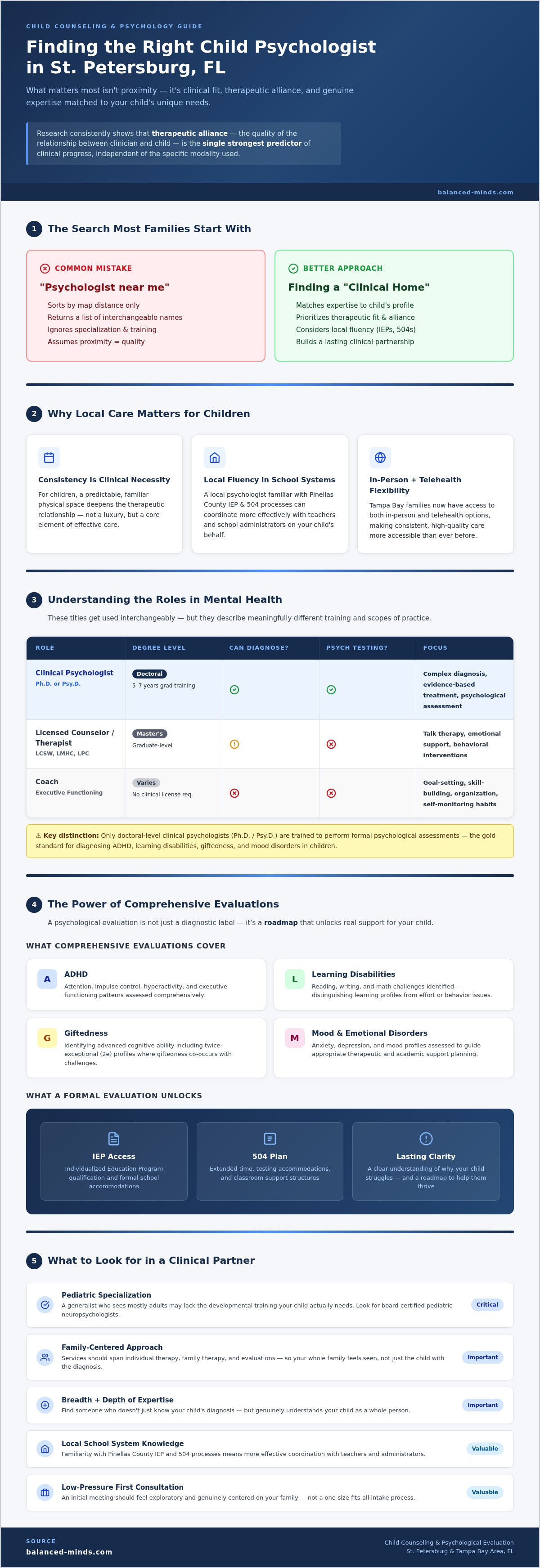
The first result in a search isn't always the right one. Pediatric mental health is a specialized field, and a generalist who sees mostly adults may not have the developmental training or assessment tools your child actually needs. This is where the concept of therapeutic alliance becomes essential: research consistently identifies the quality of the relationship between clinician and client as the single strongest predictor of clinical progress, independent of the specific modality used.
Families seeking child counseling in St. Petersburg, FL benefit most when they look for a provider whose expertise genuinely matches their child's profile. Breadth of expertise matters, but so does depth. The goal is to find someone who doesn't just know your child's diagnosis, but understands your child.
Understanding the Specialized Roles in Modern Psychology
One of the most common sources of confusion for families beginning this journey is the terminology itself. Psychologist. Therapist. Counselor. Coach. These words get used interchangeably in everyday conversation, but in a clinical context, they describe meaningfully different training backgrounds, scopes of practice, and therapeutic functions. Understanding those distinctions doesn't just satisfy curiosity; it helps you ask sharper questions and make a more grounded choice about who actually belongs in your child's corner.
Psychologists vs. Counselors vs. Coaches
Clinical psychologists hold doctoral-level degrees, either a Ph.D. or Psy.D., which typically require five to seven years of graduate training, supervised clinical hours, and a licensing examination. That depth of preparation equips them to conduct psychological testing, formulate complex diagnoses, and deliver evidence-based treatment for a wide range of conditions. Licensed counselors and therapists, while genuinely skilled, generally complete master's-level programs and may not be trained in formal psychological assessment.
Coaching occupies a different lane entirely. It's not therapy, and it doesn't treat clinical diagnoses. Instead, coaching is a goal-oriented, skill-building process focused on practical outcomes: organizing a school week, breaking a project into manageable steps, building the habit of self-monitoring. At Balanced Minds, executive functioning coaching sits alongside therapy rather than replacing it, which means a child can receive clinical support for underlying anxiety while simultaneously developing the organizational scaffolding they need to function day-to-day. That integration is what makes the approach genuinely holistic.
The Role of Pediatric and Young Adult Specialists
Children aren't small adults, and their mental health care shouldn't treat them as such. Developmental stage shapes everything: how a child understands distress, how they communicate it, and what interventions are actually effective. The child and adolescent mental health resources published by the National Institute of Mental Health consistently emphasize that early, developmentally appropriate intervention produces significantly better long-term outcomes than delayed or generalized care.
For younger children, play therapy is often the most clinically appropriate entry point. Play is a child's native language, and a skilled therapist can observe, interpret, and gently redirect through it in ways that direct conversation simply can't reach. For adolescents, the work shifts toward identity, peer relationships, and emotional regulation. And for young adults, therapy frequently centers on what clinicians sometimes call "launching": building the independence, self-awareness, and executive capacity to navigate college, early careers, and adult relationships with confidence rather than anxiety.
Families seeking child counseling in St. Petersburg, FL benefit from that specificity in ways that a generalist practice simply can't replicate. If you're curious whether this approach fits your child's current stage, exploring what a first consultation looks like is a low-pressure place to start.
Local Insights: Mental Health Support in the Tampa Bay Area
Growing up in the Tampa Bay area comes with its own particular texture. The transient nature of many military and corporate families moving through Pinellas and Hillsborough counties, the pressure of competitive magnet school admissions, the disruptions that hurricane seasons bring to routines and family stability: these aren't abstract stressors. They're the lived backdrop against which children in this region develop, struggle, and grow. A psychologist who understands that backdrop isn't just a nice bonus. It's a clinical asset.
Families searching for child counseling in St. Petersburg, FL deserve care that's rooted in this community, not imported from a generic template. Children's mental health guidance from the APA consistently emphasizes the importance of culturally and contextually informed care, and that principle applies just as meaningfully to regional context as it does to cultural background. A provider who knows the rhythms of this region brings something that a directory listing simply can't communicate.
Navigating Pinellas and Hillsborough County School Systems
Florida's education landscape has specific procedural requirements for 504 plans and IEPs, and those requirements don't always look the same from one county to the next. Pinellas County Schools and Hillsborough County Public Schools each have their own timelines, documentation expectations, and eligibility criteria. A comprehensive psychological evaluation from a local provider doesn't just produce a report; it produces a document written in the language that local school teams actually use. That distinction matters enormously when you're sitting in an eligibility meeting and advocating for your child's right to support.
Advocacy is, in many ways, a core function of pediatric psychology. A skilled clinician doesn't hand you a diagnosis and step back. They help translate clinical findings into actionable accommodations, communicate directly with school staff when appropriate, and ensure that what happens in the testing room actually changes what happens in the classroom. That's the kind of local connection that searching for psychology near me is really pointing toward, even if the search bar doesn't quite capture it.
The Convenience and Connection of St. Petersburg Care
There's something quietly significant about walking into a private practice office that feels like it was designed with your family in mind. Balanced Minds' St. Petersburg location offers that kind of grounded, welcoming environment, a space where children can arrive as themselves without the clinical coldness that larger institutional settings sometimes carry.
For families whose schedules don't bend easily, secure telehealth sessions make consistent care genuinely achievable. A parent managing two school pickups and a work deadline doesn't have to choose between convenience and quality. Both can coexist. And when the whole family needs support, not just the child at the center of the concern, family therapy near me is available for Tampa Bay households navigating those dynamics together.
Beyond Therapy: The Power of Comprehensive Evaluations
Therapy is a powerful tool. But sometimes, before a child can truly benefit from it, a more fundamental question needs answering: what, exactly, is happening in this child's brain? A comprehensive psychological evaluation isn't a judgment or a verdict. It's a roadmap, one that traces the unique contours of how your child thinks, learns, processes emotion, and experiences the world. Without that map, even the most skilled therapist is navigating by intuition alone.
This is the clinical gap that formal testing fills. Rather than treating symptoms as they surface, an evaluation gets underneath them, identifying the root architecture that shapes your child's daily experience. The difference between guessing and knowing is not a small one. It changes the interventions selected, the accommodations requested, and the conversations you're able to have with your child's teachers, coaches, and school administrators.
At Balanced Minds, comprehensive evaluations span several distinct clinical areas:
ADHD evaluations that assess attention, impulse control, and executive functioning across multiple settings
Learning disability assessments that identify specific processing differences in reading, writing, and mathematics
Gifted testing that documents advanced cognitive abilities for academic placement purposes
Mood and anxiety evaluations that distinguish between clinical conditions and developmentally typical stress responses
One concern families sometimes raise is that testing will "label" their child in a way that follows them permanently. That fear is understandable, and it deserves a direct response. A diagnosis isn't a ceiling; it's a key. It opens doors to accommodations, services, and targeted support that wouldn't otherwise be accessible. Knowing that your child has dyslexia doesn't limit them; it explains why certain strategies haven't worked and points directly toward ones that will.
When to Seek an ADHD or Learning Disability Assessment
General therapy is the right starting point for many children. But certain patterns suggest that formal testing belongs earlier in the process: persistent academic underperformance that doesn't respond to tutoring, significant attention difficulties across multiple environments, or a gap between a child's evident intelligence and their classroom results. Families seeking child counseling in St. Petersburg, FL who notice these patterns often find that connecting with a psychologist for ADHD diagnosis provides the clarity that months of trial-and-error simply can't. Gifted testing serves a parallel purpose: in Florida schools, formal documentation is typically required for advanced academic placement, and an evaluation from a qualified neuropsychologist carries the clinical weight that school teams need.
What to Expect During the Evaluation Process
The process unfolds in three connected phases. The intake gathers your family's history, your child's developmental background, and your specific concerns. Testing administration follows, a series of standardized tasks that feel more like structured activities than exams, conducted with care so your child feels at ease rather than scrutinized. The feedback session is where it all comes together: findings are translated into plain language, and the report becomes a practical guide for home strategies, school accommodations, and next clinical steps.
That final conversation matters as much as the data it conveys. Clinical authority and genuine empathy aren't opposites, and a skilled evaluator holds both. If you're wondering whether a formal evaluation is the right next step for your family, reaching out to Balanced Minds is a low-pressure way to explore what that process might look like for your child specifically.
Taking the First Step Toward Balanced Wellness
Reaching out for help is rarely the easy thing. It's the brave thing. If you've read this far, you've already done something quietly significant: you've chosen to treat your child's inner life as worthy of serious, skilled attention. That choice matters, and it deserves to be met with the same care and intentionality you've brought to making it.
At Balanced Minds, the initial consultation isn't a sales call or an intake form dressed up as a conversation. It's a genuine opportunity to be heard. You'll have space to share what's been happening at home, at school, in your child's relationships, and in your own experience as a parent navigating all of this. From there, the team works collaboratively with you to determine whether individual therapy, family therapy, a comprehensive evaluation, or executive functioning coaching best fits your child's current needs. That matching process is thoughtful, not formulaic. The goal is to connect your family with the right specialist, not simply the next available one.
Preparing for Your First Appointment
Children and teens often arrive at a first appointment carrying some version of the same quiet fear: Am I in trouble? Is something wrong with me? The most helpful thing a parent can do before that first visit is reframe the narrative. Therapy isn't a punishment or a verdict. It's a place to figure things out with someone who's genuinely on your side. Keeping the language simple and honest tends to work better than over-explaining. "We're going to meet someone whose whole job is helping kids feel better at school and at home" lands differently than a clinical description of the process.
Once you arrive, goal-setting happens together. Therapeutic priorities aren't handed down from clinician to family; they emerge from a shared conversation about what's actually getting in the way of your child's wellbeing. That collaborative foundation is what makes the work sustainable, because both the child and the family understand what they're working toward and why.
Your Local Resource for Growth and Healing
Families seeking child counseling in St. Petersburg, FL deserve a practice that holds both clinical rigor and genuine warmth without trading one for the other. Balanced Minds is built on exactly that commitment: evidence-based interventions delivered with a heart-centered approach that sees your child as a whole person, not a diagnostic category. Every service, from gifted testing to family therapy, flows from that same foundational belief in each child's capacity to grow.
For families who want to explore the clinical side of this work in greater depth, the child psychologist St. Petersburg FL guide offers a compassionate, detailed look at what specialized pediatric psychology actually looks like in practice. And when you're ready to take that next step, we'd be honored to meet your family where you are. Schedule a consultation with our St. Petersburg team today.
Your Child's Growth Starts With One Conversation
The path from searching "psychologist near me" to finding a clinical home for your family is shorter than it might feel right now. Throughout this guide, we've explored why developmental expertise matters more than proximity, how comprehensive evaluations unlock clarity that therapy alone can't always reach, and why local fluency in the Tampa Bay school system makes a genuine difference in your child's daily life.
Families seeking child counseling in St. Petersburg, FL deserve more than a convenient appointment slot. They deserve a practice built around their child's whole story.
Your child has the capacity to grow. The right support simply helps them find it. Connect with Balanced Minds Psychology & Wellness today and take that first, courageous step toward clarity.
Frequently Asked Questions
How do I know if my child needs a psychologist or just a school counselor?
A psychologist provides doctoral-level clinical intervention and diagnostic clarity that goes beyond the scope of school-based support. While school counselors are vital for academic navigation and immediate peer conflicts, a psychologist addresses underlying mental health conditions through specialized child counseling in St. Petersburg, FL. We look for persistent patterns in mood or behavior that require deeper therapeutic work or formal evaluations that a school setting isn't equipped to provide.
What is the difference between psychological testing and a regular therapy session?
Psychological testing is a structured, diagnostic process used to create a roadmap of a child's cognitive and emotional functioning. In contrast, a regular therapy session is an ongoing collaborative space focused on emotional regulation and behavioral growth. Testing provides the "why" behind a struggle, while therapy focuses on the "how" of healing and daily management. Both work together to ensure your child receives the most accurate support possible.
Does Balanced Minds Psychology & Wellness offer telehealth for Florida residents?
Balanced Minds Psychology & Wellness provides secure telehealth services for residents throughout the state of Florida. This option ensures that families can access specialized pediatric care even when physical travel to our St. Petersburg office isn't feasible. We use HIPAA-compliant platforms to maintain the same level of psychological safety and privacy found in our in-person sessions, making consistent care attainable for busy households.
How long does a typical psychological evaluation take in your St. Pete office?
A typical comprehensive evaluation involves several hours of direct testing, though we often break this into manageable sessions to prevent child fatigue. The entire process also includes an initial intake appointment and a separate feedback session to review results. We prioritize a thorough, rhythmic pace that ensures we capture an accurate picture of your child's unique strengths and challenges without making the experience feel overwhelming for them.
Can a psychologist help with school accommodations like 504 plans in Pinellas County?
A psychologist plays a critical role in securing 504 plans and IEPs by providing the formal clinical documentation required by Pinellas County schools. Our evaluations translate complex neuropsychological data into actionable recommendations that teachers and administrators can implement. We help bridge the gap between a clinical diagnosis and the practical support your child needs to succeed in the classroom, acting as a bridge between clinical care and education.
What should I look for when searching for a 'teenage therapist near me'?
When searching for a teenage therapist, prioritize clinicians who specialize in adolescent development and emphasize the therapeutic alliance. Adolescents need to feel that their therapist is a neutral, non-judgmental mentor rather than another authority figure. Look for providers who balance clinical expertise with a warm, human approach that respects the teenager's growing need for autonomy and privacy while still involving the family in the healing journey.
Is gifted testing required for Florida public school gifted programs?
Florida public school gifted programs require formal gifted testing and a resulting gifted plan for admission. We provide standardized cognitive assessments that meet the specific criteria set by the state and local school districts. These evaluations document advanced intellectual functioning and help ensure your child is placed in an academic environment that properly nurtures their potential and keeps them engaged with their learning.
How do I explain the first therapy visit to my anxious child?
Explain the first visit by framing the psychologist as a "feelings helper" or a "brain coach" who assists kids with school or big emotions. It's helpful to avoid using language that implies something is "wrong" or that the visit is a consequence for behavior. Instead, emphasize that we are a team working together to make things easier and more comfortable for them, which helps lower their defenses before they walk through our door.


