

Online Family Therapy for ADHD: A 2026 Parent's Guide
Updated: 17 hours ago
Imagine sitting in your living room in St. Petersburg, watching your child struggle to stay still while you worry about the long drive to a Tampa clinic. You might wonder if family therapy for child with adhd could ever work through a screen when even a five-minute conversation feels like a mountain to climb. We understand that feeling of exhaustion; we know the weight of feeling like you're failing to manage behaviors that seem to have a mind of their own. It's important to remember that you aren't alone in this journey, and your home can actually be the most powerful place for healing to begin.
This guide will show you how online family therapy provides evidence-based, engaging support that empowers you as a parent from the comfort of your own sofa. We'll share the clinical proof that telehealth is a highly effective tool, with research showing success rates between 75 and 85 percent for various mental health conditions. You'll discover practical ways to keep your child focused during a session and learn about a therapy model that nurtures the entire family unit. Together, we can turn your daily environment into a restorative space where every family member has the tools they need to thrive.
Table of Contents
The Clinical Efficacy of Online Family Therapy for ADHD
When we think about pediatric telehealth, we are looking at far more than a simple video call. It is a structured, interactive family intervention designed to bridge the gap between clinical expertise and your daily life. For many parents, the idea of family therapy for child with adhd taking place on a screen feels counterintuitive. However, the data from 2026 tells a different story. Research, including a meta-analysis of randomized controlled trials, shows that online interventions are significantly effective in improving attention and social function, with success rates often reaching between 75 and 85 percent. These virtual sessions match the results of in-person therapy because they focus on the same core behavioral principles, simply delivered through a more accessible medium.
There is a unique beauty in the natural environment advantage. Instead of asking a child to perform in a sterile office, we observe and support them exactly where their challenges occur. This allows us to address behaviors in the kitchen, the playroom, or at the homework desk. By 2026, technology has evolved to facilitate better focus for neurodivergent children through interactive interfaces that turn therapeutic exercises into engaging, collaborative tasks. We aren't just talking about progress; we are witnessing it happen in the spaces where your family lives and grows.
One of the most effective models we utilize is Parent-Child Interaction Therapy (PCIT). This evidence-based approach has been successfully adapted for the digital space, allowing a clinician to coach you in real time as you interact with your child. This immediate feedback loop helps to strengthen the parent-child bond while providing you with the tools to manage disruptive behaviors with confidence and calm.
Evidence-Based Outcomes for ADHD Families
Recent longitudinal studies confirm that virtual behavioral therapy produces lasting change. Digital tools now allow for real-time tracking of executive functioning goals, ensuring that every small victory is recorded and celebrated. This data-driven approach provides a clear map of your child's development.
The Shift Toward Virtual Care in the Tampa Bay Area
For families in Pinellas County, the shift toward virtual care is often a strategic choice for wellness. We know the stress of the I-275 commute or the crawl through downtown St. Petersburg traffic. Telehealth removes these barriers, allowing you to start your session without the cortisol spike of a difficult drive. We often hear concerns about screen time, but it's vital to distinguish between passive consumption and active, therapeutic engagement. In our sessions, the screen is a tool for connection, not a distraction. If you are still exploring your options, Finding the Right Child Psychologist in St. Petersburg, FL can help you navigate this path with confidence.
Adapting Play and Behavioral Interventions for the Digital Space
Many parents worry that their child's high energy will make a video call feel like a struggle. In reality, virtual play therapy often feels more natural for a child because it happens in their own sanctuary, surrounded by their favorite toys and comforts. We don't ask your child to sit still for an hour; instead, we leverage their environment to build engagement. By Setting the Stage for a Virtual Session through intentional preparation, we turn your living room into a therapeutic space where growth feels like play.
Our approach often utilizes Parent-Child Interaction Therapy (PCIT), which is widely considered the gold standard for treating behavioral challenges via telehealth. In this model, the therapist acts as a "live coach," observing your interactions through the camera and providing real-time guidance. This allows us to address impulse control and emotional regulation exactly when they surface in your daily life. We also integrate interactive digital tools designed to help children visualize their emotions, making abstract concepts like "frustration" or "focus" tangible and manageable. If you've been searching for Family Therapy Near Me, you'll find that our virtual model offers a unique level of support that traditional offices often can't match.
The Parent as an Empowered Co-Therapist
We know that neurodivergent children often need to move to think. That's why we incorporate movement-based activities and "sensory scavenger hunts" into our sessions to keep the momentum going. Pacing is essential, so we break the time into manageable segments that match your child's developmental attention span. By staying flexible and responsive, we ensure that the session remains a positive experience rather than a chore. If you're ready to see how this dynamic approach can support your family, our team at Balanced Minds Psychology & Wellness is here to guide you through every step of the journey.
In-Person vs. Online ADHD Support: A Comparison for Florida Families
Choosing between an office visit and a virtual session is a deeply personal decision that depends on your family's unique rhythm. While traditional models often emphasize in-person connection, modern clinical data suggests that for family therapy for child with adhd, the outcomes are remarkably similar across both modalities. The effectiveness lies in the relationship and the strategy, not the physical room. For busy families in Pinellas County, logistical factors often tip the scales. Dealing with the 4:00 PM crawl on I-275 or finding childcare for siblings can turn a therapeutic hour into a three-hour ordeal. Virtual care removes these stressors, allowing everyone to arrive at the session with lower cortisol levels.
When Online Therapy is the Superior Choice
For children who struggle with transitions or experience school refusal, the home environment provides a much-needed layer of emotional security. Removing the clinical feel of an office helps lower defenses, especially for kids with social anxiety who might feel "on display" in a waiting room. Online support also ensures continuity during Florida’s unpredictable storm seasons or during family travel. It keeps the momentum of progress steady, regardless of external circumstances. This consistency is often the key to long-term behavioral success.
When In-Person Care is Recommended
There are moments when physical presence is essential for clinical safety and accuracy. If a child is experiencing high-acuity safety needs or severe physical dysregulation, the controlled environment of our St. Petersburg office provides the necessary structure. In-person visits are also required for comprehensive psychological evaluations. These assessments require standardized conditions and specific physical tools that only a clinical setting can provide. We also find that age plays a role; while elementary-aged kids thrive online, toddlers often benefit more from the hands-on sensory engagement of an in-person playroom.
Many families find their greatest success in a hybrid model. This approach might involve an initial in-person assessment followed by virtual family coaching sessions. We're here to help you determine which blend of support feels most restorative for your household.
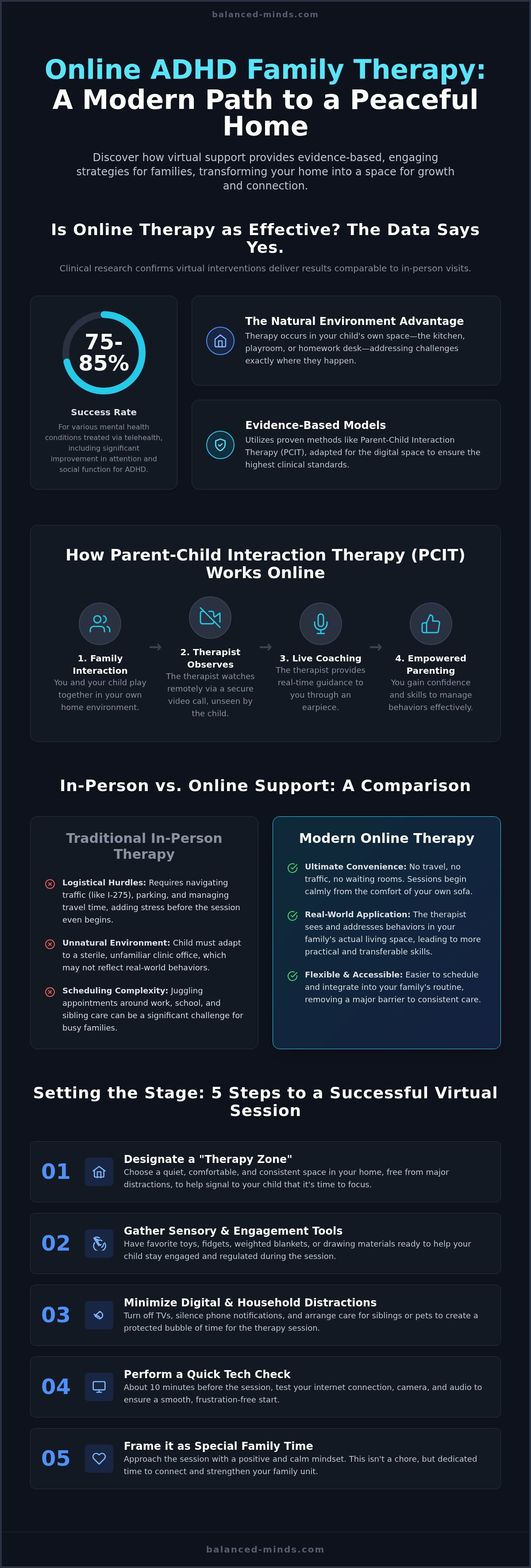
Setting the Stage: 5 Steps to a Successful Virtual Session
Preparing for a virtual session doesn't have to feel like a performance. In fact, the most successful family therapy for child with adhd happens when we embrace the messy reality of home life while adding just enough structure to help your child feel safe. Start by explaining the "computer doctor" as a special friend who helps the whole family learn new ways to talk and play together. This framing removes the pressure of "fixing" the child and positions the screen as a bridge for connection rather than a barrier. We want your child to feel that this is a collaborative space where their voice matters just as much as yours.
We also suggest curating an "ADHD Toy Box" specifically for these sessions. This isn't just a bin of random toys; it's a thoughtful selection of sensory tools, like soft putty, a weighted lap pad, or a favorite fidget, that soothe the nervous system without pulling focus away from our work. If the Wi-Fi drops or a screen freezes, take a deep breath. Your calm response to a technical glitch teaches your child more about emotional regulation than a hundred perfectly delivered words ever could. By staying flexible, we show our children that obstacles are manageable and that the connection remains even when the technology falters.
Practical Environmental Adjustments
Your child's physical surroundings act as a silent partner in the therapeutic process. We recommend optimizing the lighting to be soft and indirect, as harsh overhead glares can be overstimulating for neurodivergent sensory systems. Seating should be flexible; some children thrive on the floor with a yoga mat, while others need the boundaries of a sturdy chair to feel grounded. Establishing a consistent "anchor" spot helps the brain recognize that this specific corner of the room is for therapy. A transition ritual is a short, predictable activity, such as blowing three slow bubbles or listening to a specific calm song, that signals to your child's brain that it's time to shift from the high energy of play to the focused connection of therapy.
The 10-Minute Pre-Session Checklist
Success often lives in the ten minutes before the camera turns on. Use this time to ensure basic needs are met, as a hungry or uncomfortable child will find it nearly impossible to engage. This small window of preparation is a vital component of effective family therapy for child with adhd. Test your HIPAA-compliant secure link and check your audio quality to minimize mid-session interruptions. Finally, check in with your own mindset. Be prepared to step in as an active co-therapist or step back as a quiet observer, depending on the guidance we provide in the moment. If you're ready to create a supportive rhythm for your household, you can schedule an ADHD consultation with our St. Pete team today.
Compassionate ADHD and Family Support in St. Petersburg
At Balanced Minds, we believe that every child possesses an innate capacity for growth when they are met with the right blend of clinical expertise and genuine compassion. We bridge the gap between rigorous scientific standards and heart-centered care, ensuring that your family feels seen, heard, and supported at every turn. We understand that seeking family therapy for child with adhd is a courageous step toward healing. It isn't merely about correcting behaviors; it's about restoring the natural warmth and connection that can sometimes be overshadowed by the complexities of neurodiversity. Our commitment to evidence-based growth means that every intervention we provide is grounded in research while remaining deeply personal to your family’s unique story.
We see our role as a steady, guiding presence, helping you navigate the often-overwhelming world of pediatric mental health. By fostering a sense of psychological safety, we allow both parents and children to explore new ways of interacting without the weight of shame or judgment. Whether we are meeting you in our St. Petersburg office or through a secure digital screen, our goal remains the same: to empower your family with the tools needed to thrive in the real world.
Expertise Grounded in Neuropsychology
This high level of clinical authority ensures that our approach to family therapy for child with adhd is both effective and scientifically sound. We move beyond surface-level coaching to focus on long-term executive functioning and emotional health. By nurturing these foundational skills, we help your child develop the resilience they need for the years ahead. If you're currently seeking clarity on your child’s specific needs, finding a Psychologist for ADHD Diagnosis is an essential part of creating a roadmap for their success.
Joining the Balanced Minds Community
We've designed our intake process to be a restorative experience that lowers your defenses and invites reflection. During your initial family intake call, we’ll take the time to listen to your concerns and explore the nuances of your daily life. This conversation helps us determine whether our St. Petersburg office or our secure, HIPAA-compliant telehealth platform is the best fit for your family’s needs and schedule. We take pride in being a supportive resource for Pinellas County residents, helping you navigate the complexities of insurance and private pay options with ease. Our goal is to make the path to wellness feel attainable and clear. We invite you to Connect with our team today and take the first step toward a more harmonious and empowered home life.
Embracing a New Path for Your Family's Growth
The journey toward a more harmonious home life doesn't have to be defined by the stress of travel or the worry that your child won't engage through a screen. We've seen how the sanctuary of your own home can actually enhance the therapeutic process, turning daily challenges into real-time opportunities for growth. By choosing family therapy for child with adhd, you're opting for a model that honors your family's unique rhythm while maintaining the highest clinical standards. It's about shifting from a place of exhaustion to a place of empowerment, where every member of the household feels supported.
We specialize in executive functioning and behavioral growth, providing you with the tools to lead your household with confidence and calm. Every step you take toward professional support is a testament to your commitment to your child's wellbeing. We invite you to Schedule a Compassionate Consultation for Your Child so we can begin this partnership together. You aren't alone in this, and a more peaceful future for your family is well within your reach.
Frequently Asked Questions
Is online therapy as effective as in-person for a child with ADHD?
Online therapy is clinically proven to be as effective as in-person visits for most behavioral challenges. Studies indicate success rates between 75 and 85 percent, matching traditional office outcomes. For family therapy for child with adhd, the focus remains on evidence-based strategies and the therapeutic relationship rather than the physical location. Our St. Petersburg experts ensure that the virtual experience is just as rigorous and supportive as a face-to-face meeting in our local clinic.
How do you do play therapy if the therapist is not in the room?
We leverage your child’s natural environment to facilitate virtual play therapy. Instead of using office toys, we use your child’s favorite items to practice emotional regulation and social skills where they actually live. Our clinicians act as a "live coach," guiding you through interactions that build connection. This approach turns your living room into a laboratory for growth, ensuring that the skills learned are immediately applicable to your daily family life.
What if my child with ADHD refuses to stay in front of the camera?
We don't expect your child to sit perfectly still in front of a screen for an hour. Our sessions incorporate movement-based activities and "sensory scavenger hunts" to keep high-energy children engaged. If your child needs to move, we follow their lead while maintaining the therapeutic focus. We work with you to create a "Therapy Zone" that balances their need for physical activity with the structure required for meaningful behavioral progress.
Do I need to be in the room during my child’s online therapy session?
Your participation is a vital component of the co-therapy model we use for younger children. While older adolescents may have private time, family therapy for child with adhd often requires parents to be active participants. This allows us to coach you in real-time as you practice new behavioral strategies. By being present, you gain the confidence to manage executive functioning challenges long after the video call has ended.
Is online family therapy covered by insurance in Florida?
Most private insurance plans in Florida provide coverage for telehealth services due to 2026 telehealth parity laws. These regulations ensure that virtual mental health support is treated with the same weight as in-person visits. We encourage families in the Tampa Bay area to reach out to our office to discuss specific insurance or private pay options. We’re committed to helping you navigate the financial aspects of care so you can focus on healing.
What equipment do I need for my child’s ADHD telehealth sessions?
You only need a few simple tools to get started with our secure, HIPAA-compliant telehealth platform. A reliable laptop or tablet with a camera, a stable internet connection, and a quiet space are the primary requirements. We also recommend preparing an "ADHD Toy Box" filled with sensory items like fidgets or weighted lap pads. These tools help your child stay regulated and focused during our time together without becoming a distraction from the session.
Can online therapy help with a formal ADHD diagnosis?
While online therapy is an excellent tool for ongoing treatment, a formal ADHD Evaluation often requires an in-person visit to our St. Petersburg office. Comprehensive psychological testing involves standardized assessments that are most accurately administered in a controlled clinical environment. Once a diagnosis is established, we can seamlessly transition your family to virtual coaching or therapy sessions to begin the process of skill-building and behavioral growth from the comfort of your home.
How do I explain the concept of online therapy to my young child?
We suggest describing the therapist as a "special friend" or a "talking teacher" who helps the whole family learn how to work together. Explain that you'll be using the computer to play games and talk about feelings. Focusing on the collaborative nature of the session helps reduce any anxiety your child might feel. This framing positions the experience as a positive, family-centered activity rather than a clinical appointment that they have to endure.


