

My Marriage is Suffering Because of Our Child's Behavior: A Guide to Healing
Updated: 3 days ago
You sit in the quiet of your living room after the final bedtime battle, exhausted and unable to find anything to say to the person sitting next to you. The vibrant connection that once defined your relationship has been replaced by a clinical focus on schedules, discipline tactics, and emotional damage control. If you have ever whispered the admission, "my marriage is suffering because of our child's behavior," you are navigating one of the most complex challenges a couple can face. It's easy to fall into the "child-centric trap," where the urgent needs of a high-needs child inadvertently push the vital needs of your partnership into the background.
We understand the profound exhaustion that comes from constant arguing over discipline and the quiet guilt of feeling like roommates rather than partners. We believe that your marriage doesn't have to be a casualty of your parenting journey. You'll discover how to protect your partnership and restore family harmony even when daily life feels overwhelming. We will explore how to move from a state of survival back into a shared path of healing, ensuring your home becomes a restorative sanctuary for every member of the family.
Table of Contents
When Parenting Challenges Strain Your Partnership
It is a heavy, often silent burden to carry the feeling that your home has become a place of tension rather than a sanctuary. When you find yourself thinking, "my marriage is suffering because of our child's behavior," the weight of that realization can feel like a personal failure. We want to begin by normalizing this experience; you are not alone in your isolation. In homes where a child’s needs are high, the emotional landscape often shifts from mutual support to a state of constant vigilance. This shift isn't a sign of a weak bond, but rather a natural response to a demanding environment.
One of the most common ways this strain manifests is through what we call marital triangulation. In a healthy dynamic, the primary emotional bond exists between the partners. However, when a child’s behavior becomes intense or unpredictable, that behavior can effectively become a "third party" in the marriage. Every conversation, every plan, and every emotional reaction begins to revolve around the child’s latest crisis. This triangulation creates a barrier to intimacy because the couple is no longer looking at each other; they are both looking, often with varying degrees of panic or frustration, at the child.
Conventional marriage advice often falls short in these scenarios. Standard suggestions like "just make time for a date night" can feel dismissive when you are both grappling with chronic parenting stress that leaves you physically and mentally depleted. It is vital to distinguish between a temporary parenting rut and the chronic marital erosion that occurs when the "crisis of the day" becomes the only shared experience you have left.
The Reality of Parental Burnout in 2026
In 2026, the pressures on families are unique, with rising childhood anxiety and academic demands adding layers to the daily struggle. This environment fosters a chronic stress response where your nervous system remains in a "fight or flight" state. When you are stuck in survival mode, your brain prioritizes immediate safety over emotional connection. Decision fatigue also plays a significant role; after a day of managing complex behavioral triggers, you may simply have no cognitive energy left to offer your spouse the warmth they deserve.
Why You Aren't 'Failing' as a Couple
We often see couples who believe their relationship is fundamentally broken, but the truth is that high-needs parenting simply requires a different marital operating system. You might be experiencing a form of grief, mourning the "easier" parenting journey you expected to have. Shifting from a blame-based mindset to a team-based perspective is the first step toward healing. When you recognize that "my marriage is suffering because of our child's behavior" is a shared challenge rather than a partner's flaw, you begin to rebuild the psychological safety necessary for your partnership to thrive again.
The 'Child-Centric' Trap: Why Disconnection Happens
When we speak of the "Child-Centric Trap," we're describing a state where the child's needs, while undeniably important, have entirely eclipsed the relationship that brought the family into being. It's a subtle slide. You stop being romantic partners and start being co-managers of a crisis. If you feel that my marriage is suffering because of our child's behavior, it's likely because the "crisis of the day" has stolen your ability to have a single conversation that doesn't involve schedules or incident reports. When the child's needs dictate the entire rhythm of the home, the couple's needs are often the first thing to be sacrificed. This environment makes it nearly impossible to maintain an "Executive Partnership," where both adults feel like allies working toward a common goal. Instead, you might find yourselves becoming adversaries, keeping score of who did more or who handled the last meltdown "better."
Research from the U.S. Department of Health and Human Services highlights the circular nature of this struggle, showing how marital quality affects children and their subsequent behavior. When the marriage is strained, the child often senses the instability, which can inadvertently trigger more of the very behaviors that are causing the stress. This creates a painful loop. One parent often feels "abandoned" in the emotional labor of parenting, while the other feels "overwhelmed" by the constant pressure to perform or the criticism they receive for their parenting choices.
Common Signs Your Marriage is in the 'Trap'
Recognizing the trap is the first step toward escaping it. Look for these indicators in your daily life together:
Logistical Communication Only: Your texts and evening chats are strictly about school pickups, therapy appointments, or behavioral "red zones."
The Expertise Gap: One spouse has become the "expert" on the child's triggers, leaving the other feeling sidelined, incompetent, or like a secondary helper rather than a parent.
Touch-Avoidance: Physical intimacy feels like another chore on an already overflowing list, leading to a state where you are "touched out" by the time you see your spouse.
The Impact of Differing Parenting Styles
Our upbringings often dictate how we react when our children act out. This leads to a polarizing "strict vs. lenient" cycle, also known as the "Good Cop/Bad Cop" dynamic. One parent becomes the "heavy" while the other compensates with leniency, creating deep resentment between you. Maintaining a unified front is hard when you disagree on the "why" behind the behavior. If your partnership is fraying, exploring family therapy can help you align your perspectives and rediscover your shared mission. Acknowledging that my marriage is suffering because of our child's behavior is the first step toward reclaiming your alliance and your peace.
Is it Behavior, or Something More? Diagnosis vs. Dynamics
When you feel that my marriage is suffering because of our child's behavior, it is common to interpret that behavior through the lens of intentional defiance or a failure in your parenting strategy. This perspective often leads to a cycle of blame, where one partner accuses the other of being too harsh or too permissive. However, we frequently find that what looks like "bad behavior" is actually a symptom of a neurodivergent brain struggling to meet the demands of its environment. When a child has ADHD or executive functioning deficits, their inability to follow directions or manage emotions isn't a choice; it's a neurological roadblock. Understanding this distinction is vital because it shifts the problem from being "inside the child" or "inside your parenting" to a shared challenge you can face together.
In some cases, children may struggle with Oppositional Defiant Disorder (ODD), which can be particularly destructive to a marriage. ODD often involves a child "targeting" the parent they perceive as the weaker marital link or the one more likely to give in. This creates a devastating wedge between spouses, as one parent feels constantly attacked while the other may feel the need to protect the child from perceived "harshness." This dynamic is backed by research from The Gottman Institute, which shows how specific patterns of marital conflict can actually predict and exacerbate a child’s externalizing behaviors. By identifying the root cause, you can stop the adversarial cycle and begin to heal.
When to Seek a Professional Evaluation
If you find that your child’s reactions are consistently out of proportion to the situation, or if developmental phases like the "terrible twos" or "teen rebellion" seem to never end, it may be time for clarity. We believe that comprehensive psychological evaluations act as a "reset button" for a marriage. Rather than trying to "fix" a child who isn't broken, these assessments provide a roadmap for understanding how their brain processes the world. This clarity allows you to move away from frustration and toward a structured, supportive environment that reduces household volatility.
The Power of a Shared Language
A formal diagnosis like ADHD, Anxiety, or a Learning Disability provides a shared language that can instantly de-escalate marital tension. It allows you to move from thinking "he's doing this to us" to "he's struggling with this." This shift in perspective is transformative. Once you are both speaking the same clinical language, you can stop the "blame game" and start building a collaborative parenting plan. When you realize that my marriage is suffering because of our child's behavior rather than a lack of love, you can finally start working as a team again.
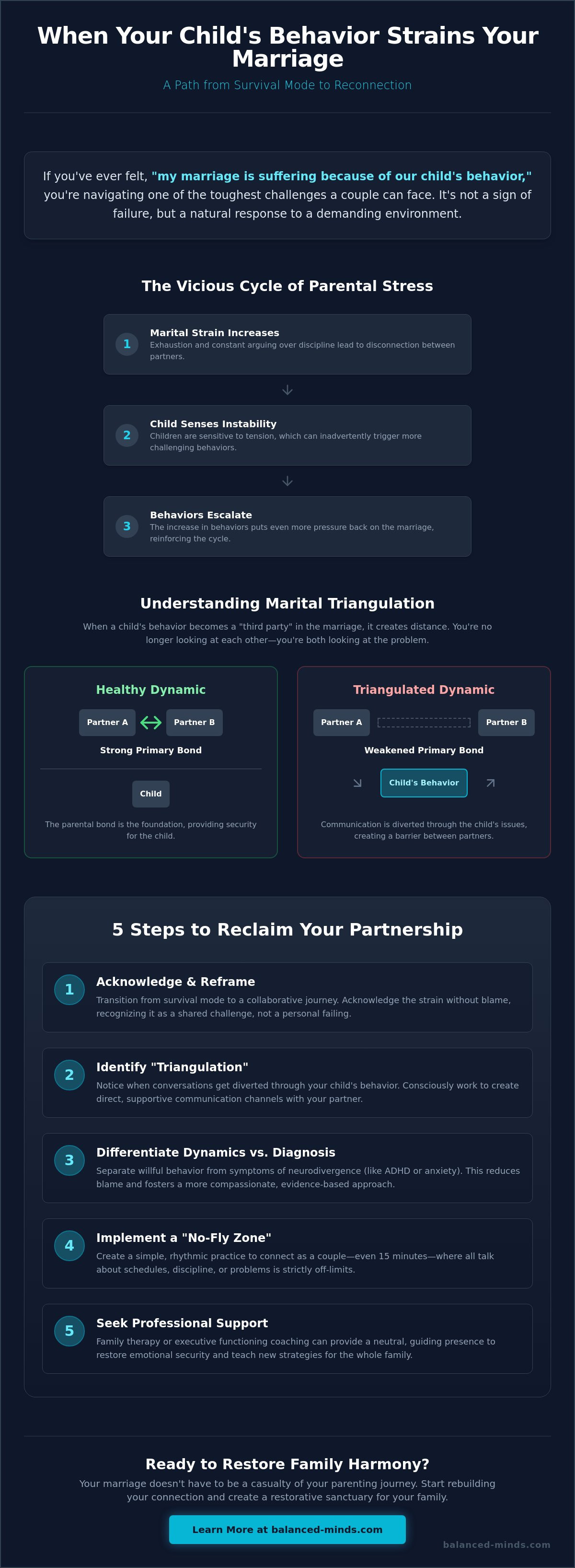
4 Steps to Reclaim Your Marriage While Supporting Your Child
Moving from a state of survival back into a partnership requires more than just good intentions; it requires a structural shift in how you interact daily. When you are in the thick of high-needs parenting, your relationship can feel like a secondary concern. However, we believe that a healthy marriage is the foundation upon which your child’s recovery is built. If you find yourself admitting that my marriage is suffering because of our child's behavior, these four steps offer a practical framework to begin your journey back to each other.
Step 1: Establishing a 'No-Fly Zone': Protect your relationship by scheduling times where child-talk is strictly prohibited. Whether it is a thirty-minute window after dinner or the first hour after you both get home, this boundary ensures you remain individuals with interests beyond caregiving.
Step 2: The 10-Minute Daily Debrief: Dedicate ten minutes each night to check in on each other's emotional state. The rule is simple: you cannot discuss the child's actions, school reports, or therapy schedules. Focus entirely on how your partner is feeling and what they need from you as a spouse.
Step 3: Radical Transparency: Contempt is the quiet killer of marriages. Practice expressing resentment or frustration before it hardens into permanent bitterness. Using "I feel" statements helps you share your burden without placing blame on your partner.
Step 4: Outsourcing the Crisis: You were meant to be parents, not full-time therapists or behavioral interventionists. By utilizing professional family therapy, you take the "clinician" role off your own shoulders, allowing you to return to being a supportive, loving couple.
Building a Unified Front
One of the most restorative things you can do is learn to disagree on discipline behind closed doors. When you present a divided front, children often sense the instability, which can increase their anxiety and behavioral outbursts. We recommend the "Tag-Team" method: learn to recognize the subtle signs that your spouse is reaching their limit and step in before they snap. A unified front serves as a psychological safety net that allows a child to feel contained and secure even during their most turbulent moments.
Micro-Connections: Intimacy in the Chaos
Traditional advice like "weekly date nights" can feel like an impossible pressure when you have a child who struggles with transitions or requires specialized care. Instead, we encourage you to find micro-connections. This might mean a five-minute window for a shared cup of coffee in the morning or a brief moment of physical touch before starting the evening routine. Finding shared hobbies that have nothing to do with parenting helps you remember the people you were before life became so complicated. Reclaiming these small spaces is how you prove to yourselves that while my marriage is suffering because of our child's behavior, it is still a bond worth fighting for.
Healing Together: Family Therapy in St. Pete and Tampa
Transitioning from individual survival to collective healing is a profound journey for any couple. If you've reached the point where you feel my marriage is suffering because of our child's behavior, seeking professional support isn't an admission of defeat. It's a brave act of honesty. We believe that seeking help is a sign of marital strength, demonstrating that you value your partnership enough to seek a steady, guiding presence through the storm. Family therapy in St. Petersburg focuses on the marital bond as the primary engine for change, ensuring that you and your spouse have the emotional security to lead your family effectively.
Many families find that individual child therapy alone isn't enough to reduce the friction at home. We often integrate ADHD coaching or executive functioning coaching into our whole-family wellness approach. These services address the practical, daily volatility that wears down a couple's patience, such as homework battles or morning routine meltdowns. By providing a structured roadmap for these challenges, we help take the "therapist" role off the parents' shoulders. This allows you to move from being "crisis managers" back to being a resilient, loving team. Even when you feel my marriage is suffering because of our child's behavior, the path to recovery is attainable through collaborative, evidence-based care.
Balanced Minds' Approach to Family Wellness
Our approach is grounded in restorative strategies tailored for families in the Tampa Bay area. we focus on helping parents reclaim their identity beyond the role of "caregiver," fostering a sense of shared humanity and mutual support. We understand that your schedules are often packed with appointments and school demands. To make support more accessible, we offer telehealth options for Florida families, ensuring that professional guidance fits into your life without adding the stress of a commute. This flexibility helps maintain the consistency needed for long-term healing and personal development.
Your Next Steps Toward Peace
Starting the conversation with your spouse about counseling can feel daunting, especially when emotions are high. We suggest framing the invitation as a way to "strengthen our alliance" rather than "fixing the marriage." In your first session at our St. Pete office, we create a safe, non-judgmental environment where you can both be heard. We will help you move away from the blame game and toward a shared vision for your family's future. Ready to restore your partnership? Contact a child psychologist in St. Petersburg today.
Moving Toward a Restorative Future Together
You don't have to carry the weight of high-needs parenting in isolation. We've explored how the "child-centric trap" can erode the vital connection between you and your spouse, but we've also seen how practical boundaries and a shared clinical language can begin to mend those fractures. Acknowledging that my marriage is suffering because of our child's behavior is often the catalyst for the profound healing your family deserves. By shifting from a state of constant crisis to one of collaborative understanding, you protect your partnership while providing your child with the emotional security they need to thrive.
We provide non-judgmental care in St. Petersburg and Tampa, helping you reclaim your identity as a couple and a team. Restore your marriage and support your child, schedule a consultation at Balanced Minds today. You possess the capacity for growth, and we're here to be your steady, guiding presence as you rediscover the warmth and connection in your home.
Frequently Asked Questions
Is it normal to feel like I don't love my child when my marriage is suffering?
Yes, it is a common and understandable response to extreme parental burnout and chronic stress. When your nervous system is stuck in survival mode, your brain often prioritizes immediate safety over emotional warmth. This state of "emotional numbness" is a temporary symptom of depletion rather than a permanent reflection of your character or your bond with your child. Recovery begins with self-kindness and restorative support.
Can our marriage survive if we disagree on how to discipline our child?
Absolutely, provided you move from being adversaries to allies in your approach. Disagreements are inevitable, but they become destructive when they turn into a polarized "good cop vs. bad cop" dynamic. Success comes from establishing a shared parenting philosophy behind closed doors. By creating a unified front, you provide a psychological safety net for your child while reducing the friction between you and your spouse.
How do we find time for our marriage when our child requires 24/7 attention?
Focus on "micro-connections" rather than large blocks of time that might feel impossible to schedule. When you feel my marriage is suffering because of our child's behavior, trying to plan a weekend getaway can feel overwhelming. Instead, prioritize five-minute windows of eye contact or a brief check-in that has nothing to do with parenting. These small moments of shared humanity help maintain your bond amidst the daily chaos.
Should we tell our child that their behavior is affecting our marriage?
No, children should not carry the emotional weight of their parents' relationship quality. While it is healthy to acknowledge that "mom and dad are feeling tired or stressed," placing the blame on the child’s behavior can lead to deep-seated guilt and increased anxiety. It is more effective to model healthy conflict resolution and seek professional support to manage the household dynamics without making the child feel responsible.
What is the difference between marriage counseling and family therapy for this issue?
Marriage counseling specifically focuses on the bond between partners, while family therapy examines the entire household system. For many, family therapy is a more comprehensive choice because it addresses how the child’s needs impact the marital relationship. We often use this framework to help parents reclaim their partnership while simultaneously developing practical strategies to support the child’s behavioral and emotional development.
How do I know if my child's behavior is a clinical issue like ADHD or just a phase?
Look for patterns of frequency, intensity, and duration that interfere with multiple areas of daily life. If the behavior is consistent across different environments, such as both school and home, it may indicate a clinical issue. A comprehensive psychological evaluation provides a definitive answer. This assessment acts as a roadmap, helping you move from frustration to an evidence-based understanding of your child's unique brain.
What if my spouse refuses to acknowledge that our child's behavior is a problem?
Start by sharing your own internal experience rather than criticizing their perspective or parenting style. Use "I" statements to explain that "I am struggling and I need your partnership." Sometimes, a spouse may use denial as a defense mechanism against shame or fear. Inviting them to a neutral, professional consultation can help bridge the gap in your perceptions and foster a sense of shared mission.
How can we stop arguing in front of our children?
Implement a "pause" rule where either partner can signal a need to stop a heated conversation immediately. When you recognize that my marriage is suffering because of our child's behavior, it is easy to get triggered in the heat of the moment. Agree to table the discussion for a scheduled time when the children are asleep or out of the house. This practice protects your children from tension while ensuring your concerns are heard.


