

Learning Disability Testing in St. Petersburg: A Compassionate Guide to Your Child's Learning Profile
Updated: 3 days ago
What if the academic struggle your child is facing isn't a sign of a deficit, but a signal that their brain simply needs a different set of instructions? It's heartbreaking to watch a bright student lose their confidence as they work twice as hard as their peers only to fall further behind. We understand the weight of your worry, especially when you're seeking learning disability testing in St. Petersburg but feel caught between school screenings and the fear of a negative label. You want answers that lead to action, not just a name for the problem.
We believe that a professional evaluation should be a bridge to understanding and a pathway to relief. Our goal is to transform that sense of frustration into a clear, restorative roadmap for success throughout the Tampa Bay area. In this guide, we'll explain how a comprehensive psychological evaluation reveals your child's unique learning profile. You'll discover how these clinical insights lead to concrete school accommodations and, most importantly, how we can work together to restore your child's natural love of learning. This journey is about more than scores; it's about helping your child feel seen, supported, and capable once again.
Table of Contents
Understanding Learning Disability Testing in St. Petersburg: Beyond the Label
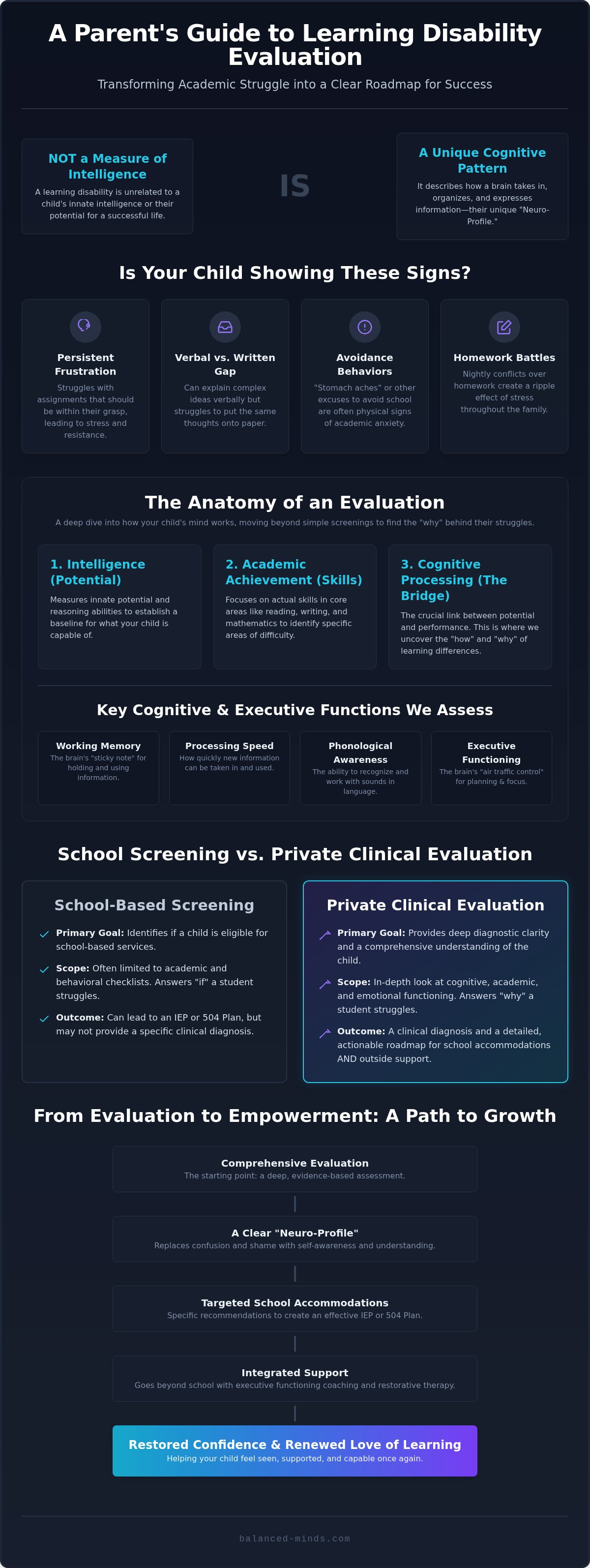
When we talk about learning disability testing in St. Petersburg, we aren't looking for a deficit. We're looking for a map. A learning disability has nothing to do with a child's intelligence or their potential for a successful life. Instead, it's a specific pattern of cognitive processing. It describes how a brain takes in, organizes, and expresses information. We like to think of this as discovering your child’s unique "Neuro-Profile." By understanding how your child absorbs and retains information, we can shift the narrative from "why can't they do this?" to "how do they do this best?"
Watching your child struggle often takes a quiet, heavy toll on the entire family dynamic. The nightly battles over math homework or the tears during reading time aren't just about school; they create a ripple effect of stress that touches every part of your home life. It's natural to feel a sense of hesitation about "labeling" your child. However, we see a diagnosis as a tool for liberation rather than a limitation. It's a key that unlocks specific resources and school accommodations. Most importantly, it provides a language for your child to understand their own experience, replacing shame with self-awareness.
Common Signs Your Child is Struggling
While every child is different, certain patterns often emerge when a student is working against their own processing style. You might notice persistent frustration during assignments that should be within their reach. One of the most telling signs is a significant gap between what a child can explain verbally and what they can actually produce on paper. When school feels like an uphill climb, children often develop avoidance behaviors. Those "stomach aches" on Monday mornings are often real physical manifestations of academic anxiety, and they are frequently the catalyst for parents seeking learning disability testing in St. Petersburg.
The Power of Early Identification in 2026
As we look at the educational standards of 2026, the old model of "waiting for a child to fail" before intervening is being replaced by a more compassionate, proactive approach. Waiting until a student is years behind grade level causes deep, avoidable emotional distress. Because of neuroplasticity, early support allows us to help children build stronger neural pathways while their brains are at their most adaptable. Identifying these needs early ensures that the right strategies are in place from the start. Early testing is a vital intervention that preserves a child's self-esteem before academic shame has a chance to take root.
The Anatomy of an Evaluation: What We Measure and Why
A comprehensive evaluation is far more than a simple checklist or a single afternoon of testing. It's a thoughtful, evidence-based process that looks at how different parts of your child's mind work together. When we perform learning disability testing in St. Petersburg, we look at three primary pillars: intelligence, academic achievement, and cognitive processing. Intelligence measures your child's innate potential and reasoning abilities, while academic achievement focuses on their actual skills in reading, writing, and math. A simple screening might tell you that a child is struggling, but a comprehensive neuropsychological evaluation tells you exactly why. This depth is what makes our approach so transformative for local families.
Cognitive processing is the bridge between potential and performance. It includes several vital functions that we measure to understand your child's unique needs:
Working Memory: The brain's ability to hold and manipulate information in the short term.
Processing Speed: How quickly a child can take in and respond to new information.
Phonological Awareness: The ability to recognize and work with sounds in spoken language.
We also integrate a deep assessment of executive functioning. These are the "air traffic control" skills that allow a child to plan, organize, and stay focused. When these skills aren't fully developed, even the brightest child can struggle to keep up with daily classroom demands. By looking at the whole child, including their emotional and behavioral state, we ensure that we aren't just looking at a score. We're looking at a person who might be feeling anxious or discouraged by their school experience and needs a supportive path forward. This holistic view helps us understand how emotional barriers might be impacting cognitive performance.
Neuropsychological Insights at Balanced Minds Psychology & Wellness
At Balanced Minds Psychology & Wellness, we go beyond the standard assessments often found in school settings. Our team provides a depth of insight that standard screenings simply cannot reach. We believe that every family deserves a clear, clinical understanding of their child's needs that feels both authoritative and accessible. If you've been searching for psychology near me to find specialized support, our comprehensive neuropsychological evaluations at Balanced Minds Psychology & Wellness offer a level of detail that transforms confusion into a concrete plan for growth.
Private vs. School-Based Testing: Making the Right Choice in Florida
Choosing between school-based and private learning disability testing in St. Petersburg is a significant decision for any family. It helps to understand that these two paths follow different philosophies. The school district uses an "Educational Model," which is designed to determine if a child’s challenges are severe enough to require special education services to access the curriculum. In contrast, our private "Clinical Model" focuses on providing a formal medical or psychological diagnosis. While both have value, their goals are distinct. Our clinical approach seeks to understand the child's entire cognitive landscape, not just their ability to meet state standards.
Many parents in Florida find themselves in a difficult position because schools often won't initiate testing until a child is significantly behind their grade level. This "wait to fail" approach can be agonizing for a parent who sees their child struggling long before the school’s data points show a crisis. Additionally, Florida public schools often face high demand, leading to lengthy waitlists that can delay support for months. By seeking a private evaluation, you can bypass these systemic delays and gain immediate insights into your child's learning style.
The Limitations of School-Based Assessments
School psychologists are often highly skilled but manage intense caseloads that limit the time they can spend on a single report. Their primary task is to see if a child meets the legal criteria for "eligibility" for specific services. This is why a school might say a child doesn't qualify for support even when they are clearly struggling. They aren't saying the struggle isn't real; they're saying it hasn't reached the specific threshold for district-funded intervention. This can leave families without a clear diagnosis or a plan for how to help their child at home.
The Private Evaluation Advantage
Navigating IEPs and 504 Plans in Pinellas County Schools
Once you have the results from your learning disability testing in St. Petersburg, the next step is sharing those clinical insights with your child's school. This transition usually happens during a Child Study Team meeting or an Eligibility Meeting. We know these rooms can feel intimidating for parents. However, your private evaluation report serves as a powerful tool that speaks with professional authority on your child's behalf. It provides the evidence needed to secure specific support, whether that's through an IEP or a 504 Plan. You aren't just a spectator in these meetings; you're a vital partner and the primary expert on your child's daily life.
IEP vs. 504 Plan: Which Path is for Your Child?
The choice between these two paths depends on how your child's learning profile interacts with the school curriculum. An Individualized Education Program (IEP) is designed for students who require specialized instruction or a modified curriculum to make progress. If the testing shows your child needs a different way of being taught, an IEP is the likely route. Conversely, a 504 Plan is for students who can handle the standard curriculum but need specific accommodations to "level the playing field." Testing results are the primary factor in determining which path is legally appropriate for your child's needs.
Common accommodations we often recommend include:
Dyslexia: Access to audiobooks, specialized multisensory reading instruction, and extended time on tests.
Dysgraphia: The use of speech-to-text software, provided copies of class notes, or oral testing options.
ADHD: Frequent movement breaks, preferential seating away from distractions, and assignments broken into smaller steps.
Advocacy Tips for St. Petersburg Parents
To start the process in Pinellas County, it's vital to submit a request for an evaluation in writing. This formal step triggers specific Florida state timelines that schools must follow. When you sit down with the school team, use the "Recommendations" section of our clinical report as your checklist. We write these sections specifically to be "school-ready," meaning the language aligns with the types of support Florida schools are equipped to provide. We want you to feel confident that the clinical data is working for your child.
If you feel unsure about how to bridge the gap between home and school, speaking with a child psychologist st petersburg fl can provide the clarity you need to move forward. We are here to ensure that the results of your learning disability testing in St. Petersburg translate into real, daily relief for your child in the classroom. You don't have to navigate the Pinellas County school system alone.
Secure the roadmap your child deserves by scheduling a comprehensive psychological evaluation with our team today.
A Partnership for Growth: The Balanced Minds Psychology & Wellness Approach
At Balanced Minds Psychology & Wellness, we believe that learning disability testing in St. Petersburg is the beginning of a transformative journey, not just the conclusion of a diagnostic process. Our approach is rooted in neurodiversity-affirming care, which means we celebrate your child’s unique cognitive style while providing the practical tools they need to flourish. We don't just hand you a report and send you on your way; we work alongside you to integrate these findings into a life-changing support system. This partnership often includes specialized ADHD coaching or executive functioning coaching to help your child master the organizational skills that may have previously felt out of reach.
By viewing your child's learning profile through a compassionate lens, we can help them move from a place of frustration to a state of empowerment. Our team is dedicated to ensuring that every child feels seen and understood throughout the entire evaluation process. We bridge the gap between clinical data and daily life, making sure that the insights we gain lead to tangible improvements in your child's confidence and academic performance. This collaborative model ensures that the "instruction manual" we create together is used effectively at home and in the classroom.
Beyond the Diagnosis: Therapeutic Support
Years of academic struggle often leave behind a residue of low self-worth, chronic test anxiety, or a general sense of being behind. We address these emotional layers by integrating testing results into therapeutic goals for mood and anxiety support. Through individual therapy, we help children and adolescents understand their own brain manual, transforming their diagnosis into a source of self-awareness rather than a reason for shame. If your child’s profile includes attention challenges, finding a psychologist for adhd diagnosis can be the first step in addressing the underlying emotional factors that often accompany learning differences.
Next Steps for Your Family
The path to clarity starts with a supportive intake call at our St. Petersburg office. During this initial conversation, we'll listen to your concerns and explain how our comprehensive evaluations can provide the answers you've been seeking. We take great care to prepare your child for testing day, ensuring they feel safe, curious, and comfortable in our environment. This child-centered approach helps us gather the most accurate data while preserving your child's emotional wellbeing. You don't have to navigate the complexities of the Florida school system alone, as we are committed to being your steady, guiding presence through every meeting and milestone. Together, we can turn academic frustration into a clear, restorative roadmap for your child's long-term success.
A Clear Path Toward Your Child's Brightest Future
Choosing to pursue learning disability testing in St. Petersburg is a profound act of care that shifts the focus from academic frustration to meaningful understanding. We've explored how a comprehensive evaluation serves as an instruction manual for your child's unique brain, providing the diagnostic clarity needed to unlock essential school resources. By choosing a private clinical model, you ensure your child receives a deep, holistic assessment that goes far beyond standard school eligibility requirements. This process is about more than just a diagnosis; it's about creating a sustainable environment where your child can finally feel successful.
We believe that every student possesses the capacity for growth when they are met with the right strategies and support. You don't have to carry the weight of academic worry alone; we are here to partner with your family at every step of this journey. Schedule a consultation with our St. Petersburg testing experts today. It's time to replace confusion with a concrete plan that restores your child’s confidence and their natural love for learning.
Frequently Asked Questions
How do I know if my child needs learning disability testing?
You should consider testing if your child shows a persistent gap between their effort and their grades or if they experience intense emotional distress during homework. Look for signs like avoidance, frequent "stomach aches" on school days, or a significant difference between their verbal intelligence and their written work. These patterns suggest that your child is working against their own processing style rather than a lack of ability.
Will Pinellas County Schools accept a private evaluation for an IEP?
Yes, Pinellas County Schools are legally required to consider private evaluations when determining eligibility for an IEP or 504 Plan. While the school district makes the final decision on eligibility, a comprehensive report from a board-certified neuropsychologist provides the clinical evidence needed to advocate for services. Our team ensures that our learning disability testing in St. Petersburg meets the specific documentation standards required by local school boards for your child's success.
What is the difference between dyslexia testing and a full neuropsychological evaluation?
Dyslexia testing focuses specifically on phonological processing and reading skills, whereas a full neuropsychological evaluation looks at the entire brain. A comprehensive evaluation measures intelligence, memory, attention, and executive functioning alongside academic skills. This broader view helps us identify if a reading struggle is actually caused by a different underlying issue, such as a working memory deficit or an attention disorder that requires a different type of support.
How long does the learning disability testing process take?
The testing process typically involves several hours of direct assessment, often spread across one or two sessions to prevent fatigue. After the testing is complete, we spend several more hours analyzing the data and writing a detailed, school-ready report. You can usually expect a follow-up meeting to review the results within two to three weeks of the final testing date, providing your family with a clear roadmap and answers quickly.
Does insurance cover learning disability evaluations in Florida?
Insurance coverage varies significantly depending on your specific provider and whether the testing is deemed medically necessary. While many plans cover evaluations for ADHD or neurodevelopmental disorders, some may view academic-only testing as an educational expense. We recommend contacting your insurance carrier directly to ask about your benefits for psychological or neuropsychological testing. We can provide you with the necessary documentation to assist in this process and help you navigate the requirements.
At what age can a child be tested for a learning disability?
Children can be tested as early as age five or six, though some signs of processing differences appear even earlier. Early identification is vital because it allows us to utilize neuroplasticity during the most formative years. If you notice your child is struggling with basic letter recognition or counting in kindergarten, seeking learning disability testing in St. Petersburg early can prevent years of academic frustration and help preserve their growing self-esteem before they fall behind.
What should I tell my child about the testing day so they aren't nervous?
You can tell your child that they'll be working with a teacher or a "brain coach" who wants to find out how they learn best. Explain that there are no grades and they can't fail any part of the day. We use engaging, game-like tasks to keep them curious and comfortable. Framing the day as a way to make school easier for them helps reduce anxiety and builds a sense of partnership.
Can a learning disability be 'cured,' or will my child always need help?
A learning disability isn't something to be cured because it's a fundamental part of how a child’s brain is wired. Instead, we focus on building compensatory strategies and using accommodations to bypass the areas of struggle. Many individuals with learning differences go on to be highly successful by leveraging their unique strengths. Our goal is to help your child understand their brain so they can navigate the world with confidence and pride.


