

How to Tell Family About Your Child’s Diagnosis
Updated: 2 days ago
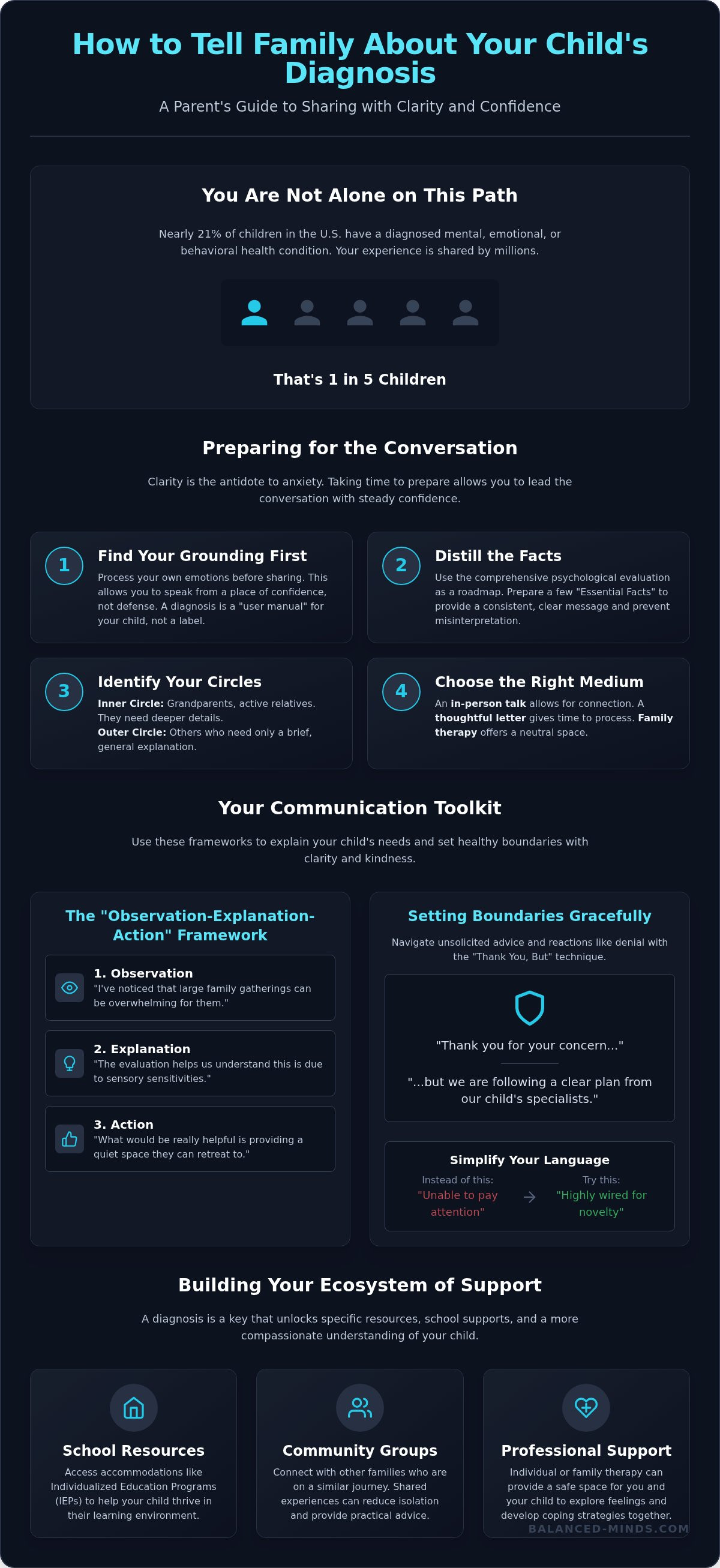
You finally have the answers you've been seeking, yet the thought of sharing them feels more like a burden than a breakthrough. When you think about how to tell family about child's diagnosis, you might worry about being blamed for "bad parenting" or fear the exhaustion of explaining clinical terms over and over. We recognize this delicate tension. With nearly 21% of children in the U.S. having a diagnosed mental, emotional, or behavioral health condition, you're certainly not walking this path alone. It's a heavy weight to carry, and it's okay to feel protective of your child's story and your own emotional energy.
We believe that sharing this information should protect your peace, not deplete it. This guide provides a gentle roadmap to help you communicate with clarity while transforming family members into true allies. We'll explore how to set firm boundaries against unsolicited advice and use accessible language to build a shared understanding. Together, we'll look at ways to manage the initial reactions of others while keeping your child's needs at the center of the conversation. By the end, you'll have the tools to foster a supportive ecosystem where your child can thrive and you can finally feel a sense of collective relief.
Table of Contents
Understanding the Emotional Weight of Sharing a Diagnosis
Receiving a diagnosis often feels like the end of one long, exhausting marathon and the start of a completely different journey. You might feel a strange mix of relief because you finally have a name for your child's struggles, alongside a deep sense of grief for the "typical" path you once imagined. These feelings are valid and universal. When you begin considering how to tell family about child's diagnosis, it's natural to feel exposed. You aren't just sharing medical information; you're entrusting others with your child's identity and your own vulnerability as a parent.
Gaining a deeper perspective on Understanding Childhood Chronic Illness helps us see that these challenges are part of the human condition rather than a personal failure. In the U.S., nearly 1 in 5 children aged 3 to 17 have a diagnosed mental, emotional, or behavioral health condition. We view this diagnostic journey as a path toward clarity rather than a catalog of deficits. A label isn't a cage. It's a key that unlocks specific resources, school supports, and a more compassionate understanding of how your child’s unique brain functions.
Why We Hesitate to Speak Up
Many parents pause before speaking because they fear the weight of generational judgment. You might worry that grandparents will dismiss the diagnosis as "just a phase" or hint at "bad parenting" as the cause. There is also the quiet fear that cousins or siblings will treat your child differently; perhaps with a sense of pity that feels alienating. This hesitation often stems from the sheer exhaustion of knowing you'll have to act as the primary expert, repeatedly translating complex clinical terms for relatives who may not be ready to hear them.
Finding Your Own Grounding First
Before you become the messenger for your family, you must prioritize your own emotional stability. Processing your own reactions away from the gaze of others allows you to speak from a place of steady confidence rather than raw defense. It's helpful to reframe the diagnosis as a "user manual" for your child’s specific needs. It helps you navigate their world more effectively. If you find yourself struggling to find the right words or feeling overwhelmed, engaging in Individual Therapy for Children can provide a safe space for you and your child to explore these feelings. When you feel grounded, you can approach the conversation as an invitation to a supportive partnership rather than a confrontation. You deserve to have a network that holds you up as you hold up your child.
Preparing for the Conversation: What to Know Before You Speak
Clarity is the antidote to the anxiety that often accompanies a new diagnosis. Before you decide how to tell family about child's diagnosis, it's helpful to organize the information provided in your child’s comprehensive psychological evaluation. These documents are more than just lists of symptoms; they are roadmaps that explain how your child learns, interacts, and experiences the world. By distilling this into a few "Essential Facts," you can provide a consistent message that prevents confusion and misinterpretation.
We suggest identifying your "Inner Circle" versus your "Outer Circle" of family members. Your inner circle might include grandparents or siblings who play an active role in your child’s life and require a deeper level of detail. For the outer circle, a brief explanation may suffice. You should also consider the best medium for this delivery. While in-person conversations allow for emotional connection, a thoughtful letter gives relatives time to process the news before responding. If the situation feels particularly complex, a Family Therapy session can provide a neutral, facilitated space where everyone feels heard and supported.
Simplifying Clinical Language
When we use heavy clinical jargon, we risk losing our audience to confusion or fear. Instead of focusing on deficits, we can describe your child's needs through the lens of their unique strengths. A diagnosis is a difference in brain processing, not a lack of ability. For example, when discussing ADHD, you might explain that your child’s brain is "highly wired for novelty" rather than "unable to pay attention." This shift helps family members see the child, not just the condition, and focuses the conversation on how they can best provide support.
Anticipating Difficult Questions
It's common for well-meaning relatives to ask questions that feel like an interrogation. They might ask about causes, often leaning on outdated myths regarding diet or screen time. Preparing for these moments by leaning on professional backing can shield you from taking these questions personally. Relying on the expertise of a psychologist for ADHD diagnosis provides a source of truth that moves the conversation away from opinion and toward evidence-based reality. When you set a clear goal for the conversation, whether it's seeking support or simply providing information, you remain the leader of your family’s narrative.
Practical Strategies for Telling Different Family Members
Every relationship in your life carries a different emotional frequency, which means your approach to how to tell family about child's diagnosis should be equally unique. You don't need to give a clinical lecture to everyone you know. Instead, we recommend tailoring your message based on how often that relative interacts with your child. By providing specific, relatable context, you help them move past the "label" and see the child they already love through a more compassionate lens.
We find that the "Observation-Explanation-Action" framework is a powerful tool for these moments. Start with an Observation of a behavior the family has already seen, such as "You know how [Child] often gets overwhelmed at loud birthday parties?" Follow this with a gentle Explanation: "We've learned that their brain processes sensory information more intensely than ours." Finally, provide an Action: "It helps them if we have a quiet 'cool-down' spot ready before the guests arrive." This structure invites family members to join your "Support Squad" by giving them a clear role in your child's success.
Talking to Grandparents: Bridging the Generational Gap
Grandparents often experience a unique form of denial, sometimes rooted in the fact that these conditions were frequently overlooked or stigmatized in previous generations. It's helpful to acknowledge that while these challenges aren't new, our understanding of them has evolved. You might say, "In the past, these struggles were often misunderstood, but modern science now gives us the tools to support [Child] effectively from the start." Focus on how this clarity allows your child to navigate the current Florida school system with specific protections like IEPs or 504 plans, ensuring they don't fall behind. This frames the diagnosis as a proactive advantage rather than a setback.
Explaining the Diagnosis to Siblings
Siblings need age-appropriate honesty that balances their curiosity with emotional security. It's common for younger children to worry that a diagnosis is something they might "catch," so clear reassurance is vital. We also suggest focusing on the concept of fairness versus equality; explain that while everyone in the family gets what they need, those needs look different for everyone. If siblings are struggling to process these changes in household dynamics, seeking family therapy near me can provide a neutral space for them to voice their feelings. This ensures that every member of the family feels seen and supported as you transition into this new chapter of understanding together.
Navigating Reactions and Setting Healthy Boundaries
Sharing news of this magnitude often acts as a mirror, reflecting back the internal world and coping mechanisms of those we love. When you consider how to tell family about child's diagnosis, it’s essential to prepare for a spectrum of reactions that may range from quiet denial to immediate "fix-it" mode. These responses rarely reflect your child's reality; instead, they are often the result of a relative's own fear, confusion, or lack of information. By identifying these patterns early, you can remain centered in your role as your child's primary advocate.
We often see four primary reactions in family dynamics:
Denial: A refusal to believe the diagnosis is accurate, often accompanied by the claim that "they'll grow out of it."
Anger: Blame directed at the education system, the doctors, or even your parenting style.
Pity: Seeing the child through a lens of deficit rather than a lens of unique capability.
The "Fix-it" Mode: Bombarding you with unsolicited advice, supplements, or alternative "cures" that lack scientific backing.
To navigate these moments, we recommend the "Thank You, But" technique. This allows you to acknowledge the relative’s intent without compromising your child's care. For example, "I appreciate that you want to help, but we are committed to the evidence-based path we've established with our clinical team." If you find that these conversations are causing significant strain on your relationships, engaging in Family Therapy can help mediate these complex dynamics and restore a sense of harmony. It is also vital to protect your child from being "over-observed" during family gatherings; they should never feel like a specimen under a microscope.
When Family Members Stay in Denial
It is painful when a loved one refuses to acknowledge your child’s needs, but it’s helpful to recognize that denial is often a form of misplaced love. They may be trying to protect the child, or themselves, from a reality they find frightening. In these instances, you may need to stop the cycle of explaining. Simply "existing" with the diagnosis and modeling healthy support is often more powerful than a repeated clinical argument. Remember, you are the gatekeeper of your child’s self-esteem. If a relative’s skepticism begins to affect your child's sense of self, it is your right to limit those interactions until boundaries are respected.
Clear communication protects your peace and your child's dignity. When faced with the "He looks fine to me" comment, you might respond with: "We’re glad his challenges aren't always visible to everyone, but we’re focused on the internal hurdles he’s working hard to overcome." If a relative persists with unsolicited advice, use this script: "I appreciate your concern, but we are following our doctor's evidence-based plan, and we aren't looking for alternative suggestions at this time." Redirecting the conversation back to the child’s latest victory or strength helps remind everyone that your child is a whole person, not a diagnosis to be solved.
Building Your Ecosystem: Support in St. Petersburg and Beyond
A diagnosis acts as a vital passport. It grants your child access to essential Florida-specific school resources like Individualized Education Programs (IEPs) and 504 plans. When you're deciding how to tell family about child's diagnosis, framing the news as a tool for academic and social equity helps relatives see the practical benefits. You're inviting them to witness a journey of growth rather than a struggle with a deficit. Locally, the Tampa Bay area offers various support networks that remind us we aren't walking this path in isolation. Connecting with these groups fosters a sense of shared humanity and reduces the weight of the journey. Relying on professional psychology near me provides the clinical authority and warm accessibility needed to keep your family ecosystem balanced. We encourage you to hold a long-view perspective. Your child’s development isn't defined by a single moment, but by the steady accumulation of support and understanding over time.
Leveraging Professional Support for the Whole Family
Family therapy sessions offer a structured, safe environment to educate extended relatives. These sessions demystify professional support and help everyone understand the unique "user manual" for your child's brain. ADHD coaching can provide immediate, practical wins that family members can celebrate together, such as improved organizational skills or better emotional regulation. If your relatives live outside of St. Petersburg or Tampa, telehealth options allow them to join these educational conversations from anywhere. This inclusivity helps prevent the feelings of isolation that often occur when family members live far apart. It builds a unified front of support that benefits the child’s self-esteem and the family's collective peace.
Your Next Steps in Tampa Bay
Your journey continues with finding a child psychologist in St. Petersburg who can offer ongoing guidance. Reviewing the results of a comprehensive psychological evaluation with a nurturing expert turns abstract data into a concrete plan for your child's wellbeing. This process ensures that the information feels grounded and relevant to your daily life rather than remaining academic. We want to remind you that you are the most powerful advocate your child will ever have. By seeking clarity and building a supportive network, you are creating a restorative environment where your child can truly flourish. Your dedication to their growth is the greatest gift you can provide, and we are here to walk alongside you every step of the way.
We've walked through the delicate process of transforming a clinical diagnosis into a bridge for family connection. By grounding your conversations in evidence-based facts and using clear communication frameworks, you can move from a place of defensive isolation to one of shared understanding. Learning how to tell family about child's diagnosis is a journey of setting healthy boundaries that prioritize your child’s dignity and your own psychological peace. You're building an ecosystem where your child can be seen for their strengths rather than their hurdles.
Since 2021, Balanced Minds has served the St. Petersburg and Tampa communities with heart-centered expertise. We invite you to schedule a consultation with our compassionate team at Balanced Minds today to strengthen your family’s support network. You are the steady, guiding presence your child needs, and you don’t have to navigate this path alone.
Frequently Asked Questions
What if my parents think I am just 'over-parenting' or 'making things up'?
It's painful when your efforts to support your child are dismissed, but you can lean on the objective results of a comprehensive psychological evaluation. Remind your parents that these findings are tools for clarity; they are designed to help your child thrive in the Florida school system rather than reflecting your parenting style.
Should I tell my child about their diagnosis before I tell the rest of the family?
We generally recommend speaking with your child first, as this allows them to understand their own unique brain processing before hearing it from others. When you prioritize your child's narrative, you empower them to feel secure and informed. This internal clarity helps them navigate future conversations with relatives from a place of confidence. If you feel unsure about the right words, our individual therapy for children can help you frame the diagnosis in a strengths-based way.
How much detail do I really need to share with distant relatives?
You have full control over how much information you share with your outer circle of family members. For distant relatives, a brief explanation focusing on how they can be supportive is often enough. You don't owe anyone an exhaustive clinical history or a deep dive into the evaluation results. Focus on the action-oriented part of your communication, such as "It helps our child if we keep the environment calm," which protects their privacy while fostering support.
What do I do if family members refuse to follow our therapist's recommendations?
Consistency is vital for your child’s progress, so if relatives refuse to follow clinical recommendations, you must step into your role as a gatekeeper. You might say, "We’ve seen significant improvements by following this evidence-based plan, and we need everyone to be on the same page for our child’s benefit." If these conflicts persist, our family therapy sessions in St. Petersburg can provide a facilitated space to educate relatives and help them understand the practical benefits of these interventions.
How can I explain a 'Gifted' diagnosis without sounding like I am bragging?
Reframe a gifted diagnosis as a specific educational need rather than a trophy of superior ability. You can explain that giftedness often comes with unique asynchronous development or emotional sensitivities that require a specialized approach in the classroom. Focus on the resources your child needs to stay engaged, such as the Pinellas County school board requirements for gifted testing. This shifts the focus from bragging to advocating for the environment where your child can truly flourish in Tampa Bay.
Is it okay to wait a few months after the evaluation before telling anyone?
It is perfectly acceptable to wait until you feel emotionally grounded before deciding how to tell family about child's diagnosis. You deserve the time to process the findings and understand the "user manual" for your child’s needs without the added pressure of outside opinions. Taking this pause allows you to lead the conversation from a place of calm authority later on. We often see that parents who take this time feel more resilient when navigating the reactions of others.
How do I handle family members who want to share the news with others without my permission?
Protecting your child’s privacy is a fundamental boundary that you must state clearly and firmly to everyone involved. You might tell family members, "We are sharing this with you because we trust you, but we aren't ready for this information to go beyond our immediate circle." If someone crosses this line, it's okay to limit the information you share in the future. Your child’s identity is theirs to own, and maintaining that confidentiality is an essential part of advocacy.


