

How to Find a Good Child Therapist in Tampa: A Parent’s Compassionate Guide (2026)
Updated: 1 day ago
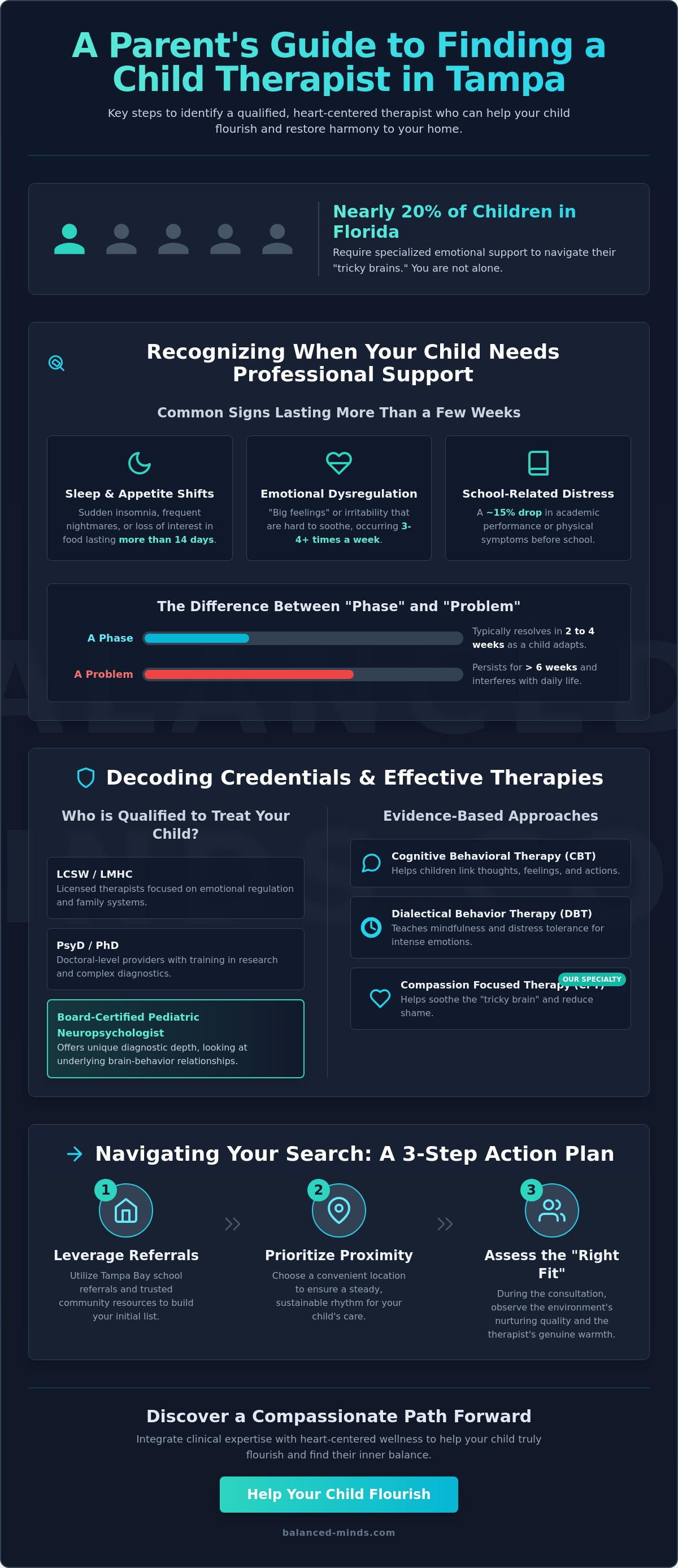
Imagine it's 10:45 PM on a Tuesday. You're sitting at your kitchen table, staring at a school report or a tear-stained pillow, wondering if your child's struggles are a reflection of your own parenting. You aren't alone; 2024 health data shows that nearly 20 percent of Florida children require specialized emotional support to navigate their tricky brains. It's natural to feel overwhelmed by the complex school system or the fear that a clinical environment will feel cold and judgmental. You deserve a partner who understands that your family's peace is the priority.
Learning how to find a good child therapist in tampa shouldn't feel like a lonely or clinical chore. We agree that your child needs a space that feels safe, nurturing, and deeply human. This guide provides the essential steps to identifying a qualified, heart-centered therapist in 2026 who can help your child flourish while restoring harmony to your home. We'll walk through how to evaluate clinical credentials, navigate Florida insurance, and find a mentor who truly connects with your child's unique spirit.
Key Takeaways
Deepen your understanding of your child’s "tricky brain" and learn to recognize the gentle signs that they may benefit from a specialized, play-based therapeutic space.
Gain clarity on how to find a good child therapist in tampa by decoding clinical credentials and understanding the diagnostic depth a neuropsychologist provides.
Navigate local logistics with ease by leveraging Tampa Bay school referrals and prioritizing proximity to ensure a steady, sustainable rhythm for your child’s care.
Learn how to assess the "right fit" during a consultation by observing the nurturing quality of the environment and the genuine warmth of the therapist’s connection.
Discover a compassionate path forward that integrates clinical expertise with heart-centered wellness to help your child truly flourish and find their inner balance.
Table of Contents Recognizing When Your Child Needs Professional Support Decoding Credentials: Who is Qualified to Treat Your Child? Navigating the Tampa Bay Search: Logistics and Referrals Assessing the "Right Fit": The First Consultation A Compassionate Path Forward at Balanced Minds
Recognizing When Your Child Needs Professional Support
Parenting is a journey of deep love and frequent uncertainty, especially when we notice our little ones struggling to navigate their world. We often view Child psychotherapy as a sanctuary rather than a clinical requirement; it's a specialized space where children use play, conversation, and skill-building to process complex emotions. Our "tricky brains" are part of a shared human experience, and acknowledging that a child's mind is still learning how to regulate doesn't mean anything is "broken." It simply means they need a bit of extra scaffolding to flourish. We're all born with brains that can be easily overwhelmed by the modern world, and therapy provides the soothing environment needed to find balance again.
Many parents begin researching how to find a good child therapist in tampa when they reach what we call the "tipping point." This usually occurs when a child's internal distress begins to spill over into their external world, disrupting the peace at home or causing friction in their friendships. Shifting your perspective from "what did I do wrong?" to "how can we help them thrive?" is the first step toward healing. It's a move away from shame and toward a collaborative partnership between you, your child, and their therapist.
Common Signs It’s Time to Seek Help
While every child has "off" days, certain patterns suggest a need for professional guidance. In our Tampa community, we often see these indicators manifest in specific ways:
Sleep and appetite shifts: Significant changes lasting more than 14 days, such as sudden insomnia, frequent nightmares, or a noticeable loss of interest in favorite meals.
Emotional dysregulation: "Big feelings" or irritability that feels impossible to soothe, occurring more than 3 or 4 times a week without a clear external trigger.
School-related distress: A 15% drop in academic performance or physical symptoms like stomach aches specifically occurring before heading to Tampa-area classrooms.
The Difference Between "Phase" and "Problem"
Distinguishing between a developmental milestone and a clinical concern requires looking at duration and intensity. A typical "phase" usually resolves within 2 to 4 weeks as a child adapts to a new situation or age. However, if symptoms of anxiety or mood disorders persist for more than 6 weeks and interfere with daily functioning, it's a sign that professional support is necessary. Early intervention is a profound gift of resilience; it provides your child with tools they'll use for the rest of their lives. When you explore how to find a good child therapist in tampa, you're taking a brave, nurturing step toward securing your child's future wellbeing and psychological safeness.
Decoding Credentials: Who is Qualified to Treat Your Child?
As we begin the journey to support your child's wellbeing, the "alphabet soup" of letters after a professional's name can feel overwhelming. Understanding these titles is a vital step in learning how to find a good child therapist in tampa who truly resonates with your family's needs. Licensed Clinical Social Workers (LCSW) and Licensed Mental Health Counselors (LMHC) are skilled professionals who often focus on emotional regulation and family systems. Doctoral-level providers, such as those with a PsyD or PhD, bring years of training in psychological research and complex diagnostics. For children with intricate learning profiles, a Board-Certified Pediatric Neuropsychologist offers a unique level of diagnostic depth; they look beyond surface behaviors to understand the underlying brain-behavior relationships.
We believe in using evidence-based modalities that provide a sense of safeness and practical progress. These approaches ensure your child isn't just "talking," but actively building a toolkit for life. Common effective frameworks include:
Cognitive Behavioral Therapy (CBT): Helps children identify how their thoughts influence their feelings and actions.
Dialectical Behavior Therapy (DBT): Focuses on mindfulness and distress tolerance for children experiencing intense emotions.
Compassion Focused Therapy (CFT): Our specialty, which helps children soothe their "tricky brains" and reduce the shame often associated with mental health struggles.
The American Psychological Association suggests that Finding a good therapist involves looking for someone who uses these proven methods while building a strong, nurturing connection with your child. A generalist may offer broad support, but specialized care is essential for ADHD or giftedness, where the "twice-exceptional" brain requires a more nuanced perspective.
Therapist vs. Psychologist: Which Do You Need?
Therapists provide the consistent, weekly emotional support that helps children build resilience and coping strategies. However, if you notice your child struggling with focus, memory, or social cues, a psychologist for adhd diagnosis is often necessary for comprehensive testing. These evaluations provide a clear roadmap for school and home. By 2025, clinical standards have shifted to ensure that testing and therapy work together as a holistic treatment plan, creating a seamless bridge between understanding a diagnosis and treating the child's heart.
Specialized Care for ADHD and Executive Functioning
Clinical therapy addresses the emotional weight of ADHD, but executive functioning coaching focuses on the practical "how" of daily life. During the 2024-2025 school year, local students in St. Pete and Tampa faced increasing academic demands that required sophisticated organizational skills. Specialized coaching helps students manage these pressures by teaching time management and task initiation. When you research how to find a good child therapist in tampa, look for providers who offer both testing and coaching. This integrated approach ensures your child doesn't have to retell their story to multiple people. If you're looking for a supportive environment to start this process, we invite you to connect with our compassionate team today.
Navigating the Tampa Bay Search: Logistics and Referrals
The journey toward healing often begins with the practical details of our daily lives. When you are exploring how to find a good child therapist in tampa, the physical distance between your home and the clinic plays a vital role in maintaining the rhythm of care. We often find that families who choose a provider within a 15 or 20 minute radius of their home or school are more likely to attend sessions consistently, especially during the humid Florida summer or busy school weeks. Proximity isn't just about convenience; it's about reducing the stress on your child's "tricky brain" before they even step into the therapy room.
Your local school system serves as a powerful bridge to professional support. Counselors within the Pinellas County or Hillsborough County school districts often maintain curated lists of providers who have successfully supported their students. These educators see how children interact in social environments every day, making them excellent partners in your search. As you begin this process, it is helpful to consult trusted resources on how to find a mental health professional to understand the different types of support available for your family's unique needs.
The financial side of therapy can sometimes feel like a maze, but there are clear paths through it. While many specialized child therapists in Florida operate as out-of-network providers to ensure a higher quality of focused care, they often provide "Superbills." These are detailed documents you can submit to your insurance for potential reimbursement. In 2024, many families are successfully using these out-of-network benefits to access the specific expertise their child requires without being limited by a narrow list of in-network options.
Finding a Child Psychologist in St. Petersburg, FL
St. Petersburg offers a unique community atmosphere that can make the therapeutic process feel more integrated and less clinical. Local parent groups in the Old Northeast or Kenwood areas are often wonderful starting points for finding the right child psychologist in St. Petersburg, FL. Having a local office allows for more frequent family therapy sessions where parents and children can interact in a soothing, neutral space. This physical presence helps build a sense of "safeness" that is sometimes harder to cultivate through a screen.
Questions to Ask During the Initial Phone Screen
When you first connect with a potential provider, use these questions to see if their approach feels like a warm fit for your family's heart:
“What is your experience with [specific struggle] in children my child’s age?” This helps you gauge if they understand the developmental nuances of your child's stage of life.
“How do you involve parents in the therapeutic process?” We believe that parents are essential partners in a child's growth, and a good therapist will have a clear plan for your participation.
“What does a typical first session look like in your Tampa office?” Knowing the structure helps you prepare your child, reducing any anxiety they might feel about the unknown.
Choosing between telehealth and in-person care is a deeply personal decision. For some children, the comfort of their own bedroom allows them to open up more quickly. For others, the dedicated "safe space" of a physical office in Tampa provides a necessary boundary between their struggles and their home life. Understanding how to find a good child therapist in tampa means honoring which environment allows your child to feel most secure and seen.
Assessing the "Right Fit": The First Consultation
The initial meeting is more than just an appointment; it's a sensory experience for both you and your child. When you walk into the office, observe the surroundings carefully. Does the environment feel like a sterile, clinical box, or is it a nurturing space designed to help a child flourish? Environmental psychology research suggests that warm lighting and soft textures can reduce a child's cortisol levels by up to 22 percent during stressful introductions. A space that feels like a sanctuary helps lower the "tricky brain" defenses, making the path to healing much smoother.
The connection between the clinician and your child is the most vital factor in the room. Watch how the therapist initiates contact. Do they get down on the child's eye level? Do they speak with a genuine warmth that invites curiosity? This initial rapport accounts for nearly 30 percent of successful outcomes in pediatric mental health. As you explore how to find a good child therapist in tampa, prioritize a professional who treats your child as a whole person rather than a set of symptoms.
We believe a clear roadmap is essential for peace of mind. During this first visit, the therapist should outline a structured plan, including any necessary psychological testing or specific therapeutic milestones. You should leave the room feeling like you've gained a partner, not just a provider. Trust your parental intuition. If the dynamic feels like a true partnership, you've likely found the right guide for your family's journey.
Red Flags to Watch For
Be wary of any provider who promises "quick fixes" for deep-seated emotional challenges. Real growth takes time, and complex internal struggles don't vanish in two or three sessions. Transparency is another cornerstone of trust. If a clinician is vague about fees or diagnostic processes, it creates unnecessary anxiety. Most importantly, avoid therapists who attempt to exclude parents entirely. We know that a child's progress is most sustainable when the family is integrated into the healing process.
The Importance of Psychological Safety
A soothing presence from the therapist helps the child's nervous system shift into a state of safeness, which is where real brain growth occurs. We use mindfulness and compassion-focused techniques to help children regulate their emotions from the very first session. It's also worth noting that a teenage therapist near me must build trust differently than a child therapist. Adolescents require a unique blend of autonomy and respect to feel secure enough to share their inner world. Understanding these developmental shifts is a critical step in learning how to find a good child therapist in tampa who can grow with your family.
If you're ready to see how a compassionate approach can transform your child's wellbeing, we invite you to connect with our dedicated team today.
A Compassionate Path Forward at Balanced Minds
Our practice changes that narrative by offering a warm, inclusive home for healing. We don't just look at symptoms; we see the whole child. Our integrated approach provides everything from comprehensive diagnostic testing to specialized ADHD coaching, ensuring your child has a roadmap to success.
We understand that a child's well-being is deeply connected to the health of the entire household. This is why we prioritize family therapy near me as a cornerstone of our practice. By involving parents and siblings, we create a shared language of compassion that helps everyone manage the complexities of life with more ease and less shame. When you're looking for how to find a good child therapist in tampa, it's vital to choose a partner who values the family unit as much as the individual child.
Why Choose Balanced Minds Psychology & Wellness
Our clinic blends rigorous clinical standards with a heart-centered delivery that prioritizes psychological safety. We offer specialized expertise in:
Gifted and 2e (twice-exceptional) testing for academic placement.
Comprehensive ADHD and neurodevelopmental evaluations.
Evidence-based treatment for mood disorders and anxiety.
Our goal is to help every Tampa child and young adult flourish by providing tools that honor their unique "tricky brains" while building lasting resilience. We meet families where they are, providing a steady, guiding presence through every developmental milestone.
Getting Started with Your First Appointment
We've designed our intake process to be as stress-free as possible for busy Florida parents. You can start with a low-pressure consultation to ensure our St. Pete office feels like the right fit for your child's growth. When preparing your child for their first visit, tell them they're visiting a "soothing" space where they'll meet people who care about their thoughts and feelings. It's a place for play, discovery, and support. You can schedule an evaluation or therapy session today to begin this journey of growth together.
Nurturing Your Child’s Brightest Future
Navigating your child's mental health journey requires both a compassionate heart and a clear map. You've learned how to identify the subtle signs of a "tricky brain" and the importance of verifying clinical credentials to ensure your child receives evidence-based care. By prioritizing the therapeutic bond during that first consultation, you're building a foundation of safeness where your child can truly be seen. Knowing how to find a good child therapist in tampa is about more than just a search; it's about finding a partner who honors your family's unique story and collective journey.
At Balanced Minds Psychology & Wellness, we provide that steady, expert guidance. Whether you need specialized ADHD coaching, gifted testing, or compassionate therapy, our team offers a restorative space for growth. We welcome families to our St. Petersburg office or through secure telehealth across the Tampa Bay area. You don't have to navigate these complexities alone. Begin your family’s journey toward flourishing at Balanced Minds Psychology & Wellness and discover the resilience that lives within your child.
Frequently Asked Questions
How much does child therapy cost in Tampa without insurance?
Private pay rates for child therapy in the Tampa Bay area typically range between $120 and $250 per hour according to 2024 regional market data. While these figures vary based on the provider's experience, many families find that investing in a specialist helps their child flourish more quickly. We understand that navigating these costs feels heavy; therefore, we encourage you to ask about sliding scale options which 15% of local private practices offer to increase accessibility.
What is the difference between a child therapist and a pediatric psychologist?
The primary difference lies in their educational background and the scope of their clinical practice. A child therapist usually holds a master's degree and focuses on talk or play therapy, while a pediatric psychologist has a doctoral degree and is trained to conduct complex diagnostic testing. Both professionals provide high-quality care, but a psychologist is often necessary if your child requires a formal evaluation for ADHD or autism.
Can my child get therapy at school in Hillsborough or Pinellas County?
Children attending public schools in Hillsborough and Pinellas counties can access mental health support through the district's Multi-Tiered System of Supports. In 2023, Florida allocated $160 million to school mental health grants, allowing schools to staff counselors who address academic barriers. While these services are helpful for school-based issues, they often lack the depth of private sessions when you're looking for how to find a good child therapist in tampa for long-term clinical needs.
How long does it usually take to see results from child therapy?
Most children begin to show measurable progress within 12 to 20 weekly sessions, according to clinical benchmarks from the American Psychological Association. Every child's journey is unique because their tricky brains process emotions at different speeds. You might see small, soothing shifts in their behavior after just 4 weeks, but lasting resilience usually develops over several months of consistent, nurturing support from a dedicated professional.
Does my child need a psychological evaluation before starting therapy?
A formal psychological evaluation isn't a requirement for starting therapy in 90% of cases unless there's a suspected developmental or learning disorder. Most therapists begin with a 60 minute clinical intake to understand your child's history and current struggles. This initial meeting allows us to create a compassionate roadmap for your child's growth without the immediate need for intensive diagnostic testing or complex paperwork.
Is telehealth as effective as in-person therapy for young children?
Research published in 2021 indicates that telehealth is just as effective as in-person visits for treating childhood anxiety and depression in children aged 7 and older. For younger children, we often find that a hybrid approach works best to keep them engaged. While digital screens can feel distant, our therapists use interactive tools to ensure the session remains a safe, restorative space for your little one.
What if my child refuses to talk to the therapist?
It's completely normal for a child to remain quiet during their first few sessions as they test the safeness of the environment. We don't force children to talk; instead, we use play, art, and movement to help them express what's happening in their world. This non-judgmental approach reduces their shame and allows a trusting partnership to form naturally over time, even without many words.
How do I explain therapy to my child without making them feel "broken"?
You can explain therapy by describing the therapist as a feelings coach who helps people understand their tricky brains. It's helpful to tell them that everyone needs a little extra support sometimes to help their heart feel lighter. By framing it as a journey to help them flourish, you ensure they don't feel broken, but rather supported. This is a vital step when you're learning how to find a good child therapist in tampa.


