

Helping My Teen Cope with School Stress: A Compassionate Parent’s Guide
Updated: 2 hours ago
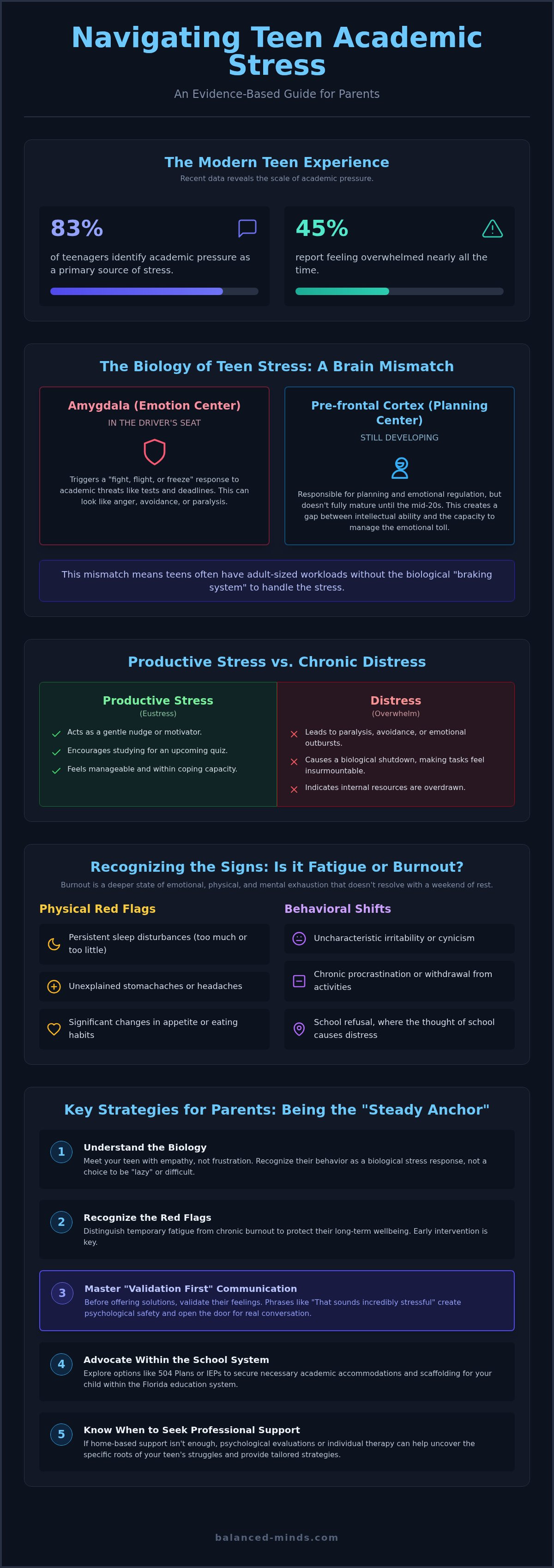
Recent data from 2026 reveals that 83% of teenagers identify academic pressure as a primary source of stress, while 45% report feeling overwhelmed nearly all the time. It is heart-wrenching to watch our children withdraw or become uncharacteristically irritable under the weight of a heavy workload. We often find ourselves searching for the most effective ways of helping my teen cope with school stress while fearing the long-term impact of chronic burnout. At Balanced Minds Psychology & Wellness, we recognize that these struggles aren't simply about a lack of effort; they're a complex nervous system challenge that requires a partnership of deep empathy and clinical strategy.
This guide offers evidence-based strategies to help your teenager navigate academic pressure while fostering the emotional resilience they need for long-term wellbeing. We'll explore the biological "mismatch" of the developing brain, identify the physical red flags of burnout, and provide clear steps for academic advocacy within the Florida school system. Our goal is to help you create a calmer home environment where your teen feels truly supported and capable of navigating their educational journey with confidence.
Table of Contents
Understanding the Biology of Teen School Stress
To truly begin helping my teen cope with school stress, we first need to look under the hood at what is happening inside their body. School stress isn't just a mental state; it's a physiological reaction where the nervous system perceives academic or social challenges as threats to safety. We often see a profound "mismatch" because we ask teenagers to handle adult-sized workloads, complex deadlines, and high-stakes testing while their brains are still undergoing major renovations. The pre-frontal cortex, which is responsible for executive functions like planning and emotional regulation, doesn't fully mature until the mid-twenties. This means that while they have the intellectual capacity for hard work, they don't yet have the biological "braking system" to manage the heavy emotional toll that comes with it.
We should distinguish between two types of pressure. Academic stress can sometimes be "productive stress," acting as a gentle nudge that motivates a student to study for an upcoming quiz. However, when the pressure exceeds their current coping capacity, it shifts into "distress." This is where we see paralysis, avoidance, or emotional outbursts. Instead of motivation, the teen experiences a biological shutdown that makes even simple tasks feel insurmountable. Understanding this distinction helps us move away from seeing a child as "lazy" and instead seeing them as a person whose internal resources are temporarily overdrawn.
The Developing Brain and Academic Pressure
During high-pressure moments like finals or SAT prep, a teen's amygdala, the brain's emotional center, often takes the driver's seat. This is why a simple math test can trigger a full "fight, flight, or freeze" response. You might see your child get angry (fight), avoid their homework entirely (flight), or stare blankly at a page for hours (freeze). These aren't choices; they're survival mechanisms. It's helpful to remember that neuroplasticity is a teen's superpower for building resilience. Their brains are incredibly adaptable, meaning the compassionate support we provide now can literally rewire how they handle challenges for the rest of their lives.
Common Triggers in the Modern Classroom
The landscape of education has changed, creating new biological triggers that didn't exist a generation ago. Digital portals like Focus or Canvas provide 24/7 access to grades, which can keep a student in a state of constant hyper-vigilance rather than allowing them to rest after school. In high-achieving Florida school districts, we often see the "perfectionism trap" where the pressure to maintain a specific GPA feels like a requirement for survival. This is compounded by the social-academic overlap, where peer comparison and college admissions anxiety turn every classroom interaction into a high-stakes competition. By recognizing these triggers, we can be more effective in helping my teen cope with school stress by validating their experience rather than just attempting to fix their schedule.
Recognizing the Signs: Is Your Teen Struggling or Burning Out?
Recognizing the difference between a tired teenager and one who is fundamentally burning out is a vital first step in helping my teen cope with school stress. While it is normal for students to feel drained at the end of a long semester, chronic burnout is a deeper state of emotional, physical, and mental exhaustion. Fatigue typically resolves with a weekend of rest. Burnout, however, leaves a teen feeling cynical, detached, and increasingly incapable of meeting daily demands. We must look for physical red flags like persistent sleep disturbances, unexplained stomachaches, or significant changes in appetite. These are often the body's way of communicating what the mind cannot yet put into words.
Behavioral shifts also serve as a compass for parents. You might notice your teen becoming uncharacteristically irritable or engaging in chronic procrastination. In some cases, this evolves into school refusal, where the mere thought of entering the building triggers intense distress. If you are noticing these anxious signs in St. Pete children, it is a signal that their internal resources are depleted and they need a supportive intervention. Identifying these patterns early allows us to provide the necessary scaffolding before a crisis occurs.
The Emotional Language of Stress
When a teenager says, "I hate this school," they are rarely expressing a literal dislike for the building or the curriculum. Most often, this is the emotional language of feeling overwhelmed and incapable. School stress is deeply tied to self-esteem; when a student feels they cannot meet expectations, they may begin to view themselves as a failure. We also see "masking," where a teen appears to be performing perfectly on paper, maintaining high grades and extracurriculars, while they are quietly crumbling inside. These high-performing students are often at the highest risk for sudden burnout because their struggle remains invisible until it reaches a breaking point.
Academic Red Flags to Watch For
A sudden drop in grades in a subject your teen previously enjoyed is a clear indicator that something has shifted. You might also see the "spinning wheels" effect, where they spend five hours on a single assignment with very little to show for it. This lack of productivity despite high effort is a hallmark of a nervous system stuck in a "freeze" state. Avoidance of specific teachers or classes can also point toward localized stressors that need addressing. Learning healthy ways to deal with it is an essential part of helping my teen cope with school stress. If these patterns continue, exploring Individual Therapy for Adolescents can provide the specialized support needed to navigate these hurdles.
Practical Strategies for Parents: Being the "Steady Anchor"
When the weight of academic expectations feels too heavy, our role as parents shifts from being a manager to being a steady anchor. One of the most effective ways of helping my teen cope with school stress is establishing a "validation first, solutions second" rule for our daily interactions. When a teenager's nervous system is flooded with cortisol, they literally cannot access the logical part of their brain to problem-solve. By validating their emotions first, we help lower their physiological arousal, creating the psychological safety needed to eventually look at solutions together.
We can also support our children by curating a physical environment at home that encourages regulation. Designating "low-stress zones" where school talk is strictly off-limits allows their brain to finally exit "threat mode" and begin the recovery process. Modeling these boundaries in our own lives is equally powerful; when we openly discuss our own work stress and how we choose to take restorative breaks, we give them a tangible blueprint for healthy coping. Simple tools like micro-breaks every 25 minutes or sensory grounding techniques, such as focusing on five things they can see and four things they can touch, help keep their stress from reaching a state of total paralysis. For those interested in complementary holistic support, you can check out Heal With Suha for remote Reiki sessions that promote deep relaxation and emotional regulation.
Effective communication starts with shifting our language from interrogation to observation. Questions that begin with "Why didn't you" often trigger immediate defensiveness, whereas "I notice" statements invite connection. We can validate the intensity of their feeling without necessarily agreeing that the situation is permanent or hopeless. This distinction is vital because it honors their current reality while keeping the door open for future growth.
Consider this script for a moment when your teen is distressed over a poor grade: "I can see how much this hurts, especially after how hard you studied for that test. It is okay to feel disappointed right now. I am right here with you, and when you are ready, we can figure out the next step together." This approach prioritizes the relationship over the result, which is a cornerstone of helping my teen cope with school stress effectively.
Building Executive Functioning Skills
Many students struggle not because they lack intelligence, but because they lack the executive tools to manage complex, multi-step workloads. We can teach them the concept of "chunking," which involves breaking a massive research paper into tiny, 20-minute tasks that feel achievable. Encouraging a nightly "brain dump" list helps clear mental clutter before bed so they can actually achieve the restorative sleep they need. For some students, these hurdles are rooted in neurodiversity, and specialized ADHD coaching can provide the specific organizational scaffolding they need to bridge the gap between their internal effort and their academic output.
Advocating for Your Teen within the Florida School System
Navigating the administrative side of education can feel overwhelming, yet it is a critical component of helping my teen cope with school stress. In Florida, parents have specific pathways to ensure their child’s mental health is prioritized alongside their academic performance. Understanding the distinction between a 504 Plan and an Individualized Education Program (IEP) is the first step. A 504 Plan provides accommodations for students whose mental or physical challenges impact major life activities, such as concentrating or learning; an IEP is reserved for those who require specialized instruction. When we document how chronic stress or anxiety hinders a teen's ability to function, we create a legal bridge to the support they deserve.
Initiating these conversations within Pinellas or Hillsborough County schools begins with the guidance counselor. We suggest coming to these meetings prepared with observations of how school-related pressure manifests at home. If your child is enrolled in advanced tracks like Advanced Placement (AP), International Baccalaureate (IB), or AICE, the "pacing" of the curriculum can often be the primary stressor. Advocacy might involve requesting a modified schedule or, in some cases, pivoting away from a specific track to preserve your child’s long-term wellbeing. Protecting their mental health is not a sign of giving up; it is a strategic choice to ensure they remain capable of growth.
Collaborating with Teachers and Counselors
When we speak with educators, it is helpful to frame school stress as a health and wellness issue rather than a lack of motivation or effort. This shift in perspective invites teachers to become partners in our child’s recovery. We can request temporary stress-relief measures such as extended time on assignments or reduced output for non-essential tasks during particularly difficult weeks. Building a strong "School-Parent Partnership" ensures that the strategies we use at home are mirrored in the classroom, providing the consistency a dysregulated nervous system needs to feel safe again.
Navigating High-Stakes Testing in Florida
Florida’s emphasis on state-mandated assessments, such as the FAST and various End-of-Course (EOC) exams, often creates a peak in student anxiety. While the requirements for Bright Futures scholarships are a significant consideration for many families, they should not come at the cost of a teen’s psychological safety. Managing test anxiety often requires specific accommodations, such as testing in a separate, quiet room or having frequent breaks. Professional documentation is essential for securing these standardized testing accommodations, as it provides the clinical evidence required by testing boards. If you need to "unlock" the right level of support at school, consider how Comprehensive Psychological Evaluations can provide the clarity and authority needed for your advocacy efforts.
When to Seek Professional Support: Therapy and Testing
Recognizing when the weight of academic pressure has exceeded a family's internal resources is a profound act of love. While we strive to be the primary support system for our children, there is often a "tipping point" where professional intervention becomes a necessary bridge to recovery. At Balanced Minds Psychology & Wellness, led by board-certified pediatric neuropsychologist Dr. Jennifer Katzenstein, we act as specialized partners in helping my teen cope with school stress. We move beyond surface-level symptoms to address the clinical roots of distress, ensuring that our support is both proactive and restorative for the entire family unit.
Engaging in Individual Therapy for Adolescents provides your child with a confidential environment to untangle the complex knot of academic expectations and self-worth. In this space, they can process the emotional toll of high-stakes testing and peer comparison without the fear of being "fixed" or judged. This professional relationship allows teens to develop a more robust sense of self, which acts as a protective shield against the chronic stressors they face in the classroom every day.
Therapy vs. Coaching: Which Does Your Teen Need?
It's essential to understand whether your teen needs emotional processing or practical skill-building to navigate their current hurdles. Therapy addresses the internal landscape of anxiety and mood, helping them regulate the intense feelings we discussed earlier. In contrast, executive functioning coaching focuses on the external mechanics of time management and organization. Many families find that Family Therapy is also a vital component, as it helps de-escalate the "homework wars" and restores a sense of peace to the home. By utilizing a multidisciplinary approach, we ensure that both the emotional and practical hurdles of helping my teen cope with school stress are addressed simultaneously.
The Power of a Comprehensive Evaluation
When a student is working hard but failing to see results, the missing piece is often an objective understanding of how their brain processes information. A comprehensive psychological evaluation provides the "why" behind the struggle, identifying whether the root cause is a learning disability, ADHD, or a specific processing speed challenge. This diagnostic clarity transforms the narrative from "my child isn't trying" to "my child needs specific tools." These results provide the authoritative documentation required to secure the Florida school accommodations we explored in the previous section. We invite you to schedule a consultation with us to begin building a personalized roadmap for your teen’s academic success and emotional wellbeing.
Nurturing Resilience and Long-Term Wellbeing
The transition from feeling helpless to becoming an empowered advocate is a journey of small, compassionate steps. We've seen that by understanding the unique biology of the adolescent brain and recognizing the subtle red flags of burnout, you can shift the family dynamic from frustration to deep connection. This process of helping my teen cope with school stress is not about eliminating every challenge, but about providing the steady anchor and strategic support they need to navigate them with confidence.
At Balanced Minds Psychology & Wellness, we're dedicated to being a steady partner in that journey. Led by board-certified pediatric neuropsychologist Dr. Jennifer Katzenstein, our practice offers a seamless blend of emotional therapy and diagnostic testing to address both the "how" and the "why" of academic struggles. Whether you join us in our St. Petersburg office or through secure telehealth sessions, you'll find a supportive environment rooted in evidence-based care. Support your teen’s wellbeing—Contact Balanced Minds Psychology & Wellness today.
Every conversation rooted in validation and every strategic accommodation at school builds a foundation for long-term emotional security. While the path through high school can be demanding, your teen has the capacity for incredible growth when met with the right combination of empathy and clinical expertise.
Frequently Asked Questions
How do I know if my teen’s school stress is "normal" or an anxiety disorder?
Normal stress is typically situational and subsides once a test or project is over. In contrast, an anxiety disorder involves persistent worry that feels out of proportion to the event and interferes with daily functioning. If your child’s distress lasts for most days over a six-month period or leads to school avoidance in St. Petersburg, it may be time for a professional evaluation. We look for whether the anxiety prevents them from enjoying life outside of academics.
Can school stress cause physical symptoms like stomachaches or migraines?
The mind and body are inextricably linked through the nervous system. When a teenager feels overwhelmed, their body releases stress hormones like cortisol and adrenaline, which can manifest as tension headaches, migraines, or gastrointestinal distress. If your teen is experiencing physical discomfort as a result of academic pressure, you can check out Enrich Chiropractic for affordable, one-on-one support. These physical red flags are often the body's way of signaling that the emotional load has become too heavy to carry. We frequently see these symptoms flare up on Sunday nights or before high-stakes exams in Florida schools.
The decision should be based on whether the challenge is fostering growth or causing significant distress. If the workload leads to chronic sleep deprivation or a total withdrawal from hobbies they once loved, pivoting to a standard track might be the healthiest choice for their long-term wellbeing. Protecting your child's mental health is more important than a single GPA point. We encourage families to view these adjustments as a proactive wellness tool rather than a failure.
How can I help my teen with procrastination without nagging?
Procrastination is often a "freeze" response to feeling overwhelmed rather than a lack of motivation. You can support them by offering to sit nearby while they work or by helping them break a large assignment into tiny, five-minute tasks. Using "I notice" statements helps keep the conversation supportive and non-judgmental. For many students in our local community, executive functioning coaching provides the external structure they need to build these organizational skills without the friction of parental nagging.
What is the first step to getting a 504 plan for school stress in Florida?
The first step is to submit a written request for a 504 evaluation to your child's guidance counselor or the school's coordinator in Pinellas or Hillsborough County. You should provide professional documentation that explains how a mental health condition impacts a "major life activity," such as learning or concentrating. This clinical evidence is the key to helping my teen cope with school stress by securing formal accommodations like extended time or a quiet testing environment.
Does my teen need a full psychological evaluation for academic struggles?
A comprehensive psychological evaluation is highly beneficial when the "why" behind the struggle is unclear. These assessments look beyond surface-level behavior to identify processing speed challenges, learning disabilities, or ADHD. Instead of guessing, testing provides a data-driven roadmap for both parents and educators. It helps us move away from harmful labels and toward targeted, effective support that honors your child's unique brain. This clarity allows for more precise advocacy within the Florida school system.
How long does teen therapy usually take to show results for school stress?
While every child's journey is unique, many families notice subtle shifts in communication and mood within the first six to eight sessions. Therapy is a process of building trust and learning new emotional regulation skills, which takes time to integrate into daily life. Consistent attendance at our St. Petersburg office or via telehealth helps maintain momentum. We focus on sustainable, heart-centered growth rather than quick, temporary fixes for the complex pressures your teenager faces.
Is telehealth therapy as effective as in-person for stressed teenagers?
Research indicates that telehealth is often just as effective as in-person sessions for treating anxiety and mood challenges in adolescents. Many teenagers feel more comfortable opening up from the safety and privacy of their own bedroom. It also removes the stress of navigating Tampa Bay traffic, making it easier to maintain a consistent therapeutic schedule. We provide secure, HIPAA-compliant virtual sessions to ensure your teen feels psychologically safe while developing the tools they need to thrive.


