

Healing the Home: Family Therapy for ADHD in 2026
Updated: 2 days ago
What if the persistent friction in your household isn't a sign of "bad parenting," but rather a signal that your family's current communication system has simply been outpaced by ADHD? For many parents, the daily routine feels like a constant battle. You might feel exhausted from acting as a drill sergeant while siblings quietly harbor resentment. We understand that "walking on eggshells" is a lonely way to live, especially when you feel like you're navigating school hurdles and emotional meltdowns entirely on your own. Investing in family therapy for adhd child support isn't about fixing a broken individual; it's about building a sturdier, more compassionate bridge that connects everyone in the home.
We agree that the traditional "solo struggle" model of ADHD management is outdated and often leads to burnout for the whole family. In this guide, you'll discover how to transform your home from a place of conflict into a sanctuary of shared growth and predictable structure. We'll explore how the latest 2026 clinical guidelines in Florida prioritize therapy-first approaches to help your child thrive. We'll also preview specific tools that improve executive functioning and restore emotional bonds, finally allowing you to step out of the "manager" role and back into the role of a loving parent.
Table of Contents
What is Family Therapy for ADHD and Why Does it Matter?
When we think about ADHD, we often picture a single child struggling to focus or sit still in a classroom. However, ADHD doesn't live in a vacuum; it lives in the living room, at the dinner table, and in the car on the way to soccer practice. Choosing family therapy for adhd child support means recognizing that the diagnosis affects every person under your roof. It's a collaborative process where parents, the child, and often siblings come together to understand how their interactions shape the home's emotional climate.
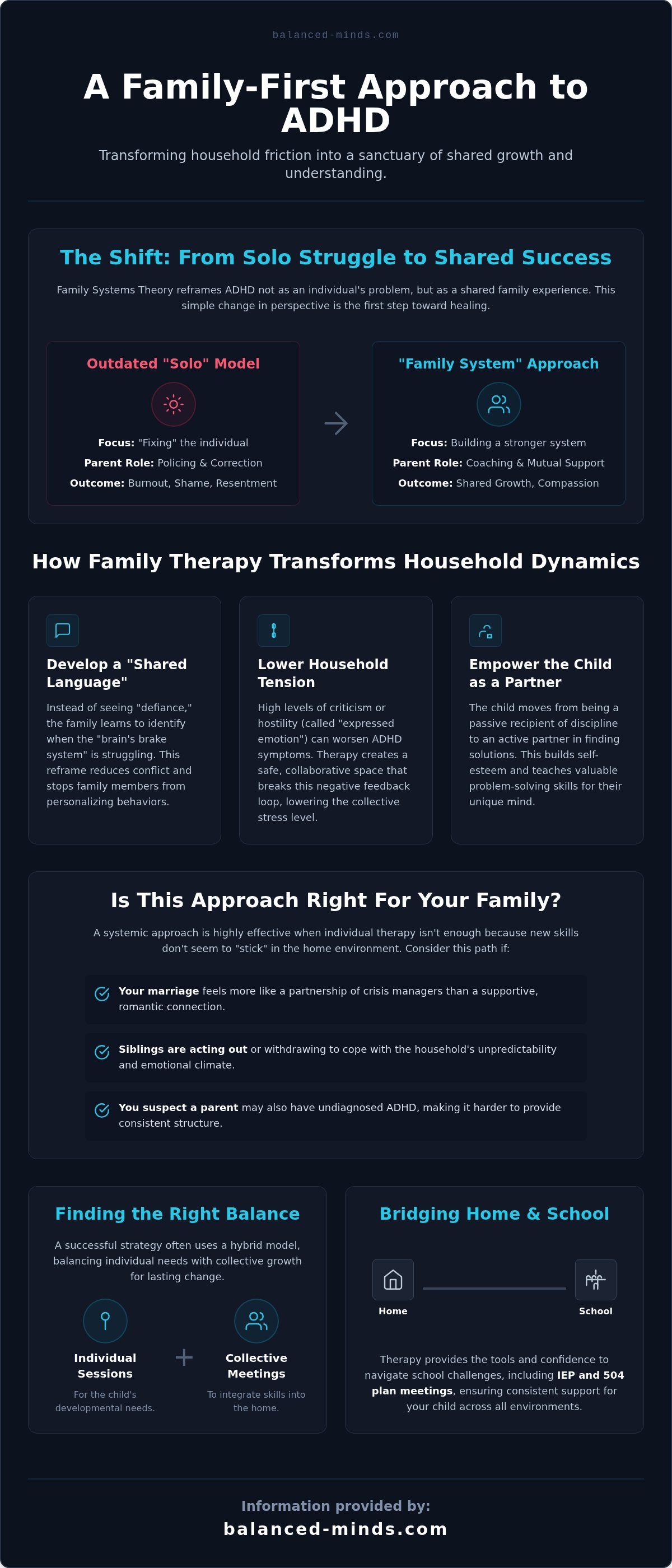
This approach is rooted in Family Systems theory. This framework suggests that a family is like a mobile; when one piece moves, every other piece shifts to maintain balance. If a child is struggling with impulsivity, a parent might naturally shift into a "policing" role to keep things safe and orderly. This shift, while well-intentioned, can create a cycle of tension and exhaustion. Family therapy helps us move from this policing dynamic toward a "coaching" dynamic, where the focus is on mutual support rather than constant correction.
The Difference Between Family Therapy and Parent Training
Many families start with parent training, which is an excellent way to learn specific behavioral management skills. While training focuses on what to do, family therapy focuses on how we feel while doing it. It addresses the "shame cycle" that can develop when a child feels they're always in trouble and parents feel like they're failing. We often integrate principles from Parent-Child Interaction Therapy (PCIT) to strengthen these emotional bonds. By involving siblings, we also address the quiet resentment that can grow when one child seems to take up all the emotional oxygen in the room.
Is Your Family a Good Candidate for This Approach?
You might wonder if your household needs this level of support or if individual therapy is enough. Working in a vacuum often leads to a "relapse" of old patterns once the child returns to the family environment. Consider these indicators that a systemic approach is needed:
The marriage feels like a partnership of roommates managing a crisis rather than a romantic or supportive connection.
Individual therapy for your child has reached a plateau because the new skills don't seem to stick in the home environment.
Siblings are acting out or withdrawing to cope with the household's unpredictability.
One or both parents suspect they may also have ADHD, making it harder to provide the consistent structure the child needs.
Our team at Balanced Minds sees family therapy for adhd child success as a way to lower the collective heart rate of the home. It provides a safe, non-judgmental space where everyone's needs are heard, ensuring that progress isn't just a solo achievement but a shared family victory.
How Family Therapy Transforms Your Household Dynamics
At the heart of our approach is the belief that a diagnosis shouldn't be a source of blame, but a roadmap for understanding. Many families arrive at our practice feeling stuck in a cycle of frustration and personal rejection. One of the most powerful shifts we witness during family therapy for adhd child support is the development of a shared language. Instead of a parent seeing "defiance" and a child feeling "attacked," we help the family identify when the "brain's brake system" is struggling. This simple reframe reduces the sting of these moments, allowing everyone to breathe a little easier and approach challenges with curiosity rather than criticism.
We also focus heavily on reducing what clinicians call "expressed emotion," which refers to the level of criticism or hostility within the home. High levels of tension can actually worsen ADHD symptoms, creating a feedback loop that leaves everyone exhausted. By creating a collaborative problem-solving environment, we empower the child to participate in their own growth. This shift moves the child from being a passive recipient of discipline to an active partner in finding solutions that work for their unique mind. If you're feeling overwhelmed by the weight of these daily interactions, our team can help you design a personalized family roadmap that honors everyone's needs.
Improving Communication and Reducing Conflict
Effective communication with an ADHD brain requires a different set of tools. We teach families how to give "single-step instructions" that don't overload the child's working memory. We also introduce the concept of collaborative family meetings. These aren't sessions for listing grievances; they're safe spaces where we use empathy to de-escalate power struggles. We often incorporate elements of Behavioral Parent Training (BPT) to give parents tangible ways to support their child's unique cognitive profile while maintaining their own emotional well-being.
Building Structure as a Team
Structure shouldn't feel like a cage; it should feel like a prosthetic for the child's executive functions. We work with the entire household to design routines that act as a steadying presence. This might include visual aids, shared digital calendars, or environmental cues that take the pressure off the parent to be a constant "drill sergeant." Most importantly, we help you rediscover "positive rituals." These are the small, joyful moments of connection, such as a nightly reading time or a weekend walk, that remind everyone they're a family first and an ADHD management team second. This restorative work is essential for healing sibling resentment and restoring the emotional bond between parents and children.
Individual vs. Family Therapy: Finding the Right Balance
Choosing the right therapeutic format often feels like a puzzle for parents. We believe that the most effective support shifts as your child grows and their needs evolve. For younger children, the family environment is the primary place where change happens, making a family-centered approach essential for lasting progress. As children move into adolescence, their need for privacy and personal agency naturally increases. This is why we often recommend a flexible model that adapts to these developmental milestones. The initial step in this journey is often finding a psychologist for ADHD diagnosis to create a clear, evidence-based roadmap tailored to your child's specific neurodivergent profile.
When Individual Therapy for the Child is Necessary
Individual sessions provide a dedicated space for a child to explore their internal world without the pressure of family expectations. This is particularly vital when co-occurring conditions like anxiety or depression are present; these challenges often require a targeted, one-on-one focus to build emotional regulation. For older teens, individual work fosters the self-advocacy skills they'll need as they transition toward adulthood. Cognitive Behavioral Therapy (CBT) for ADHD is a practical tool for older children that helps them reframe negative self-talk and manage the executive functioning gaps that lead to daily frustration. While individual work is powerful, it's most effective when it doesn't happen in isolation from the rest of the household.
The Power of the Combined Approach
We've found that a "hybrid" model often yields the most sustainable results for the entire household. This approach combines individual growth with family therapy for adhd child support to ensure that new skills aren't just learned in a clinical setting, but lived at the dinner table. When we work with the whole family, we help parents and children stay aligned, reducing the misunderstandings that can happen when a therapist's advice is lost in translation. Searching for family therapy near me is often the first step toward bridging this gap. It allows us to "generalize" the breakthroughs made in individual sessions, turning a child's personal progress into a collective family victory.
Knowing when to transition between these formats is part of the ongoing conversation we have with our families. You might consider adding or shifting toward a family-based approach if you notice these signs:
The child is making progress in therapy but household conflict remains high.
Parents feel "out of the loop" regarding the strategies the child is learning.
Siblings are showing signs of stress or behavioral changes in response to the ADHD dynamics.
The child has reached a plateau in individual sessions and needs a more supportive "system" to move forward.
By balancing these two approaches, we ensure that the child feels personally empowered while the family remains a sturdy, cohesive unit of support.
Practical Strategies for Florida Families and School Success
Living in the Tampa Bay area brings unique rhythms to family life, from the start of the school year in the intense August heat to the long, humid summer breaks. For parents in Pinellas and Hillsborough counties, navigating the school system often feels like a full-time job. We see family therapy for adhd child support as an essential tool for bridging the gap between home and the classroom. This collaborative approach helps you prepare for IEP and 504 plan meetings by providing clinical insights that teachers can actually use. When we work together, we help you articulate your child's needs in a way that fosters partnership with school staff rather than confrontation.
One of the most common challenges we address is the "after-school collapse." This happens when a child uses all their mental energy to stay focused and "mask" their symptoms during the school day, only to release that built-up tension the moment they step through the front door. We help families create a low-demand transition period that allows the child to decompress without sparking a household conflict. If you're looking for more localized resources, our guide to parenting near me offers a deeper look at support networks within the St. Pete and Tampa communities.
Navigating Schools in St. Pete and Tampa
Understanding your rights under Florida education laws is the first step in securing the right accommodations. Whether your child is in a private academy in St. Petersburg or a large public school in Tampa, they're entitled to a learning environment that respects their neurodiversity. Our clinical team often acts as a bridge, helping you translate psychological evaluations into practical classroom strategies like preferential seating or extended testing time. If you need assistance coordinating with your child's school team, you can reach out to our specialists to discuss an advocacy plan that supports your child's academic journey.
Managing ADHD in the Florida Heat
The long Florida summers and frequent stormy afternoons can disrupt the predictable routines that ADHD brains crave. When the heat makes outdoor play difficult, it's easy for household tension to rise. We encourage families to identify local sensory-friendly spaces, such as shaded parks in St. Pete or indoor play areas, to provide necessary physical outlets. During busy school weeks or inclement weather, our secure telehealth options ensure that your family's progress doesn't have to pause just because life gets in the way. By maintaining this steady support, we help your family stay regulated regardless of the season or the forecast.
Starting Your Journey with Balanced Minds Psychology & Wellness
At Balanced Minds, we believe that every family possesses the innate capacity for growth, even in the midst of daily chaos. When you begin your journey with us, our first priority is listening to your family’s unique story. We don't see ourselves as experts who are here to lecture you; instead, we act as a steady, guiding presence on your path toward a calmer home. Our intake process is designed to create an immediate sense of psychological safety, allowing you to share your challenges without fear of judgment.
Choosing family therapy for adhd child support means choosing a partnership. We recognize that the needs of a family with a child who has Inattentive ADHD are vastly different from those managing the Combined profile. Our team carefully tailors every therapy plan to match these specific nuances, ensuring that the strategies we develop are relevant to your daily life. By integrating executive function coaching into the family dynamic, we help you build the practical structures your child needs to thrive. We also provide a restorative space for parents to process their own exhaustion, validating your experience as you navigate these complexities.
Our Approach to Family Counseling in St. Pete
Our work is deeply restorative and moves beyond simple behavioral management to address the emotional climate of the entire household. This involves helping you understand the "why" behind the "what," which naturally turns frustration into empathy. Whether we are meeting in our St. Petersburg office or via secure telehealth, our goal is to help you restore the emotional connection that ADHD often strains. We focus on care, awareness, and recovery, making the path to wellbeing feel attainable for every member of your household. This approach aligns with the 2026 Florida health guidance that prioritizes therapy and behavioral support as a primary path for childhood development.
Ready to Find Calm in the Chaos?
Starting this process is a courageous step toward healing. We offer a complimentary 15-minute consultation to help you decide if our approach is the right fit for your family's needs. For busy families across the greater Tampa Bay area, our secure telehealth options provide the convenience you need to maintain consistent support regardless of your schedule. You can book an initial intake assessment at our St. Petersburg office, where we'll begin the work of transforming ADHD management from a solo struggle into a shared journey. Healing is possible, and we're here to walk alongside you as you build a more resilient and communicative home.
Restoring Your Family's Natural Rhythm
ADHD doesn't have to define the emotional climate of your home. By shifting from a model of individual management to a collaborative journey, you can replace constant friction with a shared sense of purpose. We've seen how building a "shared language" and implementing structured routines act as essential supports for your child's executive functions; these tools protect the well-being of every family member. Choosing family therapy for adhd child support is about more than just managing symptoms. It's about reclaiming the joy of being a family and fostering a home where everyone feels understood.
We offer both in-person sessions at our St. Petersburg office and the flexibility of secure telehealth for families throughout Florida. You don't have to navigate these school hurdles or household meltdowns in isolation. Schedule a consultation with our St. Petersburg team to start healing your family dynamic today. We believe every household has the potential for deep connection. We look forward to helping you find yours.
Frequently Asked Questions
Is family therapy more effective than individual therapy for a child with ADHD?
Family therapy is often more effective for younger children because it transforms the daily environment rather than just the child's internal state. While individual therapy builds personal skills, family therapy for adhd child support ensures those skills are supported by parents and siblings. This systemic approach prevents the "relapse" that can happen when a child returns to a high-stress home environment. We often recommend a hybrid model to balance personal growth with household harmony.
How long does family therapy for ADHD typically last before we see results?
Most families begin to notice a shift in their household communication within the first few weeks, though a standard course of treatment typically involves 12 to 20 sessions. The duration depends on your family's specific goals and the complexity of your dynamics. Research indicates that consistent attendance over several months allows new patterns to become permanent. We work at a pace that feels sustainable for your family, ensuring that progress is steady and restorative.
Do we have to bring the child with ADHD to every single family session?
You don't always need to have every family member present at every session. We often utilize a flexible approach that includes parent-only check-ins, sibling sessions, or individual time for the child. This allows us to discuss sensitive parenting strategies or marital strain without the child feeling "on the spot." We'll collaborate with you to determine the most effective combination of attendees for each stage of your family's healing journey.
Can family therapy help if I suspect I have ADHD as well as my child?
Yes, family therapy is a profoundly helpful space for parents who also navigate ADHD. Because neurodivergence often runs in families, we focus on creating structures that support both the parent's and the child's executive functioning needs. We address the unique challenges of "ADHD parenting ADHD," helping you build a home environment that feels manageable rather than overwhelming. This dual focus reduces shame and fosters a sense of shared humanity within the household.
Will insurance in Florida cover family therapy for an ADHD diagnosis?
Many insurance plans in Florida provide coverage for family therapy when it's part of a clinical treatment plan for an ADHD diagnosis. The 2026 Florida telehealth parity law also ensures that virtual sessions receive the same coverage as in-person visits. While we operate as out-of-network providers, we can provide you with a superbill to submit for potential reimbursement.
We handle sibling resentment by giving them a voice and validating their experience within the family mobile. It's common for siblings to feel that the child with ADHD takes up all the "emotional oxygen," leading to quiet withdrawal or acting out. During sessions, we create a safe space for them to express these feelings without guilt. This inclusive process helps siblings move from a place of resentment toward becoming compassionate partners in the family's growth.
What if my spouse or partner is hesitant to participate in family therapy?
It's quite common for one partner to feel hesitant about therapy, and we approach this with complete non-judgment. We can start by working with just one parent to implement positive changes in the home. Often, as the hesitant partner sees the household becoming calmer and more predictable, they feel more comfortable joining the process. Our goal is to create a low-pressure environment where every adult feels heard and respected rather than blamed or lectured.
Can family therapy help with school-related behavioral issues in Tampa Bay?
Family therapy is an excellent tool for addressing school-related challenges across Pinellas and Hillsborough counties. We help you translate clinical insights into practical strategies for IEP or 504 plan meetings. By managing the "after-school collapse" at home, we reduce the overall stress on the child, which often leads to better focus and behavior in the classroom. Our team acts as a bridge between your home life and your child's academic success in the Tampa Bay area.


