

Group Therapy for Teens in St. Petersburg: A Parent’s Compassionate Guide to Peer Support
Updated: 3 days ago
What if the very thing your teenager fears most, being seen and judged by their peers, is actually the exact environment where they will finally feel understood? It's a heavy burden for parents to watch their children feel isolated despite being constantly connected online, or to see them struggle with the relentless academic burnout common in Pinellas County high schools. We understand that you want more for your child than just "getting by"; you want them to feel a genuine sense of safety and community. This is why group therapy for teens in St. Petersburg has become such a vital resource for local families seeking a more inclusive, neurodivergent-affirming approach to mental wellness.
We believe that when teens come together in a supportive space, they discover a unique social laboratory where they can practice vulnerability and build lasting confidence. In this guide, you'll discover how specialized peer support helps adolescents manage anxiety and find true belonging. We will explore the practical benefits of our group sessions, from improved emotional regulation to the relief of connecting with others who truly understand the specific pressures of Florida life. Together, we can help your teen move from a place of quiet struggle to one of shared strength.
Table of Contents
What is Group Therapy for Teens and Why Does it Work?
Group therapy is much more than a simple conversation among peers. It is a carefully structured, therapist-led environment designed to foster social growth and emotional resilience. For many adolescents, the path toward healing begins with the realization that their struggles aren't unique. This psychological concept, known as "universalization," acts as a powerful antidote to the isolation many young people feel. When a teen hears another person describe a similar fear or frustration, the weight of their own burden begins to lift. It replaces the "what is wrong with me?" narrative with a sense of shared humanity.
In our practice, we see how Group psychotherapy provides a framework where teens can explore their identities without the fear of being misunderstood. While individual therapy offers deep personal insight, group therapy for teens in St. Petersburg introduces a dynamic layer of peer feedback. Adolescents are naturally wired to value the opinions of their peers over the advice of adults. When a fellow teen validates their experience or offers a gentle perspective, it often resonates more deeply than a clinical observation. Our role as facilitators is to ensure this interaction remains safe and non-judgmental, creating a container where vulnerability is met with compassion rather than criticism.
The Difference Between Support Groups and Group Therapy
It's common to confuse these two formats, but they serve different purposes. Support groups typically focus on sharing experiences to provide comfort. In contrast, when families seek group therapy for teens in St. Petersburg, they are looking for a professional environment where clinical skill-building is the priority. These sessions are led by licensed clinicians, such as a Psychologist or LMHC, who actively guide the group dynamics. We focus on evidence-based strategies to manage anxiety and depression, ensuring that every session moves beyond conversation into meaningful therapeutic work.
The 'Social Laboratory' Effect
We often describe our sessions as a "social laboratory." This is a space where teens can practice interpersonal effectiveness in real-time. Whether they are navigating the social hierarchies of Pinellas County schools or managing the stress of local academic expectations, the group mirrors these real-world environments. By interacting with peers in a guided setting, they receive immediate, safe feedback. This helps them refine their social skills and build genuine confidence before they step back into their daily lives.
Group Therapy vs. Individual Therapy: Choosing for Your Teen
Deciding on the right path for your child's mental health is a deeply personal journey. Florida currently ranks 44th in the nation for youth mental health, a statistic that highlights the urgent need for accessible and effective support systems for our families. Parents often wonder whether their teen needs the one on one attention of individual sessions or the collaborative energy of a peer group. Both modalities offer significant value, but they serve different developmental needs. Understanding which environment will best nurture your child's growth is the first step toward their recovery.
Individual therapy is often the most compassionate starting point for teens navigating acute crisis, high risk behaviors, or deep personal trauma. It provides a private, sacred space to process family specific dynamics and build foundational coping skills. However, for many adolescents in Pinellas County, individual work is only half of the equation. Recent research on group therapy's effectiveness suggests that peer based interventions can be equally or even more powerful for addressing social anxiety and identity exploration. While an adult therapist provides wisdom, a peer group provides a mirror.
We often recommend a hybrid approach for maximum growth. This allows a teen to process deep emotions privately while using group therapy for teens in St. Petersburg to test those new skills in a real world setting. It's also a more cost effective way to ensure your child receives consistent, high quality care. By participating in a group, teens learn that the 22% of Florida students reporting persistent stress are not just a statistic; they are a community. If you're curious about how these sessions could support your child's growth, exploring our options for Group Therapy is a gentle next step.
When to Prioritize Group Therapy
Group therapy is the ideal choice for teens who are struggling with social isolation or "shutting down" within the high pressure environments of local schools. It is particularly effective for adolescents who need to practice setting healthy boundaries and developing assertive communication. For our neurodivergent teens, these groups offer a rare and vital community where they can feel truly understood without the need to mask their authentic selves.
When Individual Therapy is the Better First Step
If your child is currently managing acute symptoms or engaging in high risk behaviors, the focused attention of individual therapy is usually necessary. This setting allows for the initial processing of sensitive family trauma and the development of internal stability. Once a teen has built the foundational coping skills needed to regulate their emotions, they are often much better prepared to join and benefit from a group dynamic.
Navigating Teen Pressures in St. Petersburg and Tampa Bay
Living in the Tampa Bay area brings a unique set of challenges that often go unnoticed behind the postcard-perfect images of our sun-drenched beaches. While St. Petersburg is celebrated for its vibrant arts scene and coastal beauty, our local teenagers are navigating a high-pressure environment that can feel overwhelming. From the competitive hallways of Pinellas County high schools to the relentless "filtered" lifestyle promoted on social media, the weight of expectation is constant. We see these pressures manifest as persistent anxiety and a deep-seated fear of falling behind. This is where group therapy for teens in St. Petersburg provides a necessary sanctuary, allowing adolescents to step away from the performance and reconnect with their authentic selves.
The 2023 Youth Risk Behavior Survey highlights that 40% of high school students nationwide report persistent feelings of sadness. Locally, we see this reflected in the way our youth struggle with seasonal stress, particularly during the grueling college application season or the shift in the Florida school calendar. By grounding our sessions in clinical and empirical evidence for group therapy, we create a space where these universal struggles are validated. It's about more than just coping; it's about helping your child find their footing in an evolving community that often prizes image over substance.
A holistic approach to wellbeing often includes physical health as a pillar of self-esteem.
Academic Burnout in Pinellas County Schools
The culture of achievement in our local schools often creates a "perfectionism trap" that is difficult to escape alone. Whether your child attends a specialized magnet program or a competitive private academy, the drive for elite grades and sports can lead to profound burnout. In our groups, we help teens process the belief that their worth is tied solely to their performance. We focus on building resilience and helping them find balance amidst the noise. If you are looking for a Teenage Therapist Near Me: Finding Compassionate Care in St. Petersburg and Tampa, you'll find that our team is deeply familiar with these specific local academic stressors.
Social Media and the 'Filtered' Florida Life
St. Petersburg's influencer culture and beautiful backdrops exacerbate the "comparison trap" for many of our youth. Our teens aren't just comparing themselves to distant celebrities; they're comparing their daily lives to the carefully curated highlights of their own classmates. This digital pressure often distorts body image and self-esteem. Our sessions offer a "digital-free" safe space in our St. Petersburg office where we deconstruct these interactions. We teach teens how to build authentic connections that don't depend on a screen.
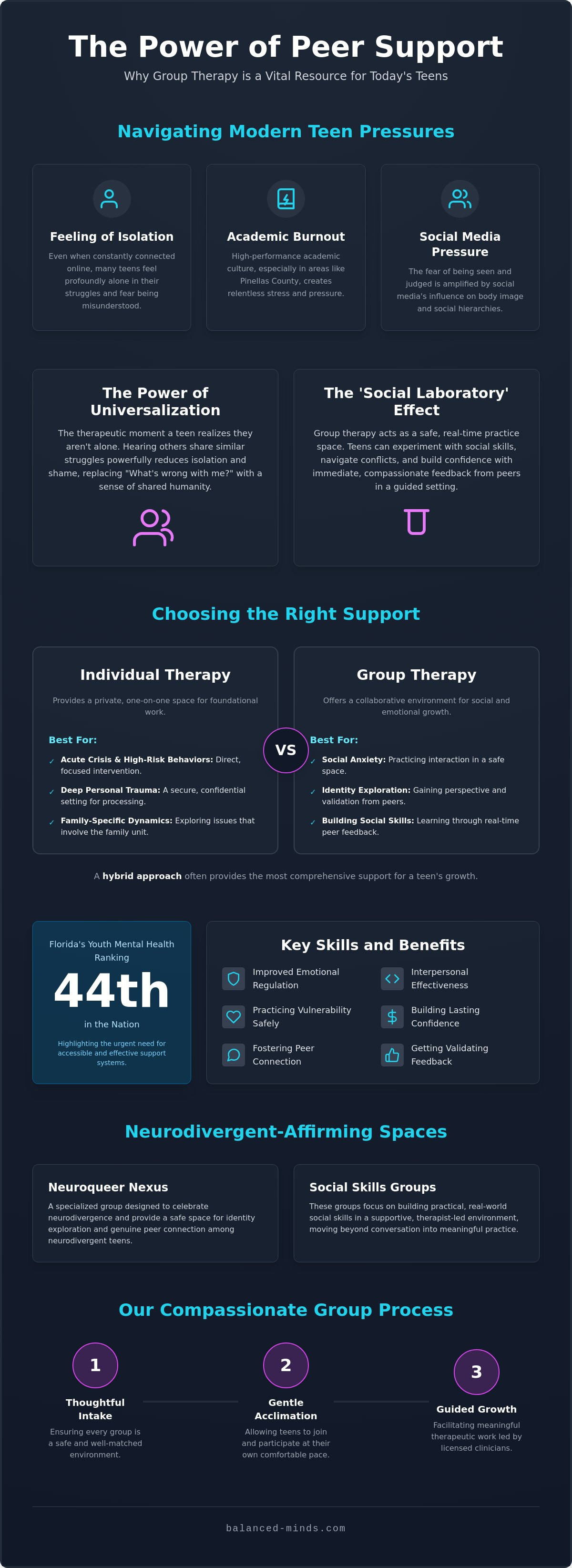
What to Expect: The Balanced Minds Group Process
Taking the first step into a new therapeutic environment can feel daunting for any adolescent. We recognize that those "first session jitters" are a natural part of the journey toward healing. Our process for group therapy for teens in St. Petersburg is designed to ease this transition, ensuring that every participant feels welcomed and emotionally secure from the moment they walk through our doors. We don't expect teens to arrive ready to share their deepest thoughts; instead, we build a foundation of trust that allows vulnerability to emerge at its own pace.
Each session follows a rhythmic structure that balances clinical work with human connection. We begin with a gentle check-in, where teens practice naming their internal states. This simple act of naming an emotion helps them transition from the noise of their school day into the quiet focus of our space. This is followed by a skill-building segment, where we introduce practical tools for managing anxiety or improving communication. The final portion of the hour is dedicated to peer processing, allowing the group to discuss real-life challenges in a supportive atmosphere. As a parent, you'll receive regular updates on your child's progress, though we maintain the teen's confidentiality to preserve the trust they've built with their peers.
The Screening and Matching Process
We believe that clinical matching is essential for a restorative experience. We don't simply drop teens into a group and hope for the best. During the initial intake, we assess each teen's readiness and specific needs to ensure they are placed with peers who share similar goals. This thoughtful approach helps create a cohesive dynamic where everyone can thrive. If you're still exploring your options, our guide on Finding the Right Child Psychologist in St. Petersburg, FL: A Parent’s Compassionate Guide offers more insight into how we pair families with the best possible support.
Confidentiality and Safety Protocols
Safety is our highest priority. Every group begins by establishing a set of "Group Rules" that all participants agree to follow for mutual privacy. These guidelines protect the group and ensure that our St. Pete clinicians can manage conflict or heavy topics with grace. We are particularly mindful of quieter participants, using our facilitation skills to ensure every voice is heard without being forced. If you feel your teen is ready to experience this level of support, we invite you to learn more about our current Group Therapy offerings.
Specialized Teen Groups at Balanced Minds St. Petersburg
We believe that every teenager deserves a space where they don't just exist, but truly belong. At Balanced Minds, our specialized group therapy for teens in St. Petersburg offers tailored environments that address the specific, intersectional identities of our local youth. We understand that a one-size-fits-all approach rarely works for adolescents who are already feeling marginalized or misunderstood by the world around them. By creating niche groups, we ensure that the "universalization" we discussed earlier feels immediate and deeply personal. Your child isn't just joining a group; they're finding their people.
Our current offerings are designed to meet the diverse needs of the St. Pete community:
Social Skills for Teens: This group focuses on strengthening confidence in real-world settings. We help adolescents move past the "performance" of social interaction and build genuine, lasting connections.
Neuroqueer Nexus: A vital, supportive space specifically for late-diagnosed neurodivergent and queer youth. It's a place to explore identity without the pressure to conform or mask.
Chronic Illness Support: We connect young adults and teens facing significant health challenges, providing a community that understands the unique emotional toll of chronic illness.
Girls Process Support: These sessions offer a safe container for navigating the complexities of healthy dating, setting firm boundaries, and cultivating internal self-worth.
Focus on Neurodivergent-Affirming Care
In many traditional settings, the goal of social training is to help teens "fit in" or appear more neurotypical. We reject that model. Our neurodivergent-affirming care celebrates "neurospicy" identities, creating a safe group where "fitting in" isn't the goal; authentic belonging is. We integrate ADHD coaching principles into our group dynamics to help teens understand and advocate for their unique brain wiring. If you're still in the earlier stages of this journey, our guide on Finding a Psychologist for ADHD Diagnosis in St. Petersburg, FL provides a compassionate starting point for your family.
Building Skills for the Future
As your teen approaches the threshold of adulthood, the skills they cultivate in group therapy for teens in St. Petersburg become foundational for their future success. These sessions prepare adolescents for the transition to college or the workforce by developing the executive functioning skills needed for group collaboration and self-advocacy. They learn how to navigate conflict, express needs, and support others; all essential traits for a healthy adult life. We invite you to contact us today to find the right group for your teen and take this restorative step toward their wellbeing.
Empowering Your Teen’s Journey Toward Connection
Supporting your child through the complexities of adolescence requires a dedicated partnership. We've explored how the "social laboratory" of a peer group allows teens to transform their isolation into a sense of true belonging. By embracing the power of shared humanity, your teen can move beyond academic burnout and social anxiety to find genuine confidence.
Conveniently located in the heart of St. Petersburg, our office serves as a safe hub for local families navigating unique Florida-specific pressures. Whether your child is seeking to improve their social skills or needs a restorative environment to explore their identity, group therapy for teens in St. Petersburg offers a vital bridge to a healthier, more connected future. Ready to help your teen find their tribe? Explore our current St. Petersburg groups and book an intake today. We look forward to walking this path alongside your family with compassion and expertise.
Frequently Asked Questions
Is group therapy as effective as individual therapy for teens?
Group therapy is highly effective for adolescents and often surpasses individual therapy when addressing social anxiety or identity development. While individual work is vital for deep trauma, the peer environment provides a unique social laboratory where teens practice real-time interactions. This collaborative setting helps reduce the isolation many Pinellas County students feel by showing them they aren't alone in their daily struggles.
What if my teen refuses to talk in the group?
It's completely normal for teens to feel hesitant or quiet during their first few sessions. Our facilitators are trained to respect each child's pace, recognizing that active listening is a valuable form of participation. We never force a teen to speak; instead, we create a supportive atmosphere where they eventually feel safe enough to share their voice once they feel a sense of belonging.
How long does a typical teen group therapy program last in St. Pete?
Many teen programs in the St. Pete area are structured around 8 to 12 week cycles, though some groups continue throughout the school year to provide ongoing support. We find that this timeframe allows for meaningful bond formation and consistent skill building. During your initial intake, we'll discuss the specific schedule and duration that best aligns with your teen's goals and our current group offerings.
Does insurance cover group therapy sessions at Balanced Minds?
Whether insurance covers group therapy for teens in St. Petersburg depends on your specific plan and provider. We recommend that parents contact their insurance carrier directly to verify their benefits and see if group sessions are covered under their behavioral health policy. Our team can provide the necessary documentation if you're seeking reimbursement through out-of-network benefits, helping you navigate the financial aspects of your child's care.
How do you ensure my teen's privacy in a group with other local kids?
We prioritize emotional safety by requiring every participant to sign a group confidentiality agreement before their first session. Our clinicians actively manage the group dynamic to ensure that what's shared in the room stays in the room. While we can't control every outside interaction, we find that the mutual desire for a safe space encourages teens to respect each other's privacy and build deep, restorative trust.
Can my teen do both individual and group therapy at the same time?
Many families find that a hybrid approach is the most effective way to support their child's growth. Individual therapy allows for the processing of sensitive personal topics, while group therapy for teens in St. Petersburg provides a space to apply those insights in a social setting. We often coordinate between individual and group facilitators to ensure your teen receives cohesive care that addresses every aspect of their wellbeing.
What is the average size of the teen groups at your St. Petersburg office?
To maintain a sense of intimacy and psychological safety, we keep our groups small, typically ranging from five to eight participants. This size is large enough to provide diverse peer perspectives but small enough to ensure that every teen receives personalized attention from the facilitator. This balance helps prevent anyone from feeling lost in the crowd or overwhelmed by the social dynamic of the group.
How do I know if my teen is 'ready' for group therapy?
A teen is usually ready for group therapy when they're stable enough to engage with others and have a basic willingness to attend, even if they're nervous. If a teen is in an active crisis or requires intense one on one stabilization, we'll likely recommend starting with individual therapy first. Our comprehensive intake process is specifically designed to help us determine if a group setting is the healthiest fit for your child.


