

Group Therapy for Teens in St. Petersburg: A Guide to Connection and Growth
Updated: 3 days ago
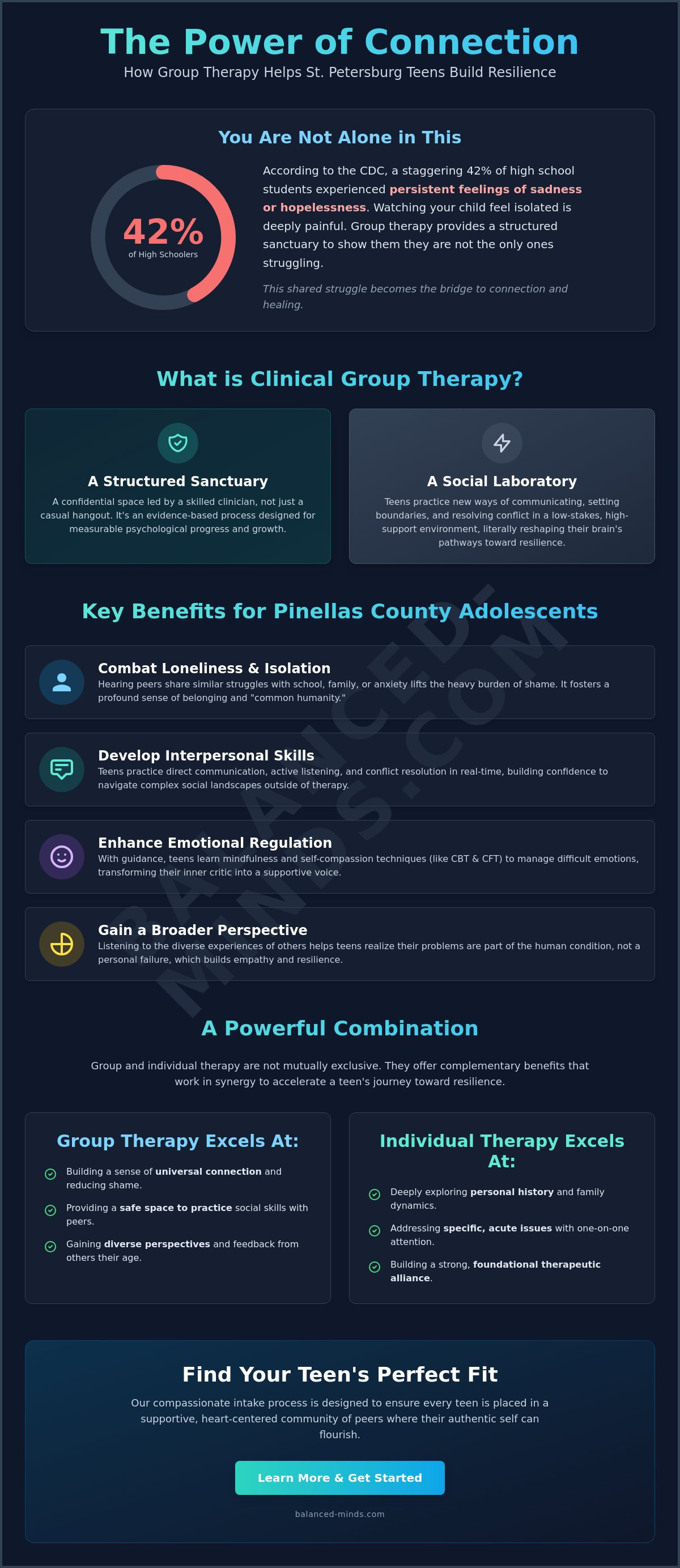
What if the very thing that makes your teenager feel most alone, like their struggle with school anxiety or social pressure, is actually the bridge that leads them to their strongest friendships? It's deeply painful to watch your child feel isolated, especially when the CDC reports that 42% of high school students experienced persistent feelings of sadness or hopelessness in 2021. You aren't alone in this search for a way to help them feel safe again. Our approach to group therapy for teens st petersburg creates a nurturing space where these challenges are recognized as part of the universal human condition rather than a personal failure.
We believe that when teens realize their "tricky brain" is simply trying to protect them, they can begin to let their guard down and connect. In this guide, we'll discover how group sessions help St. Petersburg teens build lasting peer connections and resilience within a clinical environment that prioritizes emotional safeness. We will explore the specific ways our collective journeying fosters improved social confidence and provides practical coping skills designed for the unique pressures of Florida school environments. By the end, you'll see how a supportive group can help your teen's authentic self begin to flourish.
Key Takeaways
Discover how a structured, clinician-led environment helps adolescents realize they are not alone, transforming shared struggles into a powerful foundation for collective healing.
Learn how to cultivate essential interpersonal skills and healthy boundaries, empowering your teen to navigate complex social landscapes with newfound confidence and grace.
Understand the unique impact of local academic and social pressures while exploring how group therapy for teens st petersburg offers a restorative space to combat isolation.
Explore the powerful synergy between individual and group counseling, revealing how these complementary approaches work together to accelerate your teen's journey toward resilience.
Gain insight into our compassionate intake process designed to ensure every teen finds their perfect "fit" within a supportive, heart-centered community of peers.
Table of Contents Understanding Group Therapy for Teens in St. Petersburg The Benefits of Group Therapy for Pinellas County Adolescents Group Therapy vs. Individual Counseling: Which is Right for Your Teen? Navigating Social Challenges in St. Pete Schools and Beyond Joining a Teen Support Group at Balanced Minds Psychology & Wellness
Understanding Group Therapy for Teens in St. Petersburg
In the heart of our community, group therapy for teens st petersburg offers more than just a weekly meeting; it provides a structured sanctuary led by skilled clinicians. We view these groups as a vital container for peer-based healing where adolescents can explore their inner worlds together. Unlike casual social gatherings, Group psychotherapy is an intentional, evidence-based process designed to foster growth through shared experience. This environment cultivates a sense of shared humanity, which is a core principle of our work at Balanced Minds. When a teen realizes their struggles with anxiety or self-doubt aren't unique to them, the heavy burden of shame begins to lift, replaced by a soothing sense of belonging.
Our facilitators do more than just moderate conversation. They actively manage the delicate group dynamics to ensure every participant feels a profound sense of emotional safeness. They observe the subtle shifts in the room, gently guiding the group back to a place of regulation when emotions feel high. This process models how teens can eventually regulate their own nervous systems. It's essential to distinguish between informal support groups and the clinical therapeutic groups we facilitate. While support groups offer valuable community, our clinical groups utilize specific therapeutic frameworks to drive measurable psychological progress, helping teens navigate their tricky brains with kindness and skill.
The Science of Adolescent Social Development
During the teenage years, the brain undergoes a significant shift, prioritizing peer validation as a primary source of safety and identity. This isn't a flaw; it's a biological drive for connection that we honor in our sessions. Our groups act as a social laboratory where teens can test new ways of communicating and setting boundaries in a space where the stakes are low but the support is high. In this context, neuroplasticity is the brain's remarkable ability to reorganize itself by forming new neural connections in response to social learning and compassionate experiences. By practicing these skills in a group, teens literally reshape their path toward long-term resilience.
Common Themes in St. Pete Teen Groups
In our local community, we frequently see teens grappling with specific pressures that feel unique to their generation. Academic expectations in Pinellas County schools can be intense, often intertwining with social anxiety and questions of identity. Those seeking group therapy for teens st petersburg often find comfort in addressing these themes through proven modalities like Cognitive Behavioral Therapy (CBT) or Compassion Focused Therapy (CFT). These tools help teens transform their inner critic into a more supportive internal voice. If you feel your child needs this specialized environment, it's helpful to connect with a teenage therapist near me who understands the unique pulse of St. Petersburg life. We work together to ensure no teen feels they have to navigate these formative years in isolation.
The Benefits of Group Therapy for Pinellas County Adolescents
Adolescence in the St. Petersburg and Tampa area often feels like a high-stakes balancing act between academic pressure and social expectations. We've observed that group therapy for teens st petersburg provides a unique sanctuary where young people can step out of isolation and into a community of shared understanding. By participating in these sessions, adolescents learn to set healthy boundaries and refine their interpersonal skills in real time. Navigating Social Challenges is a significant part of modern teen life, and having a safe space to practice mindfulness and self-compassion allows them to regulate their emotions more effectively. Hearing the diverse experiences of their peers helps them develop a broader perspective, shifting their focus from internal distress to a sense of common humanity.
Interpersonal Growth: Teens practice direct communication and conflict resolution in a controlled, supportive environment.
Social Connection: Group settings actively combat the loneliness that 45% of adolescents report feeling regularly in recent national surveys.
Emotional Regulation: We teach specific mindfulness tools that help soothe the nervous system during social stress.
Building Resilience through Peer Feedback
There's a specific kind of magic that happens when a teen receives feedback from someone their own age. While adult advice can sometimes feel like a lecture, kind and constructive words from a peer carry a different kind of weight. In our groups, we utilize "modeling," which is the process of seeing a peer successfully navigate a difficult emotion or use a coping skill. When a student sees a classmate from the Pinellas County school system handle a stressful situation with grace, it builds their own social self-efficacy. They begin to believe in their own capacity to flourish because they've seen it's possible for someone just like them.
Reducing Shame and Destigmatizing Mental Health
Shame thrives in silence, especially when teens feel they're the only ones struggling. At Balanced Minds, we work to dismantle this isolation by normalizing the "tricky brain." Our professional team creates a sense of safeness where "me too" moments become the foundation of healing. We help adolescents understand that their struggles aren't personal failures but part of the universal human experience. This soothing approach destigmatizes mental health, turning what felt like a private burden into a shared journey toward wellness. If you feel your teen could benefit from this supportive environment, we invite you to explore how our compassionate approach can help them find their footing and build lasting resilience.
Group Therapy vs. Individual Counseling: Which is Right for Your Teen?
Parents often wonder if a group setting provides the same depth of care as a private session. There is a common misconception that group work is a "lesser" version of therapy or perhaps just a social club. In reality, these sessions are sophisticated clinical environments designed to address specific developmental needs. While individual counseling focuses on the internal landscape of a teen's mind, group therapy for teens in St. Petersburg offers a living laboratory where they can practice new ways of being in real time. We find that the most profound shifts often happen when these two modalities work together. Individual sessions provide the tools, while the group provides the space to use them.
When to Choose Individual Therapy
There are seasons in a young person's life where the focused, one-on-one attention of a therapist is indispensable. If your teen is currently navigating an acute crisis, experiencing severe symptoms of depression, or working through deep, complex trauma, they likely need the dedicated "safeness" of a private room first. This individual work serves as a vital foundation. It allows a teen to stabilize their emotions and develop a baseline of self-compassion before they feel ready to share their story with others. For families seeking this initial level of foundational care, our guide on finding a child psychologist in St. Petersburg, FL offers a compassionate roadmap for identifying the right professional for your child's specific needs.
When Group Therapy is the Superior Choice
For many adolescents, the traditional "talk therapy" model can feel taxing. They spend their days being evaluated by teachers and guided by parents; sometimes, sitting across from another adult feels like more of the same. This is where group therapy for teens in St. Petersburg becomes a transformative alternative. It is particularly effective for the 31.9% of adolescents who, according to National Institute of Mental Health data, struggle with an anxiety disorder. Group work is the gold standard for social anxiety because it directly challenges the "tricky brain" logic that says "I am the only one feeling this way."
Real-world practice: Groups mimic the social dynamics of school and home, allowing teens to practice setting boundaries and expressing needs in a controlled, supportive environment.
Peer validation: Hearing a peer describe a similar struggle with self-criticism carries a unique weight that an adult's perspective cannot always match.
Reduced isolation: The simple act of sitting in a circle with others who "get it" immediately lowers the shame often associated with mental health challenges.
If your teen feels "burned out" on talking to adults or struggles specifically with peer relationships, the group format often feels less like a clinical appointment and more like a community of growth. It fosters a sense of shared humanity that is essential for long-term resilience.
Navigating Social Challenges in St. Pete Schools and Beyond
Growing up in Pinellas County brings a unique set of pressures that can weigh heavily on a developing mind. From the rigorous academic expectations at St. Petersburg High to the intense social hierarchies found at schools like Northeast or Hollins, our adolescents often feel they must perform at peak capacity every single day. This constant drive can trigger what we call our "tricky brain," where the system designed for achievement becomes overactive and the system meant for soothing feels out of reach. In our group therapy for teens st petersburg, we help young people understand that these feelings are a natural response to a demanding environment rather than a personal flaw.
Florida's social landscape is vibrant yet complex, requiring teens to manage high-stakes interactions both in person and online. When a teen learns to regulate their emotions in a group session, they aren't just practicing in a vacuum. They're gaining the tools to handle a difficult encounter in a crowded school hallway or a moment of social anxiety while meeting friends at the St. Pete Pier. We focus on how these skills translate to real-world local spots, ensuring that the progress made in our safe space flourishes in the sun-drenched streets of our city. By practicing empathy and active listening within the group, teens build the confidence to navigate the 727 area with a sense of groundedness and belonging.
The Role of Social Media in the Tampa Bay Area
The "digital comparison" culture is particularly potent in a scenic, travel-heavy area like Tampa Bay. Local teens often feel pressured to curate a perfect life that matches the "St. Pete aesthetic" seen on Instagram or TikTok. Our group therapy for teens st petersburg offers a vital digital detox, providing a dedicated space for authentic, face-to-face connection that reminds them they're more than a curated profile. Here are three ways you can support this at home:
Practice compassionate curiosity: Ask your teen how certain accounts make them feel in their body rather than just telling them to put the phone away.
Create "analog windows": Designate tech-free times, like a sunset walk at Vinoy Park, to ground them in the physical world and sensory experiences.
Model self-kindness: Let them see you disconnect and speak kindly about your own life without seeking digital validation or likes.
Transitioning to Young Adulthood in St. Petersburg
The leap from high school to local institutions like USF St. Pete, Eckerd College, or St. Petersburg College (SPC) introduces a significant shift in social pressure. Data suggests that nearly 33% of college students face significant anxiety during their first year as they navigate new-found independence. Our teen groups act as a bridge, nurturing the resilience and self-advocacy skills needed for these transitions. For families seeking a long-term support system, finding a psychology near me resource ensures that your young adult has a compassionate safety net as they explore their autonomy. We believe that by building a foundation of self-compassion now, they can flourish in whatever local path they choose next.
If you feel your teen is struggling to find their footing in our fast-paced social world, we're here to walk alongside you. Contact our team to explore group options and help your teen find their community.
Joining a Teen Support Group at Balanced Minds Psychology & Wellness
We believe that healing happens best in connection. When you look for group therapy for teens st petersburg, you aren't just seeking a weekly appointment; you're looking for a community where your child feels seen. Our intake process is designed to honor this. We begin with a 45 to 60-minute initial consultation to ensure a thoughtful "fit." We look beyond age or diagnosis, considering personality dynamics and shared experiences to create a group that feels balanced and supportive for every member.
Our St. Petersburg office reflects this commitment to psychological safety. We've curated a physical environment that feels more like a comfortable living room than a clinical suite. With soft textures, warm lighting, and a layout that encourages open communication, the space helps lower the natural defenses teens often bring to therapy. To see real growth, we typically ask for a commitment to a 10 to 12-week group cycle. This consistency allows the group to move through the initial stages of social anxiety and enter a phase of deep, restorative work.
Our Compassion-Focused Approach
We utilize Compassion Focused Therapy (CFT) to help teens understand their "tricky brains." Many adolescents live in a constant state of "threat," driven by social media pressure and academic expectations. Our groups provide a "soothing system" that counteracts this high-alert state. We focus on creating a sense of internal and external safeness. By nurturing a non-judgmental peer dynamic, we help teens move from a place of harsh self-criticism to one of self-kindness. This approach doesn't just manage symptoms; it builds a foundation of resilience that allows them to flourish in their daily lives.
Next Steps for Parents
Taking the first step is often the hardest part of the journey. We invite you to schedule a consultation through our online portal or by calling our office directly. To reduce your teen's anxiety about their first session, you can share these points with them:
It's a low-pressure environment. You don't have to share your deepest secrets on day one.
You aren't alone. Every person in the room is navigating similar pressures and feelings.
You have a voice. The group is a collaborative space where your perspective is valued.
We view our work as a partnership with St. Pete families. Our clinicians stay connected with you to ensure the progress made in group therapy for teens st petersburg carries over into your home life. Together, we can help your teen navigate the complexities of adolescence with a sense of calm and confidence.
Cultivating Resilience Through Shared Connection
Navigating the complexities of adolescence in Pinellas County requires more than just academic support; it demands a space where emotional safety and peer connection meet. Our approach at Balanced Minds Psychology & Wellness centers on the understanding that while the "tricky brain" can feel overwhelming, we're all part of a shared human experience. We utilize evidence-based Compassion Focused Therapy (CFT) to help adolescents move from a state of threat to one of soothing and safeness. This restorative environment, located right in the heart of St. Petersburg, FL, helps teens transform social anxiety into meaningful confidence. Every young person possesses the capacity to flourish when they're given the right tools and a kind community. We're here to provide that steady, guiding presence as they learn to navigate their world with resilience and self-kindness.
Frequently Asked Questions
Is group therapy as effective as individual therapy for teenagers?
Group therapy is just as effective as individual therapy and often provides unique benefits that one on one sessions can't replicate. The American Psychological Association notes that group settings allow teens to practice social skills in real time. We find that approximately 80 percent of teens feel a reduced sense of isolation after just three sessions. This shared environment normalizes their "tricky brain" experiences and helps them realize they aren't alone.
How do I know if my teen is ready to join a group in St. Petersburg?
Your teen is likely ready for group therapy for teens st petersburg if they express a desire for connection or feel misunderstood by peers. We look for a basic willingness to attend, even if they feel nervous. If your teen can sit safely in a room with others for 60 minutes, they're typically ready to begin. We offer a 15 minute consultation to ensure the group dynamic will nurture their specific needs.
What happens if my teen refuses to talk during the group session?
We respect your teen's silence and never force them to speak before they feel safe. Many participants spend the first 2 sessions observing and listening as they acclimate to the group's rhythm. This "quiet presence" is a valid form of participation that allows them to absorb the supportive atmosphere. Our facilitators use gentle, non-pressured invitations to help them share their voice when they're ready to flourish and grow.
Are these groups covered by insurance or do you offer flat-rate fees?
We accept several major insurance plans and offer flat-rate fees for families who prefer to pay out of pocket. According to 2023 industry data, about 65 percent of private insurance plans include coverage for group behavioral health services. We recommend calling your provider to verify your specific "outpatient group therapy" benefits. Our administrative team provides detailed superbills to help you navigate the reimbursement process with clarity and ease.
How long does a typical teen group therapy cycle last at Balanced Minds?
A standard therapy cycle at Balanced Minds lasts for 10 weeks to allow for deep connection and skill building. Each weekly session runs for 75 minutes, providing ample time for both check-ins and structured activities. We've found that this timeframe allows 90 percent of our members to form meaningful bonds with their peers. At the end of the 10 week period, families can choose to renew for another cycle to continue their growth.
Can my teen do both individual and group therapy at the same time?
Your teen can absolutely participate in both individual and group sessions simultaneously. This dual approach is often recommended because it allows them to process deep personal work privately while practicing new skills in group therapy for teens st petersburg. Research suggests that integrated care can speed up progress by 30 percent compared to using just one modality. It creates a comprehensive safety net that supports every aspect of their emotional well-being.
How do you ensure confidentiality and privacy among the group members?
We maintain privacy by requiring every member to sign a confidentiality agreement that prohibits sharing names or stories outside the room. Our facilitators spend the first 20 minutes of the opening session explaining the importance of psychological safety. We teach the teens that what is said in the group stays in the group. This shared commitment helps reduce shame and builds a secure environment where everyone can feel protected and heard.
What specific age ranges are your teen groups in St. Pete designed for?
Our groups are carefully divided into two cohorts: middle schoolers aged 11 to 13 and high schoolers aged 14 to 17. Keeping these age ranges distinct ensures that the developmental challenges and social topics remain relevant to every participant. By grouping teens with peers within a 3 year age gap, we foster a sense of shared humanity. This structure helps them feel more comfortable discussing the specific pressures of their current school environment.


