

Executive Functioning Coaching for College Students in Tampa: A Compassionate Path to Academic Independence
Updated: 3 days ago
What if the reason you’re struggling with deadlines isn’t a lack of discipline, but simply a gap in your cognitive toolkit? It’s a painful irony to be academically gifted enough to handle university coursework, yet feel like a failure because you can’t seem to start a paper until the night before it’s due. We understand the heavy weight of shame that comes with chronic procrastination and the quiet anxiety of watching a scholarship slip away. You aren't lazy or unmotivated; you’re simply navigating a transition from parent-managed structure to a self-authored life that your brain isn't quite ready for yet.
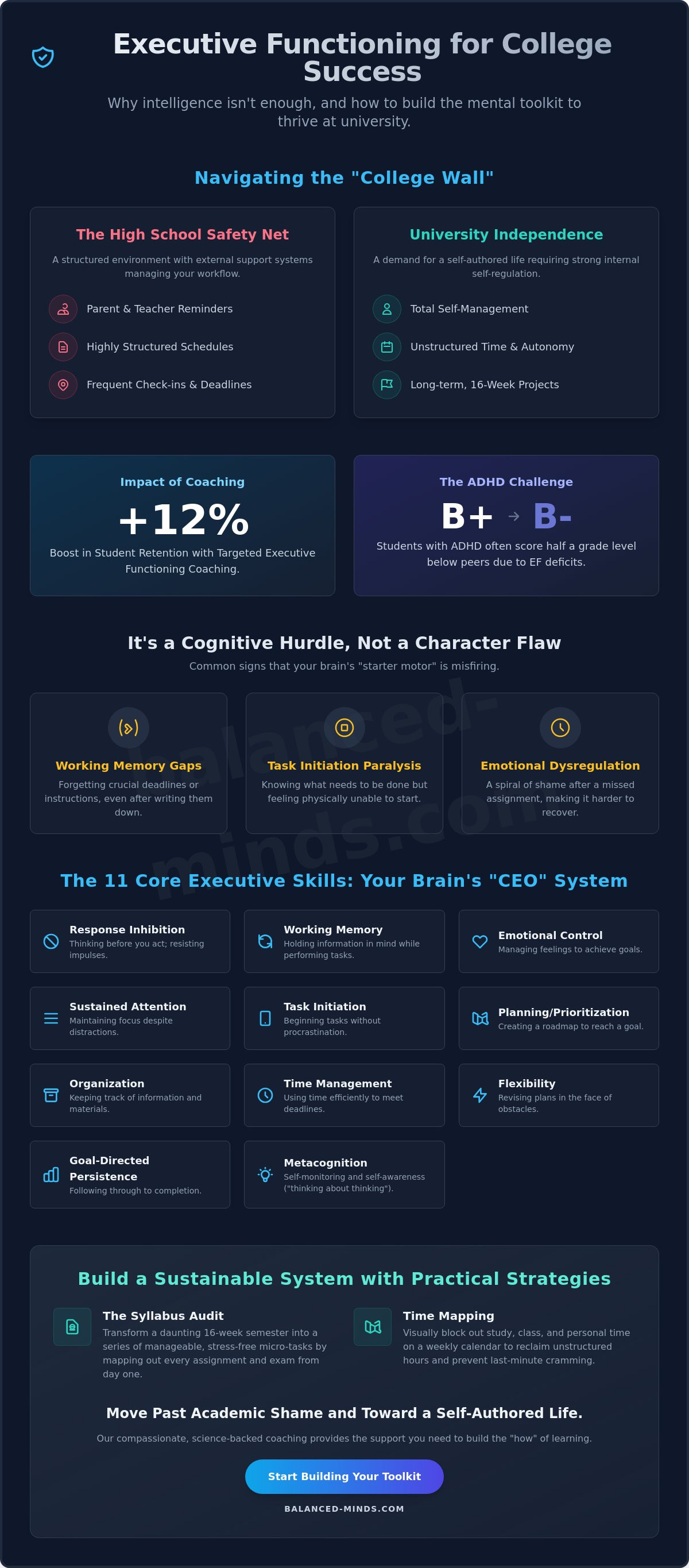
Our team provides specialized executive functioning coaching for college students tampa to help you bridge the gap between your potential and your daily reality. We’re here to help you move from a state of constant crisis to a place of sustainable systems that respect your neurodivergence. Research suggests that targeted coaching can boost student retention by as much as 12 percent, proving that these skills are the real foundation of success. In the following sections, we’ll explore how compassionate support can help you reduce academic anxiety, master your schedule, and finally start tasks without the need for a deadline-induced panic.
Key Takeaways
Understand the "College Wall" and why high intelligence doesn't always translate to seamless organization without a strong internal "CEO" system.
Explore the 11 core executive skills to pinpoint exactly where your academic workflow is breaking down and how to rebuild it with intention.
Learn how specialized executive functioning coaching for college students tampa focuses on the "how" of learning, providing a different kind of support than traditional subject-based tutoring.
Gain practical strategies like the Syllabus Audit and Time Mapping to transform a daunting 16-week semester into a series of manageable, stress-free micro-tasks.
Discover how a science-backed, nurturing approach can help you move past academic shame and toward a self-authored life of true independence.
Table of Contents
Navigating the "College Wall": Why Executive Functioning Matters for Tampa Students
The 11 Core Executive Skills: Identifying Your Strengths and Stumbling Blocks
Coaching vs. Tutoring vs. Therapy: Finding the Right Fit for Your Journey
Building a Sustainable System: Practical Strategies for Tampa Bay Students
The Balanced Minds Approach: Clinical Expertise Meets Practical Coaching
Navigating the "College Wall": Why Executive Functioning Matters for Tampa Students
We often think of intelligence as the primary engine of academic success, but it's the executive functions that act as the "CEO of the brain." These core executive skills are responsible for the high-level planning, organization, and execution required to turn a complex syllabus into a finished project. For many students in the Tampa Bay area, from the sprawling campus of USF to the historic grounds of the University of Tampa, the transition to college life hits like a physical barrier. We call this the "College Wall." It happens when your cognitive ability is high, but your internal system for managing newfound autonomy hasn't quite caught up to the demands of university life.
This shift represents a fundamental change in how you interact with the world. In the past, much of your regulation was likely external, provided by the structured environment of home and high school. Now, the responsibility has shifted entirely to internal self-regulation. Without those external reminders, even the most brilliant students can find themselves feeling adrift in a sea of unstructured time.
The High School Safety Net vs. University Independence
In high school, a network of teachers and parents often provides a constant safety net. You might have been able to "wing it" because someone was always there to remind you of a looming deadline or a missing assignment. At the university level, that safety net vanishes. Suddenly, you're expected to manage a 16-week semester with very few check-ins. When the old tools of last-minute cramming and "just remembering" start to fail, it can be deeply unsettling. It isn't that you've lost your edge. It's simply that the game has changed, and the demand for self-authored systems has tripled.
Signs You Are Struggling with Executive Skills (Not Intelligence)
Distinguishing between a lack of effort and a gap in executive function is vital for your mental well-being. Many students we support through executive functioning coaching for college students tampa describe a state of "task paralysis." This is the exhausting experience of knowing exactly what needs to be done but feeling physically unable to start. You aren't being lazy; your brain's "starter motor" is simply misfiring.
Other common signs include challenges with:
Working Memory: You might find yourself forgetting crucial deadlines or instructions even after writing them down.
Task Initiation: The "paralysis" of staring at a blank screen for hours while the clock ticks toward midnight.
Emotional Regulation: The heavy spiral of shame that follows a missed assignment, which often makes it even harder to show up for the next class.
Recognizing these signs is the first step toward self-compassion. When we understand that these are cognitive hurdles rather than character flaws, we can begin the work of building systems that actually work for your unique brain.
The 11 Core Executive Skills: Identifying Your Strengths and Stumbling Blocks
We view executive functions as a collection of specialized cognitive tools rather than fixed personality traits. Just like physical muscles, these abilities can be trained and strengthened over time with the right support. When we partner with young adults through executive functioning coaching for college students tampa, we begin by demystifying why certain tasks feel so much heavier than others. Understanding these 11 core skills helps us shift the narrative from "I'm not capable" to "I'm still developing this specific skill."
For many, Navigating the 'College Wall' reveals that while some skills are strong, others are lagging. It's common for students with ADHD to struggle with these deficits more acutely. Research indicates that college students with ADHD often receive grades that are half a grade level below their peers, largely due to challenges with these underlying cognitive processes. By identifying your unique profile, we can build a path toward balance.
Response Inhibition: The ability to think before you act, such as choosing to study instead of scrolling through social media.
Working Memory: Holding complex instructions in your mind while you complete a multi-step lab report.
Emotional Control: Managing the frustration of a difficult grade so it doesn't derail your entire week.
Flexibility: The capacity to pivot when a study group cancels or a professor changes a deadline.
Sustained Attention: Keeping your focus on a long lecture even when the subject matter feels dry.
Task Initiation: Overcoming the "blank page" syndrome to start an assignment without a crisis deadline.
Planning/Prioritization: Deciding which of four competing assignments deserves your energy first.
Organization: Keeping track of digital files, physical notes, and your physical workspace.
Time Management: Accurately estimating how long a 10-page research paper will actually take.
Goal-Directed Persistence: Staying the course on a long-term project when the initial excitement fades.
Metacognition: Stepping back to ask, "Is my current study strategy actually working?"
Cognitive vs. Behavioral Executive Skills
We generally categorize these tools into two groups. Cognitive skills, like planning and organization, involve the mental "blueprints" for your work. Behavioral skills, such as task initiation and sustained attention, are the "construction crew" that carries out those plans. Many students we see are excellent at the blueprints but struggle to get the crew started. If you're unsure where your specific gaps lie, our ADHD evaluations can provide a clear, science-based map of your cognitive landscape.
The Role of Emotional Regulation in Academic Success
Frustration tolerance is often the secret weapon of successful students. When a plan fails or a concept doesn't click immediately, the ability to stay calm prevents the "all-or-nothing" thinking that leads to burnout. Cognitive flexibility is the ability to pivot and find a new solution when your original study plan falls through. By nurturing these emotional skills, you create a psychological safety net that allows you to keep moving forward, even when the semester feels overwhelming.
Coaching vs. Tutoring vs. Therapy: Finding the Right Fit for Your Journey
Finding the right support often feels like trying to solve a puzzle with missing pieces. You might wonder why a subject-matter tutor hasn't solved the problem, or if clinical therapy is even the right path for your specific academic struggles. To make an informed choice, we need to understand the difference between the "what," the "how," and the "why" of your university experience. While these services often overlap, they serve very different roles in your development as an independent student.
Tutoring addresses the "what." If you're struggling with the complexities of organic chemistry or macroeconomics, a tutor provides subject-specific expertise to help you master that content. However, many students we see don't struggle with the material itself. Instead, they struggle with the process of being a student. This is where executive functioning coaching for college students tampa becomes essential. Coaching targets the "how," focusing on the executive function and self-regulation skills that allow you to manage multiple deadlines, organize digital files, and navigate a complex university schedule.
When to Choose Executive Functioning Coaching
You should consider coaching if you find yourself fully understanding the lecture material but consistently failing to turn in assignments on time. You might feel overwhelmed by the "hidden curriculum" of college life, such as managing student portals, responding to professor emails, or balancing a heavy course load with personal responsibilities. In these cases, you don't need a content expert. You need a partner to help you build sustainable systems that turn your intellectual potential into tangible academic results. Our executive functioning coaching for college students tampa is designed to bridge this specific gap between knowing and doing.
The Synergy of Therapy and Coaching
Sometimes, the barrier to success isn't just a missing system; it’s the emotional weight of past failures. Searching for psychology near me can be the first step in addressing the underlying anxiety or depression that often accompanies neurodivergence. At Balanced Minds, our clinical expertise provides a foundation for skill-building. We believe in addressing the "shame cycle" through therapeutic insight before applying practical coaching tools. This integrated approach allows us to help you heal the emotional wounds of chronic procrastination while simultaneously building the "CEO" functions of your brain.
Building a Sustainable System: Practical Strategies for Tampa Bay Students
We believe the path to academic independence isn't paved with sheer willpower, but with portable systems that travel with you. Unlike a fixed study lounge, these strategies are tools you can carry from the library to the dorm. Through our executive functioning coaching for college students tampa, we help you build a personalized toolkit that respects your brain's unique wiring while meeting the rigorous demands of higher education. We're here to help you move from a reactive state of "putting out fires" to a proactive state of self-authorship.
A 16-week semester can feel like an insurmountable mountain when viewed as a single unit. We start with a "Syllabus Audit," where we dissect each course outline to identify hidden deadlines and break large projects into manageable micro-tasks. This turns a daunting research paper into a series of small, achievable steps. We also utilize "Time Mapping" to help you visualize the "dead space" in your schedule. Whether you're navigating the sprawling USF campus or finding a quiet corner at the University of Tampa, those gaps between classes are opportunities for either restorative rest or focused work. By visualizing your week, you can reclaim hours that previously vanished into the ether.
Environment design is equally vital for maintaining focus. We encourage you to identify specific "focus zones" across the Tampa Bay area. You might find that the quiet floors of the USF Library work best for deep reading, while a local coffee shop in Hyde Park provides just enough background hum for administrative tasks. Digital hygiene is the final piece of this puzzle. Managing notifications and creating a distraction-free digital workspace is essential for protecting your limited cognitive energy from the constant pull of modern distractions.
Mastering Task Initiation and the "10-Minute Rule"
The hardest part of any assignment is the transition from thinking about it to doing it. To bypass the brain's natural resistance to boring or daunting tasks, we often suggest the "10-minute rule." Set a timer for just ten minutes and commit to working only for that duration. This lowered bar reduces the "activation energy" required to start. Most of the time, once the timer goes off, the initial paralysis has vanished and you'll find it easier to keep going. It's a gentle way to trick the brain into movement without the pressure of a multi-hour study session.
Leveraging Local Resources and Accommodations
You don't have to navigate this journey alone. Both the University of South Florida (USF) Student Accessibility Services and the University of Tampa (UT) Academic Success Center offer valuable resources for students. However, accessing certain accommodations often requires formal documentation. We can guide you through the process of finding a psychologist for ADHD diagnosis to ensure you have the clinical support needed to secure these vital tools. If you're ready to move from feeling overwhelmed to mastering your own systems, we invite you to explore our executive functioning coaching options today.
The Balanced Minds Approach: Clinical Expertise Meets Practical Coaching
Our philosophy is built on the belief that every student possesses an innate capacity for growth when provided with the right environment and tools. We don't believe in quick fixes or generic advice. This scientific foundation allows us to provide executive functioning coaching for college students tampa that is both clinically rigorous and deeply human. We start by listening to your story and understanding your unique brain profile through a personalized intake process, ensuring that the systems we build together actually fit the way you think.
The relationship between a coach and a student is one of collaboration and mutual respect. We act as a steady, guiding presence, helping you navigate the complexities of university life without judgment. By fostering a sense of psychological safety, we help you lower your defenses and approach your challenges with curiosity rather than fear. This partnership is designed to move you toward self-authored independence, where you no longer rely on external pressure to meet your goals.
Why Clinical Grounding Matters in Coaching
Many academic support programs fall into the trap of "toxic positivity" or "hustle culture," suggesting that you can simply work your way out of executive dysfunction with enough effort. We know that the young adult brain is still undergoing significant neurobiological development, particularly in the areas responsible for self-regulation. Our strategies are evidence-based and sustainable because they're designed to work with your brain's current stage of development. We focus on long-term resilience rather than short-term bursts of productivity, ensuring that the habits you form in college will serve you throughout your professional life.
Your Path Forward in St. Petersburg and Tampa
Beginning your journey is as simple as scheduling an initial evaluation to help us understand your specific stumbling blocks. We offer the convenience of in-person sessions at our St. Pete office, as well as secure telehealth options for students at USF, UT, or other Tampa-based institutions. This hybrid approach ensures that support is always accessible, regardless of your busy class schedule or transportation needs. You deserve to feel confident in your abilities and at peace with your academic journey. Reach out to our team today to schedule a consultation.
Reclaiming Your Academic Narrative
Academic success isn't a reflection of your inherent worth or intelligence. It's a developmental skill set that can be nurtured with the right support. We've explored how the transition to university life often reveals gaps in self-regulation rather than a lack of capability. By understanding your unique profile across the 11 core skills and implementing portable systems like syllabus audits, you can transform your university experience from a cycle of crisis into a journey of self-authored success.
We provide evidence-based executive functioning coaching for college students tampa that bridges the gap between clinical insight and daily academic life. You don't have to carry the weight of chronic procrastination or academic anxiety alone. We're here to help you move past the shame and toward a future of sustainable productivity and peace of mind.
Begin your journey toward academic confidence with Balanced Minds today. You possess the potential to thrive in your university environment, and we're committed to helping you discover the tools to make that possible.
Frequently Asked Questions
What is the difference between an executive function coach and a tutor?
A tutor provides subject-specific expertise to help you master content like chemistry or statistics, whereas an executive function coach focuses on the cognitive processes behind learning. Coaching targets the "how" of being a student, including time management and task initiation, rather than the "what" of a specific course. We help you build the mental systems required to turn your knowledge into finished assignments.
Does my college student need an official ADHD diagnosis to benefit from coaching?
No, your student doesn't need a formal ADHD diagnosis to benefit from our support. While many of our clients do have ADHD, executive functioning coaching for college students tampa is effective for anyone struggling with chronic procrastination or organization. We focus on strengthening the brain's self-regulation muscles regardless of whether a student has a specific clinical label or simply needs better systems.
How long does executive functioning coaching typically last for university students?
The duration of coaching is highly individualized, but many students find that one to two semesters provide enough time to internalize and automate new habits. We often start with consistent weekly sessions and gradually transition toward a maintenance phase as the student gains academic independence. Some students also utilize shorter sessions for targeted support during particularly demanding periods like midterms or finals.
Can coaching help with the transition from high school to college in Florida?
Coaching is specifically designed to help Florida students navigate the leap from the structured high school environment to the total autonomy of university life. This transition often reveals hidden gaps in executive skills that were previously managed by the safety net of home or school. We help students at institutions like USF and UT build the internal "CEO" functions necessary to handle a complex 16-week syllabus without external reminders.
Is executive functioning coaching covered by insurance in Tampa?
Executive functioning coaching is generally considered a skill-building or educational service rather than a medical treatment, so it's typically an out-of-pocket investment. However, if your student requires a comprehensive psychological evaluation to secure university accommodations, those clinical services may be eligible for insurance reimbursement. We recommend contacting your provider to discuss your specific behavioral health benefits and coverage options.
What should I do if my college student is resistant to getting help?
Resistance often comes from a place of academic shame or the fear of being "fixed." We suggest reframing the conversation to focus on the student's own frustrations, such as the exhaustion of "all-nighters," rather than focusing on grades or failures. Our approach is non-judgmental and collaborative, positioning the coach as a mentor who helps the student reclaim their time and peace of mind.
How does Balanced Minds coordinate with local Tampa universities like USF or UT?
We support students in navigating the specific requirements of the USF Student Accessibility Services and the UT Academic Success Center. While we operate independently, we provide the clinical documentation and coaching necessary for students to advocate for themselves and utilize campus accommodations effectively. This coordination ensures that the systems we build in our sessions are reinforced by the university's own support resources.


