

Executive Functioning Activities: Parent Guide (2026)
Updated: Sep 23
By 7:30 in the morning, you've already repeated the same three reminders, searched for a lost assignment, and swallowed a familiar wave of parenting frustration. It's completely understandable to feel drained when simple routines turn into exhausting battles, leaving you wondering whether your child's struggles stem from typical development, anxiety, or attention challenges. When traditional discipline fails to create lasting change, searching for activities to improve executive functioning skills can feel daunting. Real progress rarely comes from isolated cognitive drills; it grows when we weave supportive scaffolds directly into your family's daily rhythm.
You don't have to carry this friction alone. In this guide, you'll discover evidence-based, compassionate approaches that strengthen your child's working memory, focus, and self-regulation right at home. We explore playful exercises that nurture mental flexibility, stress-free systems that replace morning chaos with independence, and clear guidance on when everyday practice is best paired with individualized clinical coaching.
Table of Contents
Understanding the Core Pillars of Executive Functioning Skills
Everyday Activities to Improve Executive Functioning Skills by Age
Comparing Skill-Building Approaches: Strategy Games vs. Digital Tools
Creating an At-Home Environment That Scaffolds Executive Functioning
When to Seek Professional Support: ADHD Coaching and Psychological Evaluations
Understanding the Core Pillars of Executive Functioning Skills
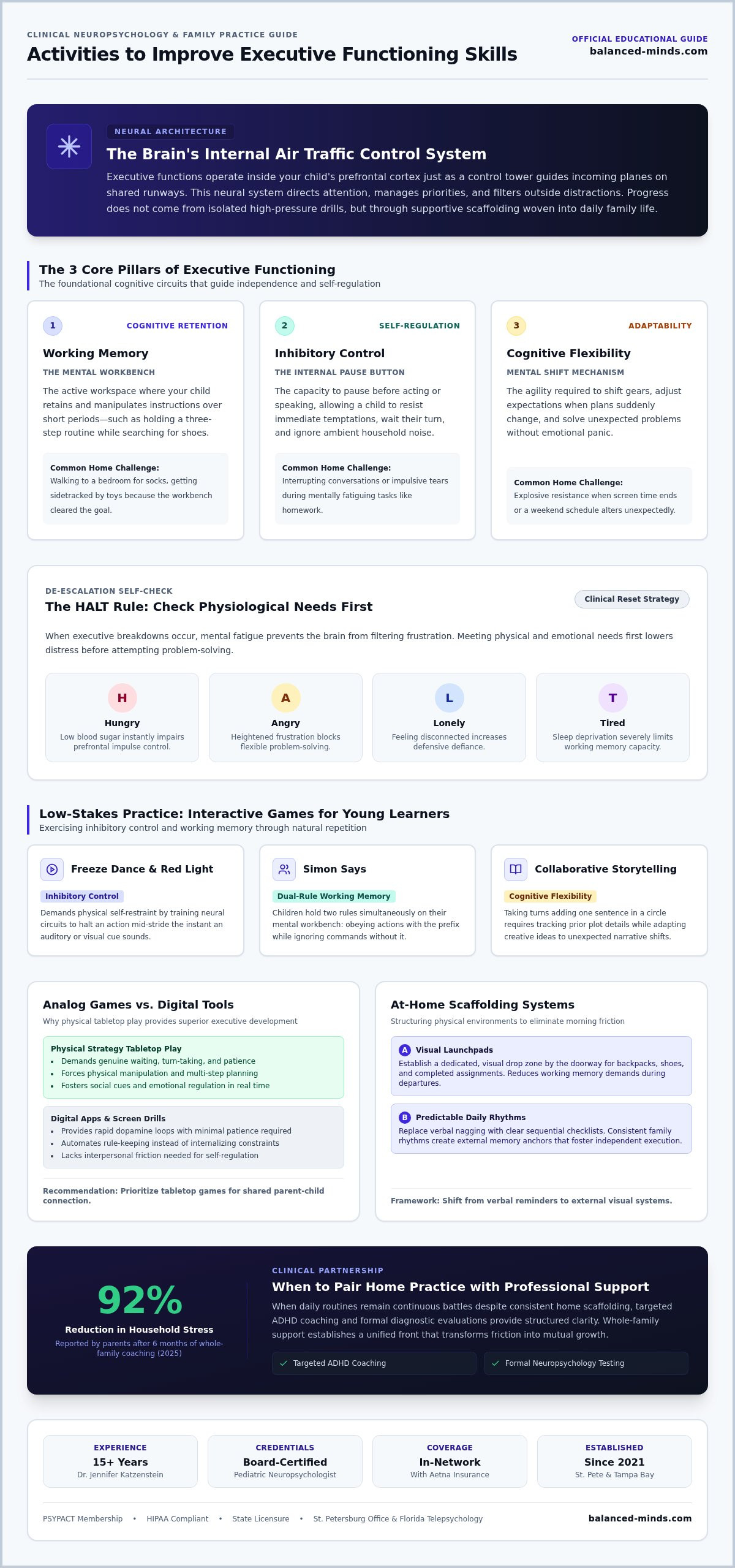
Think of executive functions as the brain's internal air traffic control system. Just as an airport tower manages dozens of incoming flights on shared runways, your child's prefrontal cortex directs attention, filters out distractions, and sets priorities. When this control system works smoothly, children can follow instructions, manage their belongings, and adapt to changes. In the field of clinical neuropsychology, we break this system down into three primary pillars:
Working Memory: The active mental workbench where your child holds and manipulates information across short intervals, such as remembering a three-step instruction while looking for their shoes.
Inhibitory Control: The capacity to pause before acting or speaking, allowing a child to resist immediate temptations, wait their turn, and ignore ambient distractions.
Cognitive Flexibility: The mental adaptability required to shift gears, revise expectations when plans change, and solve unexpected problems without emotional panic.
When you introduce targeted activities to improve executive functioning skills, you aren't just teaching isolated manners or academic tricks. You are actively exercising these neural circuits, helping your child build internal tools that support long-term independence.
Working Memory and Flexible Thinking in Everyday Family Life
Working memory lapses often look like willful defiance, but they are usually genuine cognitive drop-offs. When your child walks into their bedroom to put on socks and ends up playing with Legos, their mental workbench simply cleared out the original goal. Similarly, a lack of cognitive flexibility shows up as explosive resistance when screen time ends or a weekend schedule shifts. Recognizing these moments as skill deficits rather than deliberate disobedience helps you respond with calm guidance instead of anger.
Inhibitory Control and Emotional Regulation During Stressful Moments
Impulse control challenges frequently trigger tears and defiance during demanding homework sessions. When mental fatigue peaks, a child loses the neurological ability to filter frustration. Before addressing an executive breakdown, we recommend using the HALT rule to check if your child is Hungry, Angry, Lonely, or Tired. Meeting these physiological needs first lowers emotional distress. By modeling steady self-compassion and emotional regulation during tough moments, you provide the supportive external framework your child's developing brain needs to learn how to pause and reset.
Everyday Activities to Improve Executive Functioning Skills by Age
Building cognitive control doesn't require rigid flashcards or endless drills after school. In fact, high-pressure homework hours are usually the worst times to attempt skill-building. Real growth occurs during relaxed, low-stakes interactions where kids feel emotionally safe to stumble, reset, and try again. By pairing age-appropriate challenges with shared play, you stimulate neural pathways in the prefrontal cortex through natural repetition. As detailed in the Harvard's Center on the Developing Child activity guide, playful practice across childhood and adolescence lays the foundation for lifelong self-direction.
Interactive Games for Young Children and Early Elementary
For younger learners, physical play provides immediate feedback on self-control. Classic games double as powerful activities to improve executive functioning skills because they require kids to inhibit impulses and update mental rules on the fly:
Freeze Dance and Red Light, Green Light: These active games demand physical inhibitory control, training the brain to halt an action mid-stride when a cue sounds.
Simon Says: Children must hold two rules on their mental workbench simultaneously, obeying actions prefixed by the command while ignoring direct commands without it.
Collaborative Storytelling: Sit in a circle and take turns adding a single sentence to build an imaginary adventure. This requires kids to remember previous plot points while adapting their ideas to sudden narrative shifts.
In early childhood settings, these playful routines are essential for building lifelong executive functions. Quality early learning centres, such as Jumpstart Learning Academy, intentionally integrate cooperative games and predictable structures into their preschool and kindergarten readiness curricula to nurture these foundational self-regulation skills.
Real-World Planning Routines for Tweens and Teenagers
As academic demands increase in middle and high school, adolescents need practice managing multi-layered responsibilities. Shifting from parent-driven management to shared problem-solving builds competence without igniting defiance:
Culinary Project Management: Pick a weekly recipe and step back. Have your teen compile the ingredient list, calculate prep times, and coordinate boiling or baking steps to serve dinner on time.
Color-Coded Visual Timelines: Replace abstract digital reminder lists with physical sticky notes on a desk pad. Breaking large book reports into distinct steps helps teens visualize time blocks clearly.
Adolescent-Led Outings: Let your teen plan a Saturday trip along the St. Pete Pier or Tampa Riverwalk. Have them determine departure times, estimate parking logistics, and handle a set cash budget.
If your middle or high schooler continues to face chronic hurdles translating plans into action, pairing home practice with collaborative executive functioning coaching can offer the structured accountability and personalized tools they need to thrive.
Comparing Skill-Building Approaches: Strategy Games vs. Digital Tools
Parents often ask whether screen-based brain trainers can replace classic board games and physical planners. Technology offers undeniable convenience, but isolated digital exercises often lack the social feedback loop children need to build genuine self-control. When we examine practical activities to improve executive functioning skills, combining tactile family games with intentional organizational tools creates the most balanced, lasting growth.
Board Games and Tabletop Puzzles That Exercise Mental Agility
Physical tabletop games provide a rich training ground for the developing mind. Unlike solo tablet apps that offer automated feedback, board games require live social reciprocity, patience, and nonverbal awareness:
Forward Planning: Strategy titles like Chess, Settlers of Catan, and Rush Hour challenge players to anticipate an opponent's next two moves. This exercises working memory by holding hypothetical scenarios in mind before committing to a decision.
Flexible Rule Switching: Fast-paced card games like Uno and Spot It force players to shift visual attention rapidly between colors, numbers, and changing symbols, training cognitive flexibility on the spot.
Emotional Distress Tolerance: Waiting for a turn or losing a piece teaches real-time inhibitory control in an emotionally safe, shared environment.
Hosting a relaxed weekly game night transforms these cognitive challenges into moments of laughter and connection rather than academic pressure.
Analog Scaffolds vs. Smartphone Applications for Daily Organization
When older students transition toward greater academic autonomy, choosing between physical and digital organizational aids becomes critical. While smartphones offer calendar syncing and reminders, they also carry the constant risk of attention fragmentation. A simple notification ping can derail an hour of productive homework into endless scrolling.
Analog scaffolds often provide cleaner focus. Visual analog countdown timers make the physical passage of time tangible without exposing teens to digital distractions. In the same way, tactile paper planners allow students to map out weekly commitments and track progress toward a school-based IEP without competing app alerts.
Reserve digital apps for automated, low-friction habits like morning alarms or recurring chore checklists. When everyday strategies and organizational tweaks still fail to ease significant academic barriers, reviewing CDC guidelines on diagnostic evaluations can help you determine whether your child's patterns point to an attention difference that warrants clinical insight.
Creating an At-Home Environment That Scaffolds Executive Functioning
Children struggling with self-regulation often feel overwhelmed when their environment requires their working memory to do all the heavy lifting. By reshaping your living space, you take constant cognitive pressure off a developing brain. Thoughtful home design acts as an external skeleton, turning everyday activities to improve executive functioning skills into effortless, predictable rhythms rather than exhausting confrontations.
Visual Checklists and Predictable Morning and Evening Routines
Clutter in entryways and bedrooms creates silent cognitive static. When a child can't see their shoes or folder, frustration takes over before the day even begins:
Establish an Entryway Launch Pad: Dedicate an open cubby or low hook station specifically for backpacks, sports equipment, and lunchboxes right next to the front door. Keeping essentials visible removes the frantic morning search.
Implement Visual Checklists: Replace verbal prompts with icon-based or laminated dry-erase checklists taped to the bathroom mirror or bedroom door. Children can track their own progress through getting dressed, brushing teeth, and packing their bags.
Maintain a Unified Front: When co-parents and caregivers present consistent, predictable expectations across routines, children spend less mental energy managing uncertainty and more energy building independent habits.
Fostering Emotional Resilience and Self-Compassion During Setbacks
Emotional dysregulation is frequently what derails practical routines. When tasks stall or schedules break down, self-criticism can quickly trigger a fight-or-flight response. Modeling healthy coping skills aloud when your own plans go awry shows your child that mistakes are simply information, not personal failures. You can say, "My meeting changed times unexpectedly, so I'm going to take a slow breath and update my schedule."
To help children recognize rising stress before an explosion happens, keep a feelings wheel visible in the kitchen or workspace. Guiding your child to point to specific emotions, such as feeling rushed, embarrassed, or unheard, helps them process intense sensations calmly. Above all, offer yourself steady self-compassion as a parent. Navigating these daily challenges is taxing, and progress takes time. If you want to strengthen your home systems alongside experienced professionals, explore parenting near me resources for family balance. You don't have to carry this journey on your own; contact us today to discover practical ways we can support your household.
When to Seek Professional Support: ADHD Coaching and Psychological Evaluations
Everyday visual aids and routines build helpful structure, but sometimes at-home activities to improve executive functioning skills aren't enough on their own. When school refusal escalates, grades slip despite intense effort, or evening assignments spark constant distress, professional guidance can lift that weight. Bringing in clinical insight protects your child's emotional wellbeing and helps restore peace to your home.
Targeted Executive Functioning and ADHD Coaching for Practical Skills
Parents often wonder how skill coaching differs from traditional mental health therapy. While child therapy focuses on emotional processing and anxiety, structured ADHD coaching focuses on real-world mechanics. A coach works alongside your child to design personalized study habits, track long-term projects, and establish personal accountability. Through behavioral activation, coaches help students gently break through task paralysis and avoidance, turning overwhelming tasks into approachable steps. If you are uncertain about what is causing your child's roadblocks, exploring how to go about finding a psychologist for ADHD diagnosis in St. Petersburg can help you decide when a formal assessment is the right next step.
In-Depth Psychological Evaluations with Pediatric Neuropsychologists
Even the most creative activities to improve executive functioning skills can hit a wall when underlying attentional roadblocks remain unaddressed. When confusion lingers around why a bright student struggles to initiate or finish daily tasks, objective diagnostic testing offers true clarity. Through detailed cognitive assessments, specialists measure specific brain functions, including working memory limits, processing speed, and impulse control. Pinpointing these exact cognitive traits replaces self-blame with understanding, lifting the burden of mental health stigma from your family.
The resulting evaluation delivers the clear documentation required to establish accommodations through a 504 plan or a school-based IEP. Led by Dr. Jennifer Katzenstein, a board-certified pediatric neuropsychologist with over 15 years of experience, our team at Balanced Minds Psychology & Wellness has supported St. Petersburg and Tampa families since 2021. Whether you visit our St. Petersburg office in person or connect across Florida via secure telepsychology, we help you translate cognitive insights into practical relief. In fact, 92% of parents reported a significant reduction in household stress after six months of whole-family coaching in 2025, showing that with the right partnership, lasting progress is always possible.
Building Lifelong Independence Through Daily Partnership
Strengthening your child's self-regulation is a gradual process built on patience, predictable structures, and shared trust. By integrating supportive activities to improve executive functioning skills into relaxed family moments, you replace daily power struggles with confidence. When you combine visual organization tools with genuine emotional validation, you give your child the space they need to thrive.
If you're ready for extra guidance, Balanced Minds has supported St. Petersburg and Tampa Bay families since 2021. Led by board-certified pediatric neuropsychologist Dr. Jennifer Katzenstein with over 15 years of experience, our team provides targeted coaching and detailed evaluations. In 2025, 92% of parents reported a significant reduction in household stress after six months of our whole-family coaching. Whether you visit us locally or connect through Florida telepsychology, we're here to help. Schedule a consultation with our St. Petersburg team today to start your family's next chapter together.
Frequently Asked Questions
Can daily games and activities really cure executive functioning deficits?
No, activities cannot cure neurodevelopmental differences, but they do strengthen underlying cognitive capacity over time. Engaging in consistent activities to improve executive functioning skills helps kids create compensatory habits and exercises neural pathways in the prefrontal cortex. These exercises turn overwhelming multistep routines into automated practices, giving children practical tools to self-regulate effectively at school and home.
How do I know if my child is being lazy or struggling with executive dysfunction?
Executive dysfunction typically looks like a child who wants to meet expectations but gets completely stuck at the initiation phase. Laziness implies an intentional refusal without internal distress. Children dealing with cognitive control challenges usually express intense frustration, guilt, or anxiety when they lose their belongings or fail to start assignments despite their best intentions.
What is the difference between ADHD coaching and executive functioning coaching?
Executive functioning coaching builds general organizational, planning, and task-completion habits for any student facing self-regulation hurdles. ADHD coaching incorporates those identical scaffolding techniques while also addressing the specific neurochemistry of ADHD, including dopamine regulation, intense emotional dysregulation, and hyperfocus tendencies. Both coaching styles focus on practical real-world strategies rather than traditional clinical processing.
At what age do executive functioning skills fully mature in adolescents?
The prefrontal cortex continues developing until approximately age 25, meaning youth are naturally building these competencies throughout childhood and early adulthood. Executive skills develop unevenly across middle and high school. Introducing structured scaffolding during the teen years bridges the temporary gap between an adolescent's growing academic expectations and their developing brain biology.
Can working memory exercises help reduce my child's homework anxiety?
Yes, working memory exercises significantly decrease homework anxiety by reducing cognitive overload during academic tasks. When children practice holding and manipulating information through playful activities to improve executive functioning skills, complex assignments feel far less intimidating. Relieving the mental burden required to remember instructions lets students direct their focus toward actual problem-solving.
How does a pediatric neuropsychologist assess executive functioning skills?
A pediatric neuropsychologist uses standardized tests, clinical observations, and input from parents and teachers to measure specific cognitive traits. These assessments analyze working memory, processing speed, sustained attention, and abstract reasoning compared to peer norms. The findings provide objective data used to design targeted interventions and secure school accommodations.
Does insurance cover executive functioning coaching or psychological evaluations?
Coverage depends entirely on your specific policy terms and the exact clinical service requested. While specialized coaching is often an out-of-pocket investment, formal diagnostic evaluations are frequently eligible for insurance reimbursement. At Balanced Minds in St. Petersburg, our practice is in-network with Aetna, and we provide detailed documentation for out-of-network claims across Tampa Bay.


