

Dyscalculia Testing in Tampa: A Parent’s Guide to Math Learning Disabilities (2026)
Updated: 3 days ago
Imagine sitting at the kitchen table as the sun sets, watching your child stare at a simple math worksheet through a veil of tears. It isn't just a bad day or a lack of effort; it's a profound disconnect that feels impossible to bridge. Many parents in our community feel this same heartache, caught between the fear that their child is falling behind and the confusion of navigating a complex school system. We believe that every child possesses a unique way of processing the world, and when the traditional language of numbers feels like an unbreakable code, it's often a sign of a neurobiological difference rather than a lack of capability. Seeking specialized dyscalculia testing tampa is the first step toward replacing that nightly frustration with a sense of clarity and hope.
We understand how overwhelming it can be to advocate for your child within the Florida public school system, especially with the significant legislative changes taking effect in 2026. This guide is designed to walk alongside you as we explore how a professional evaluation can secure the necessary IEP or 504 plan accommodations. By the end of this article, you'll have a clear roadmap for understanding the latest screening requirements and practical strategies to help your child regain their confidence in the classroom. Together, we can move beyond the "learning recession" and ensure your child receives the compassionate, evidence-based support they deserve.
Key Takeaways
Learn why the weight of persistent math struggles is often rooted in a neurobiological difference in "number sense" rather than a lack of effort or practice.
Discover how professional dyscalculia testing tampa provides a nurturing environment to uncover your child's unique cognitive profile and specific learning needs.
Understand the delicate distinction between math anxiety and dyscalculia to help you address both the emotional and cognitive layers of your child's experience.
Gain clarity on navigating Florida's evolving IEP and 504 Plan processes to secure the specialized classroom support and accommodations your child deserves.
Explore how a comprehensive evaluation serves as a gentle, expert roadmap for restoring your child’s confidence and sense of possibility in the classroom.
Table of Contents
Understanding Dyscalculia: Why Math Struggles Are More Than Just "Practice"
The Dyscalculia Evaluation Process: What to Expect During Testing in Tampa
Dyscalculia vs. Math Anxiety: Distinguishing Root Causes for Better Support
Beyond the Diagnosis: Navigating IEPs and 504 Plans in Florida Schools
Compassionate Neuropsychological Testing at Balanced Minds Psychology & Wellness
Understanding Dyscalculia: Why Math Struggles Are More Than Just "Practice"
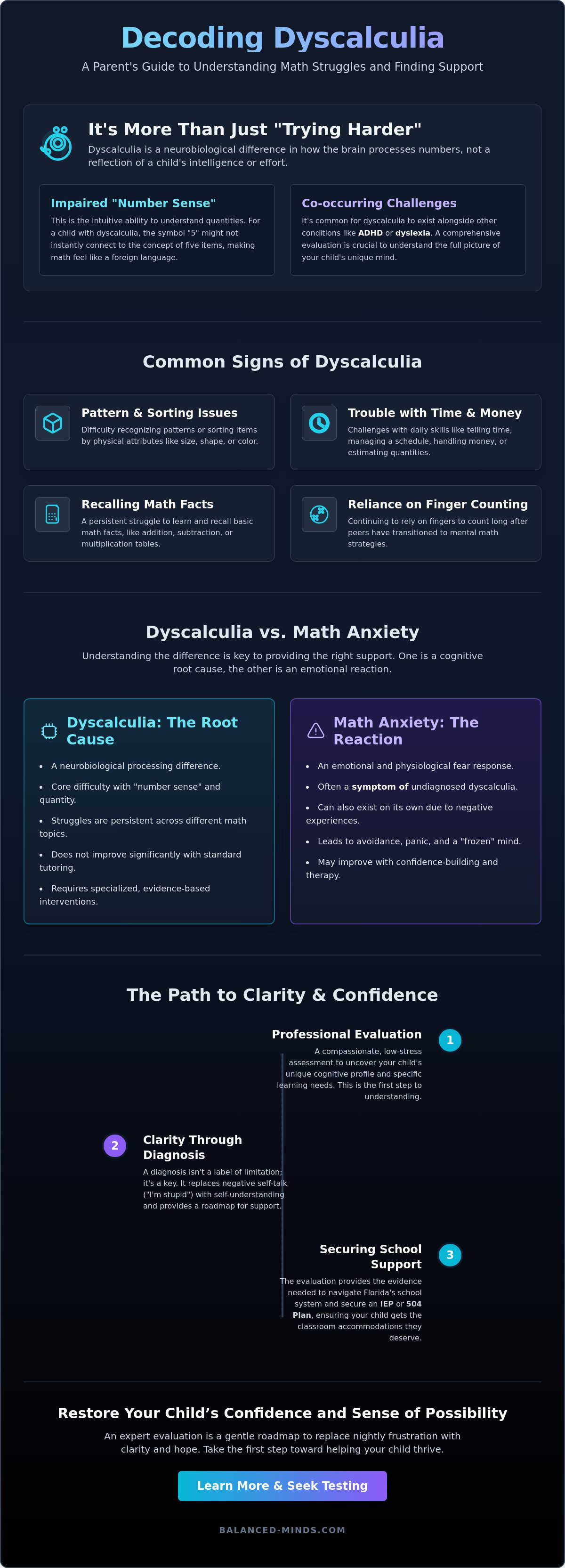
We often see parents who feel a quiet sense of desperation when their child's math grades continue to slip despite hours of tutoring. It's helpful to realize that these challenges aren't a reflection of intelligence or effort. Instead, they often stem from a specific learning disability in mathematics (SLD-M), commonly known as dyscalculia. For a foundational perspective, Understanding Dyscalculia involves recognizing it as a neurobiological difference in how the brain processes numerical magnitude. This "number sense" is the intuitive ability to understand that the symbol "5" represents five items, or that 10 is larger than 2. When this internal compass is missing, math feels like a foreign language without a dictionary.
Many well-meaning educators and parents suggest "practicing harder" or doing more worksheets, but for a child with a math disability, this often just increases math anxiety. Without professional intervention like dyscalculia testing tampa, repetitive practice can feel like being asked to read a book in the dark; no matter how long you look at the pages, the words won't become clearer. It's also quite common for these struggles to exist alongside other challenges. Research indicates that dyscalculia often co-occurs with ADHD or dyslexia, making a comprehensive evaluation essential to see the whole picture of your child's unique mind.
Common Signs of Dyscalculia in Children and Teens
Recognizing the signs early can be a profound act of love and support. You might notice your child struggling with:
Difficulty recognizing patterns or sorting items by their size and shape.
A persistent struggle to learn and recall basic math facts, such as addition or multiplication tables.
Relying on finger counting long after their peers have moved to mental math.
Challenges with daily life skills like time management, following schedules, or understanding the value of money.
The Emotional Toll of an Undiagnosed Math Disability
When a child lacks an explanation for their struggle, they often fill that void with negative self-talk. They might begin to believe they are "stupid" or "lazy," which creates a heavy shame cycle that affects their overall well-being. This stress rarely stays confined to math class; it can bleed into other subjects and create tension during family time. Rebuilding that shattered confidence often requires a specialized approach. Working with a child psychologist st petersburg fl can help your child process these feelings of inadequacy while developing the resilience they need to thrive. By seeking dyscalculia testing tampa, you are providing your child with the gift of self-understanding, which is the first step toward healing and academic success.
The Dyscalculia Evaluation Process: What to Expect During Testing in Tampa
Walking into a professional evaluation can feel like a heavy step, but we view it as the beginning of a brighter chapter for your family. Our approach to dyscalculia testing tampa is rooted in the belief that every child's brain is wired differently, and our goal is to uncover the specific map of how your child learns. We prioritize creating a low-stress, supportive environment where your child feels seen and heard rather than scrutinized. Because we want a truly accurate picture of their cognitive landscape, the testing process often spans several hours. This time allows us to move at your child's pace, ensuring they don't feel rushed or overwhelmed as we gather the necessary data to support them.
For many parents, Understanding Dyscalculia starts with realizing that a diagnosis isn't a label of limitation; it's a key to unlocking the right resources. We don't just look at the test scores in isolation. We also lean on your expertise as a parent and the observations of teachers to understand how math challenges show up in daily life. This holistic view ensures that our findings are grounded in your child's real-world experience, making the path forward much clearer.
Step 1: Clinical Interview and History Gathering
Our journey begins with a thoughtful conversation about your child's development. We'll discuss early milestones, academic history, and any family patterns of learning differences that might be present. By reviewing previous school records and standardized test scores, we can identify when the struggle with numbers first began. This partnership helps us build a foundation of trust before we ever begin the formal assessments.
Step 2: Specialized Testing Administration
During the core of the evaluation, we use a variety of tools to measure cognitive abilities and academic achievement. We look at your child's IQ to identify their inherent intellectual strengths, which often provides a boost to their self-esteem. From there, we dive into math-specific assessments that test fluency and reasoning. We also evaluate executive functions like working memory and processing speed, as these often play a hidden role in how a child manages complex math problems. If you're ready to explore how these insights can help, our team offers specialized Learning Disability Assessments tailored to your child's needs.
Step 3: The Feedback Session and Comprehensive Report
Once the testing is complete, we won't just hand you a stack of papers and leave you to figure it out. We schedule a dedicated feedback session to translate complex data into a clear, compassionate narrative. You'll receive a comprehensive report with actionable recommendations for both home and school. Our aim is to ensure you leave feeling empowered, equipped with a roadmap that turns confusion into a structured plan for your child's success.
Dyscalculia vs. Math Anxiety: Distinguishing Root Causes for Better Support
It is quite common for parents to wonder if their child is simply afraid of math or if there is a deeper cognitive hurdle at play. While math anxiety is an emotional response characterized by fear and tension, dyscalculia is a specific cognitive disability rooted in how the brain processes numbers. However, these two often walk hand-in-hand. When a child has undiagnosed dyscalculia, they experience repeated failure despite their best efforts, which naturally breeds a deep-seated anxiety toward the subject. Professional dyscalculia testing tampa is the most effective way to untangle these threads. By identifying the root cause, we can move from a place of confusion to a place of targeted support. Finding quality psychology near me ensures that both the cognitive processing needs and the emotional fallout are addressed with equal care and expertise.
We believe that a differential diagnosis is essential because the "treatment" for anxiety looks very different from the interventions needed for a learning disability. If we only treat the anxiety without acknowledging the underlying dyscalculia, the child will continue to struggle with the mechanics of math, leading to further frustration. Conversely, only providing math tutoring without addressing the emotional trauma of past failures can leave a child too stressed to utilize new skills. Our goal is to provide a clear, evidence-based answer that honors your child's whole experience.
Can Anxiety Mimic a Learning Disability?
When a child feels threatened by a math problem, their brain enters a "fight or flight" state. This physiological response actually shuts down the prefrontal cortex, the area responsible for working memory and logical reasoning. In these moments, anxiety can mimic a learning disability because the brain simply isn't "online" for math. You might notice your child can do math at home but freezes during a test. This is a sign that anxiety might be the primary driver. However, because the symptoms look so similar, dyscalculia testing tampa is necessary to see through the "fog" of stress and determine if a neurobiological difference exists beneath the surface.
Supporting the Whole Child
True healing happens when we support the child's mind and heart simultaneously. Therapy plays a vital role in dismantling math-related phobias and replacing them with a "growth mindset," where mistakes are seen as opportunities for learning rather than proof of inadequacy. Often, the stress of math struggles impacts the entire household, turning homework time into a battlefield. Engaging in family therapy near me can provide parents and children with the communication tools needed to reduce this tension. By addressing the disability while supporting the family's emotional ecosystem, we create a restorative environment where your child can finally feel safe to learn.
Beyond the Diagnosis: Navigating IEPs and 504 Plans in Florida Schools
Receiving the results of dyscalculia testing tampa is a moment of profound clarity, but it is also the beginning of a new journey within the Florida education system. We know that the transition from clinical results to classroom support can feel like learning a new language. In our local Pinellas and Hillsborough County schools, two primary paths exist to support your child: the Individualized Education Program (IEP) and the 504 Plan. While an IEP provides specialized instruction and falls under Special Education (ESE in Florida), a 504 Plan focuses on providing equal access through classroom accommodations. Both are powerful tools, and we are here to help you determine which path best serves your child's unique cognitive profile.
A private evaluation from our team carries significant weight during these school meetings. Because we provide a level of depth that school-based screenings often miss, our reports help school teams understand the specific "why" behind your child's math struggles. Whether you are navigating the requirements of Hillsborough County Public Schools or Pinellas County Schools, having a comprehensive, evidence-based document ensures that your child isn't just seen as "struggling with math," but as a student with a documented neurobiological need for support. You are your child’s most important advocate, and we strive to provide the clinical evidence you need to speak with confidence and authority.
Common Accommodations for Dyscalculia
The right accommodations can transform a child’s daily school experience from one of constant frustration to one of attainable success. We often recommend a combination of the following:
Extended time: Allowing additional time on tests and assignments involving math reduces the "freeze" response caused by processing speed challenges.
Calculators and reference sheets: Providing access to basic calculators or "cheat sheets" for multiplication tables allows the child to focus on high-level concepts rather than getting stuck on rote calculation.
Modified assignments: Shortening the number of problems or focusing on conceptual understanding rather than repetitive practice.
Visual aids: Using large-grid graph paper helps with number alignment and vertical organization, which are common hurdles for those with dyscalculia.
How We Support Your School Advocacy
Our commitment to your family doesn't end when the testing is over. We write our reports using the specific terminology and "language" that school district eligibility committees look for, making the path to services smoother for everyone involved. We don't just provide data; we offer a list of specific, evidence-based recommendations that teachers can implement immediately. If you feel uneasy about an upcoming meeting, we also offer follow-up consultations to help you prepare your talking points. If you're ready to secure the support your child deserves, we invite you to schedule one of our Comprehensive Psychological Evaluations today.
Compassionate Neuropsychological Testing at Balanced Minds Psychology & Wellness
At Balanced Minds Psychology & Wellness, we believe that every child’s struggle is an invitation for deeper understanding and compassionate growth. We recognize that seeking dyscalculia testing tampa is a significant decision for any family. It often represents the final step in a long journey of wondering why math feels like an unbreakable code. By choosing a comprehensive evaluation, you're giving your child the gift of clarity; a way to replace years of frustration with a structured, supportive roadmap for the future.
Our welcoming office in St. Petersburg is designed to put children and teens at ease from the moment they walk through the door. For our neighbors in Tampa, we also offer flexible telehealth options for initial consultations and feedback sessions, ensuring that professional support is always within reach. We don’t just deliver a diagnosis; we provide a partnership that honors your child’s unique humanity and potential. Testing isn't about finding what's "wrong," but rather discovering how your child's mind works so we can pave a smoother path forward together.
A Team Dedicated to Your Child’s Growth
Our collective of experts specializes in pediatric neuropsychology, ensuring that every evaluation is conducted with the highest level of clinical rigor. We understand that a math disability rarely exists in isolation. Because we offer a full spectrum of care, your child’s results can naturally inform other supportive services, such as ADHD Coaching or Executive Functioning Coaching. This integrated approach allows us to address the whole child, moving beyond labels to foster real-world resilience. We're committed to a non-judgmental, shame-free environment where every individual feels safe to explore their challenges and celebrate their strengths.
Take the First Step Toward Clarity
If you've spent months or years feeling like something is "off" with your child’s math progress, we encourage you to trust that parental intuition. You don't need to have all the answers before you reach out to us for dyscalculia testing tampa. Our intake process is designed to be gentle and straightforward, helping us understand your family's unique needs before we ever begin the formal testing. We're here to listen, to validate your experience, and to provide the scientific insights necessary for your child to thrive. Contact us today to discuss dyscalculia testing for your child and begin the journey toward lasting academic confidence.
Empowering Your Child’s Academic Journey
We've explored how persistent math struggles are often rooted in a neurobiological difference in number sense rather than a lack of effort. Understanding the distinction between a learning disability and math anxiety is the first step toward healing the emotional toll these challenges take on your family. A comprehensive evaluation provides the clarity needed to navigate the Florida school system, ensuring your child receives the specific accommodations they deserve through an IEP or 504 Plan. We combine clinical rigor with a heart-centered approach to ensure that dyscalculia testing tampa feels like a supportive, restorative experience for both you and your child.
You don't have to navigate these complexities alone. By choosing an evidence-based path, you're helping your child rediscover their inherent strengths and move beyond the shadow of math-related shame. Schedule a Consultation for Dyscalculia Testing in Tampa Bay and let's begin the process of building a brighter, more confident academic future together. Your child possesses an incredible capacity for growth, and it's our privilege to help them find the way forward.
Frequently Asked Questions
How is dyscalculia different from just being "bad at math"?
Dyscalculia is a neurobiological learning disability that affects the brain's ability to process numerical magnitude, while being "bad at math" is often a general term for a lack of skill or interest. It isn't a matter of effort or practice. Children with this condition struggle with the fundamental "number sense" that allows others to intuitively understand that 8 is larger than 4 or how numbers relate to one another on a number line.
What age is best for a dyscalculia evaluation?
While signs can appear as early as preschool, the best age for a formal evaluation is usually around 7 or 8 years old. This is the period when foundational math concepts like place value and basic operations are introduced in the classroom. However, we also provide evaluations for older children and teens who have developed complex coping mechanisms that mask their underlying cognitive struggles.
Will a private evaluation be accepted by Pinellas or Hillsborough County schools?
Yes, schools in Pinellas and Hillsborough County are required by Florida law to consider private evaluations when determining eligibility for an IEP or 504 Plan. Our reports are specifically written to meet the rigorous clinical standards these districts require. When you pursue dyscalculia testing tampa with our team, you receive a document designed to bridge the gap between clinical findings and classroom support.
How long does the math disability testing process take?
The testing process typically takes between four and six hours, though we often break this into two separate sessions to ensure your child remains comfortable and engaged. We want to see their best work, not their most exhausted work. This comprehensive timeframe allows us to look beyond just math scores to evaluate memory, processing speed, and intellectual strengths.
What if my child also has ADHD or anxiety?
It is very common for dyscalculia to co-occur with ADHD or anxiety, and our evaluations are designed to untangle these overlapping challenges. We look at the whole child rather than focusing on a single symptom in isolation. By understanding how these conditions interact, we can create a more effective roadmap for both emotional support and academic intervention.
Does health insurance cover psychological testing for learning disabilities?
Insurance coverage for psychological testing varies significantly depending on your specific plan and whether the testing is deemed "medical" or "educational." Many families find that while some portions may be covered, others are considered out-of-pocket investments in their child's future. We recommend contacting your insurance provider directly to understand your benefits for dyscalculia testing tampa before your appointment.
What happens if the testing shows my child doesn’t have dyscalculia?
If the results indicate that your child does not meet the criteria for dyscalculia, the testing still provides immense value by ruling out a specific learning disability. It often uncovers other factors, such as working memory gaps, processing speed delays, or math anxiety, that are hindering their progress. Regardless of the diagnosis, you will leave with a clear understanding of your child's learning profile and actionable steps to help them succeed.
How can I help my child with math at home while waiting for testing?
You can support your child by shifting the focus from rote memorization to tactile, real-world experiences with numbers. Use physical objects like beads, blocks, or coins to represent math problems, and try to keep homework sessions low-pressure to reduce the "fight or flight" response. Validating their frustration as a real challenge rather than a lack of trying can also begin to heal the emotional toll of their struggle.


