

Comprehensive Dyslexia Evaluation in Tampa: A Parent’s Compassionate Guide
Updated: 3 days ago
Your child is bright. You know it, and somewhere deep down, they know it too. So why does reading feel like climbing a wall that everyone else seems to walk right through? If you've been watching your child struggle, quietly wondering whether the school is doing enough or whether something deeper is going on, you're not alone in that worry, and you're not wrong to want answers.
Most parents who come to us have already spent months, sometimes years, in a cycle of reassurances that never quite resolve anything. The truth is, a professional dyslexia evaluation in Tampa isn't just about confirming a diagnosis. It's about understanding exactly how your child's brain works, where it shines, and where it needs targeted support. That distinction changes everything.
In this guide, we'll walk you through what a comprehensive dyslexia evaluation actually involves, how it differs from a school screening, why co-occurring challenges like ADHD and anxiety are so often part of the picture, and how a thorough neuropsychological assessment can give your family the clarity, the school documentation, and the forward momentum you've been searching for.
Table of Contents
Understanding Dyslexia: Why a Professional Evaluation in Tampa is the First Step
The Neuropsychological Difference: How Balanced Minds Evaluates Dyslexia
Private vs. School-Based Evaluations: Navigating Florida's Educational Landscape
From Diagnosis to Growth: Supporting Your Child After the Evaluation
Understanding Dyslexia: Why a Professional Evaluation in Tampa is the First Step
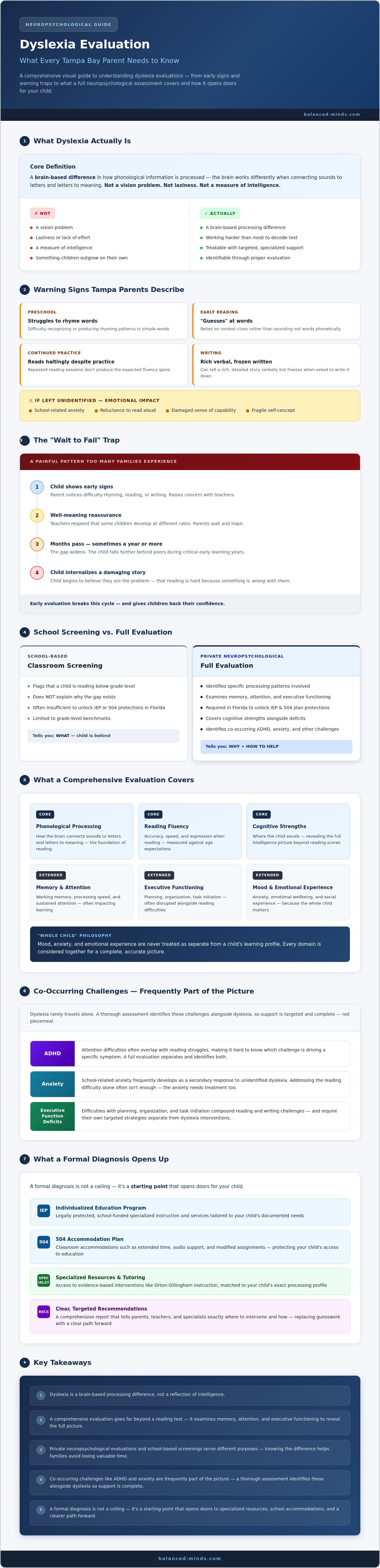
Dyslexia is not a vision problem. It's not laziness, and it has nothing to do with how smart your child is. At its core, dyslexia is a brain-based difference in how phonological information is processed, meaning the brain works differently when connecting sounds to letters and letters to meaning. That distinction matters enormously, because once parents understand that their child isn't failing to try but rather working harder than most just to decode a single sentence, the entire conversation about support shifts.
The signs Tampa parents most often describe include a child who struggles to rhyme words in preschool, who seems to "guess" at words rather than sound them out, who reads haltingly even after repeated practice, or who can tell a rich, detailed story verbally but freezes when asked to write it down. These aren't quirks to outgrow. They're signals worth taking seriously.
One of the most painful patterns we see is what's often called the "Wait to Fail" trap. A child shows early signs, parents raise concerns, and well-meaning teachers offer reassurance that some kids just develop at different rates. Months pass. Then a year. By the time a formal evaluation is requested, the child has spent critical early learning years without the targeted support their brain actually needed, and they've often begun to internalize a quiet, damaging story about themselves: that reading is hard because something is wrong with them.
That emotional weight is real. Children with unidentified dyslexia frequently develop school-related anxiety, a reluctance to read aloud, and a fragile relationship with their own sense of capability. Addressing the reading difficulty alone isn't always enough; the whole child needs to be seen.
What is a Dyslexia Evaluation?
A dyslexia evaluation is a comprehensive assessment of phonological processing, reading fluency, and cognitive strengths. It's meaningfully different from a classroom screening. A screening might flag that a child is reading below grade level; a full diagnostic evaluation explains why, identifying the specific processing patterns involved. In Florida, a formal diagnostic evaluation is typically required before a school can implement legally protected accommodations under an IEP or 504 plan, which means that a screening result, however well-intentioned, often isn't enough to open those doors.
When Should You Seek Testing in Tampa Bay?
Florida's B.E.S.T. standards set clear reading benchmarks at each grade level, and Pinellas County schools use early literacy assessments to track progress against those expectations. If your child is consistently falling below those markers, or if school feedback feels vague and incomplete despite your persistent questions, that's worth paying attention to. Parental intuition is data too. A dyslexia evaluation in Tampa with a qualified neuropsychologist can provide the clarity that reassurances simply can't.
The Neuropsychological Difference: How Balanced Minds Evaluates Dyslexia
There's a meaningful difference between knowing a child is struggling with reading and understanding why their brain processes language the way it does. That distinction is exactly what separates a neuropsychological evaluation from a standard screening or even a one-session reading test. The goal isn't simply to confirm a label; it's to build a complete, nuanced picture of how a specific child thinks, learns, and experiences their world.
A one-session approach can tell you a child is behind. A comprehensive dyslexia evaluation in Tampa, conducted at the neuropsychological level, can tell you why the gap exists, what cognitive systems are contributing to it, and precisely where to intervene. That depth of insight changes the quality of every recommendation that follows.
The "whole child" philosophy is central to how Balanced Minds approaches this work. Mood, anxiety, and emotional experience aren't separate from a child's learning profile; they're woven through it. A child carrying unaddressed anxiety about reading aloud will perform differently on a timed assessment than a child who feels genuinely safe. That's why the St. Petersburg office is intentionally designed to feel low-pressure and welcoming, creating the kind of environment where children can show up as they actually are, rather than performing under stress.
The Components of a Comprehensive Assessment
A thorough evaluation examines several interlocking systems, because reading difficulties rarely trace back to a single source. Key components typically include:
Phonological awareness: The ability to hear, isolate, and manipulate individual sounds within words. This is the foundational skill that underlies decoding, and it's frequently where dyslexia first shows its signature pattern.
Rapid naming and processing speed: How quickly the brain retrieves and sequences linguistic information. Slow processing speed can create reading difficulties that look like dyslexia but have a different underlying driver, and distinguishing between them matters enormously for treatment.
Reading fluency, accuracy, and comprehension: Separate but related skills that are each assessed individually, because a child can decode words accurately but slowly, or read fluently without retaining meaning.
Memory and executive functioning: Working memory, in particular, plays a significant role in reading; a child who struggles to hold sounds in mind while decoding a longer word will appear to struggle with reading when the real challenge is memory capacity.
Why Cognitive Strengths Matter as Much as Weaknesses
One of the most important things a neuropsychological evaluation can reveal is where a child is genuinely strong. Some children who struggle with reading demonstrate exceptional reasoning, creativity, or verbal comprehension. These are twice-exceptional learners, often called 2e, and their giftedness can actually mask the severity of a reading difficulty in classroom settings, making them particularly easy to miss. Identifying that profile changes everything about how support is structured; a child's strengths become the bridge across the areas where their brain needs more scaffolding.
If your family is exploring broader support beyond a learning evaluation, our psychology near me guide for St. Petersburg and Tampa offers a compassionate overview of the full range of care available in the area. And if you're ready to take the first step toward understanding your child's learning profile, reaching out to our team is a natural place to begin.
Private vs. School-Based Evaluations: Navigating Florida's Educational Landscape
Here's something many Tampa Bay parents don't realize until they're already deep in the process: a school evaluation and a private neuropsychological evaluation are designed to answer fundamentally different questions. A school district is legally required to determine whether a child qualifies for special education services under the Individuals with Disabilities Education Act (IDEA). That's it. The guiding framework is eligibility, not understanding. A private evaluation, by contrast, is built around your child as a whole person, examining the full cognitive landscape rather than checking boxes against a threshold.
This distinction matters because eligibility and understanding don't always overlap. A child can be denied school-based services because they don't meet a specific discrepancy formula, even when a neuropsychologist can clearly identify dyslexia in their profile. The school's conclusion isn't wrong within its own framework; it's just answering a narrower question than the one you're actually asking.
Waitlists are another practical reality. School psychologists in Hillsborough and Pinellas County districts carry significant caseloads, and the timeline from a parent's initial referral to a completed psychoeducational evaluation can stretch considerably. For a child in the middle of a critical reading development window, that wait has real consequences. A private dyslexia evaluation in Tampa can often move at a pace that better matches your child's needs.
Navigating Pinellas and Hillsborough County Schools
Before a Florida school district will conduct its own evaluation, most children move through a tiered support process known as Multi-Tiered System of Supports, or MTSS, which incorporates what many parents hear called Response to Intervention, or RTI. The intent is sound: try progressively intensive classroom interventions before moving to formal testing. In practice, this process can delay a formal evaluation by a year or more while a child receives generalized support that may not address their specific processing profile.
If you've already obtained a private evaluation, you don't need to wait for the district to start its own process before acting on those results. You can request a meeting with your child's school team, present the private report, and ask the team to consider it as part of an IEP or 504 Plan development conversation. Schools are not legally required to adopt the private report's conclusions, but they are required to consider it. Coming to that meeting prepared, with specific recommendations clearly articulated in the report, makes a meaningful difference.
One distinction worth understanding: a licensed school psychologist is trained primarily within an educational framework, focused on academic functioning and eligibility determinations. That depth is precisely what makes a private report so useful when you're advocating within a school system that tends to see children through a narrower lens.
College Board and Standardized Testing Accommodations
The documentation you build now doesn't just support your child through elementary school. Florida's FAST assessments, the SAT, and the ACT all have formal accommodation request processes, and each requires current, comprehensive evaluation documentation to support requests like extended time, separate testing environments, or alternative formats. The College Board's guidelines are specific about what qualifies as sufficient documentation, and a thorough neuropsychological report, completed by a qualified clinician, is far more likely to meet those standards than a school screening summary.
Starting this documentation process early, even before high school feels relevant, gives your family flexibility and removes future urgency from an already stressful season. If you're also exploring advocacy support or broader therapeutic resources alongside the evaluation process, our guide to finding the right child psychologist in St. Petersburg offers practical guidance for building a full support team around your child.
What to Expect: Your Child's Dyslexia Assessment Journey
One of the most common things parents tell us after completing the process is that it wasn't what they expected, and almost always, they mean that in the best possible way. The evaluation journey at Balanced Minds is designed to feel less like a series of clinical hurdles and more like a collaborative conversation about your child's unique mind. Understanding what actually happens at each stage helps families arrive prepared, which means your child arrives calmer too.
The process unfolds across three distinct phases. First, an initial consultation gathers the full developmental history: early milestones, school records, teacher observations, and the specific concerns that brought your family here. This isn't paperwork for paperwork's sake. The history shapes how the testing is interpreted, because a child who struggled with speech delays at age two carries a different profile than one whose reading difficulties appeared suddenly in second grade. That context is clinically meaningful.
Testing day itself is one-on-one time between your child and the clinician, structured to feel low-stakes and genuinely engaging. Tasks vary in format and pacing, which keeps children present without exhausting them. Nothing about the session is designed to feel like a high-stakes exam, because children who feel evaluated perform differently than children who feel understood. That distinction shapes everything about the quality of data collected during a dyslexia evaluation in Tampa.
The feedback session is where the picture comes together for your family. Rather than receiving a report and being left to interpret it alone, parents sit down with the clinician to walk through the findings in plain language, ask questions, and leave with a genuine sense of direction. Think of it less as a verdict and more as a roadmap.
Preparing Your Child for the Evaluation
How you frame the evaluation shapes how your child experiences it. Simple, honest language works best: something like, "We're going to find out how your brain learns best." That framing is accurate, and it positions the day as discovery rather than judgment. Practical preparation matters too. A full night's sleep and a solid breakfast make a measurable difference in how any child performs on cognitive tasks. Bringing a favorite snack to our St. Petersburg office is genuinely encouraged; small comforts reduce ambient stress in ways that benefit the whole session. If your child tends toward anxiety in new environments, visiting the office beforehand, even briefly, can help it feel familiar when testing day arrives.
Understanding the Final Report
The written report that follows a comprehensive assessment is thorough by design, but clinical language shouldn't create distance between findings and action. At Balanced Minds, recommendations are written to be usable, not just documentable. If Orton-Gillingham based tutoring is indicated, the report will say so specifically, giving parents and educators a concrete starting point rather than a vague suggestion to "seek additional support."
When co-occurring challenges like ADHD or anxiety emerge during testing, those findings are addressed within the same report rather than flagged for a separate process. If you're wondering whether attention difficulties might be part of your child's picture, our guide to finding a psychologist for ADHD diagnosis in St. Petersburg offers a helpful next layer of context.
A thorough report doesn't just explain what's hard. It articulates where your child is genuinely strong, and those strengths become the foundation for every strategy that follows. If you're ready to move from uncertainty toward understanding, connecting with our team is a natural first step.
From Diagnosis to Growth: Supporting Your Child After the Evaluation
The moment a family receives a dyslexia diagnosis, something interesting tends to happen. Relief and grief arrive together. Relief, because there's finally a name for what's been happening. Grief, because the years of confusion feel suddenly visible. Both responses are valid, and both deserve space. But here's what we want you to hold onto: a diagnosis is not a ceiling. It's a doorway, and what's on the other side is a far more targeted, effective path forward than anything that came before it.
The evaluation report your family receives isn't meant to sit in a drawer. It's a working document, one that connects directly to specialized reading tutors trained in structured literacy approaches like Orton-Gillingham, speech-language pathologists who address phonological processing at its root, and executive function coaches who help children manage the organizational demands that often travel alongside dyslexia. The "organization problem" that looks like carelessness is frequently a processing difference, and coaching addresses it at that level rather than treating it as a behavioral issue.
Balanced Minds supports families beyond the evaluation itself. Individual therapy for children and adolescents is available precisely because learning differences carry an emotional weight that reading instruction alone doesn't resolve. A child who has spent years feeling behind needs more than better tutoring strategies; they need a space to rebuild their relationship with learning and with themselves.
Advocating for Your Child's Rights
Once you have your evaluation report in hand, you can formally request an IEP or 504 Plan meeting with your child's school. Put the request in writing and reference the completed evaluation. Specific accommodations worth discussing include extended time on tests, access to audiobooks and text-to-speech tools, speech-to-text technology for written assignments, and reduced-distraction testing environments. Coming to that meeting with the report's recommendations clearly marked makes the conversation more productive and positions you as an informed, collaborative partner rather than an adversary. Teachers generally want to help; a concrete, well-documented report gives them the tools to do so.
The Emotional Journey: Building Resilience
Learned helplessness is one of the quieter consequences of unidentified dyslexia. Children who've tried and struggled repeatedly often stop trying altogether, not out of laziness but out of self-protection. Rebuilding reading confidence is slow, relational work. It happens in small moments: a sentence decoded independently, a story written and celebrated, a teacher who notices effort rather than output.
The family's stress is part of this picture too. Parents carry the weight of advocacy, coordination, and worry in ways that deserve acknowledgment and support. Our parenting support guide for St. Petersburg and Tampa offers practical resources for families navigating exactly this season.
A thorough dyslexia evaluation in Tampa is where clarity begins, but the growth that follows is what this whole process is really about. If your family is ready to take that first step, or if you're simply not sure where to start, we're here. Not with pressure, not with urgency, just with a genuine willingness to walk this path alongside you.
Your Child's Clarity Starts Here
Reading struggles don't resolve on their own, and reassurances don't replace answers. What this guide has walked you through is the full picture: why dyslexia is a brain-based processing difference and not a reflection of effort or intelligence, how a dyslexia evaluation in Tampa at the neuropsychological level reveals far more than a school screening can, and why the documentation you build now serves your child through every stage of their education.
Reports are detailed, actionable, and written specifically to support families navigating Florida's school systems. The St. Petersburg testing environment is designed to feel genuinely safe, because children who feel at ease show up as they actually are.
Your child's story isn't finished. It's just waiting for the right starting point. Schedule a compassionate consultation with our team today and take the first step toward the clarity your family deserves.
Frequently Asked Questions About Dyslexia Evaluation in Tampa
How much does a dyslexia evaluation cost in the Tampa Bay area?
We don't publish specific fee information here, because costs vary based on the scope of the evaluation and individual circumstances. What we'd encourage you to do is contact Balanced Minds directly to discuss current fees and what's included in a comprehensive assessment. What's worth understanding is that a thorough neuropsychological evaluation covers intake, testing, and a detailed feedback session, so you're not paying for a single reading test but for a complete picture of your child's learning profile.
Does insurance cover dyslexia testing at Balanced Minds?
Insurance coverage for neuropsychological evaluations varies considerably by plan, and it's something to verify directly with your provider before scheduling. We'd recommend calling the member services number on your insurance card and asking specifically about coverage for psychological testing and learning disability assessments. Balanced Minds can speak with you about what documentation they provide to support any reimbursement process you may pursue.
What is the difference between a school evaluation and a private dyslexia evaluation?
A school evaluation is designed to answer one question: does your child qualify for special education services under federal eligibility criteria? A private neuropsychological evaluation is designed to answer a different, broader question: how does your child's brain actually work, and what does that mean for how they learn? The school process filters through an eligibility lens; a private evaluation like those conducted at Balanced Minds examines cognitive strengths, processing patterns, memory, attention, and emotional functioning together, producing recommendations that are specific and immediately usable.
Will my child's school in Pinellas or Hillsborough County accept a private evaluation?
Florida schools are required to consider a private evaluation when making eligibility and placement decisions, though they aren't legally obligated to adopt every recommendation it contains. Schools respond well to documentation that's detailed and clinically grounded rather than vague or summary-level.
At what age should I get my child tested for dyslexia?
A dyslexia evaluation in Tampa can be meaningful as early as age five or six, particularly when early signs like difficulty with rhyming, letter-sound connections, or phonological awareness are present. Early identification matters because the brain's reading circuitry is most responsive to targeted intervention during the primary school years. That said, it's never too late; adolescents and older students benefit meaningfully from formal diagnosis, especially when pursuing accommodations for standardized testing like the SAT or ACT.
Can a dyslexia evaluation also identify ADHD or anxiety?
Yes, and this is one of the most important reasons to choose a comprehensive neuropsychological evaluation over a narrower reading assessment. ADHD, anxiety, and dyslexia frequently co-occur, and their symptoms can overlap in ways that make each one harder to identify in isolation. At Balanced Minds, the whole-child philosophy means that mood, attention, and executive functioning are examined alongside reading and phonological processing within the same evaluation, so families receive a complete picture rather than a partial one that leads to incomplete support.
How long does the testing process take from start to finish?
The process unfolds across multiple appointments rather than a single session. An initial intake consultation gathers developmental history and family concerns, followed by one or more testing sessions with your child, and then a feedback meeting where findings are reviewed with parents in plain language. The full timeline from first contact to receiving the written report depends on scheduling and evaluation complexity; contacting Balanced Minds directly will give you the most accurate current estimate for your family's situation.
What happens if my child is diagnosed with dyslexia?
A diagnosis opens concrete doors rather than closing them. The evaluation report becomes your primary tool for requesting school accommodations, whether through an IEP or 504 Plan, and for connecting with specialized support like structured literacy tutors trained in Orton-Gillingham approaches or speech-language pathologists who address phonological processing directly. Balanced Minds also offers individual therapy for children and adolescents, which matters because the emotional weight of years spent struggling with reading often needs its own space to heal alongside the academic support.


