

Compassionate School Refusal Treatment in St. Petersburg: A Parent’s Guide

Updated: 6 days ago
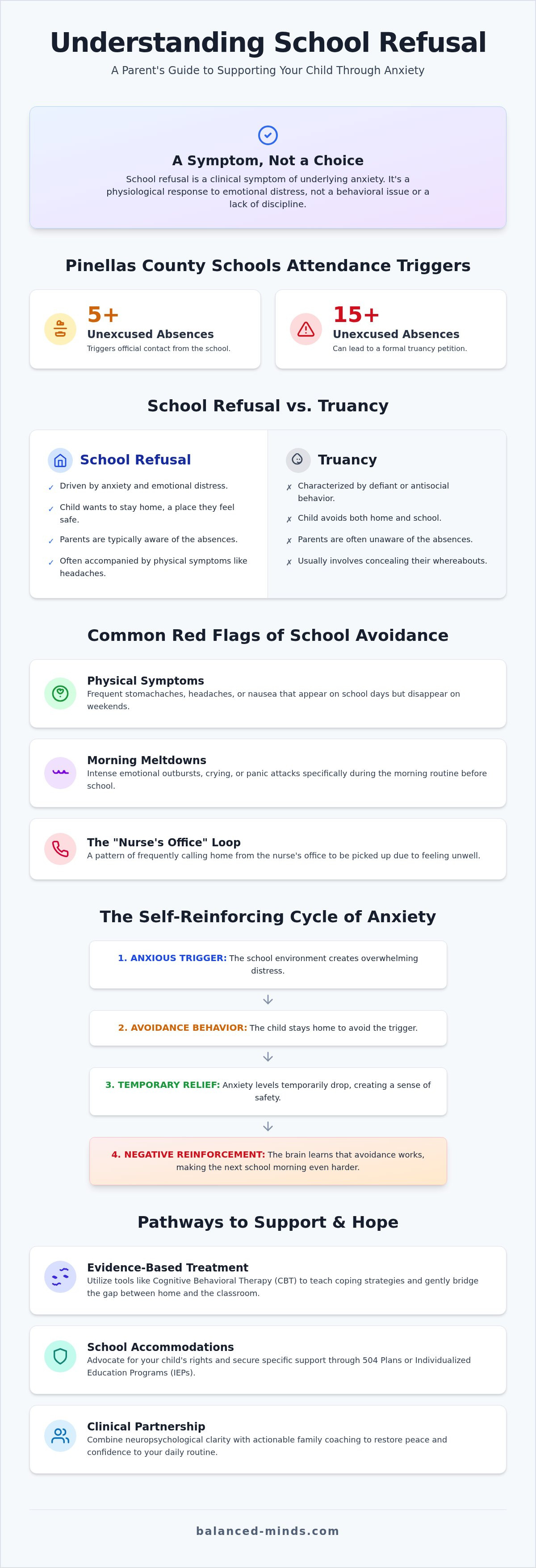
It’s 7:15 AM in St. Petersburg, and instead of a calm breakfast, you’re faced with another morning of tears and a child who feels paralyzed by the thought of entering school. You aren't alone in this struggle, and we know how heavy the weight of those daily power struggles can feel. It's natural to worry about your child's future or the legal implications of the Pinellas County Schools attendance policy, where five unexcused absences trigger school contact and fifteen can lead to a truancy petition. We believe that school refusal is a clinical symptom of underlying anxiety, not a behavioral choice or a lack of discipline.
Our goal is to help you move from fear to actionable hope. By exploring specialized school refusal treatment st petersburg parents can find the evidence-based strategies and local resources needed to help their children feel safe again. In this guide, we'll walk through how a clear clinical plan can transform your morning routine into a time of peace and provide your family with the partnership you've been looking for. We'll examine the bridge between therapy and school-home support to ensure your child regains their confidence and sense of security.
Table of Contents
Understanding School Refusal: More Than Just "Skipping Class"
If you have spent your morning negotiating, pleading, or even physically helping your child into the car only to have them retreat back to their room, please know that you aren't alone. This isn't a failure of your parenting or a sign of a "difficult" child. Instead, we view this through the lens of Understanding School Refusal as a profound emotional response to distress. It's a clinical phenomenon where the school environment triggers a level of anxiety that feels insurmountable to a young person. We see this struggle as a universal aspect of the human condition; we all have moments where our internal resources feel overwhelmed by the demands of our world.
Avoidance exists on a spectrum. For some, it begins with a quiet reluctance or a tearful plea to stay home. For others, it escalates into full physical refusal, where the child is unable to even cross the threshold of the school building. Recognizing these patterns early is the first step toward effective school refusal treatment st petersburg families can rely on to restore stability and peace to their homes.
The Red Flags of School Avoidance
The signs of school avoidance aren't always as obvious as a child refusing to get out of bed. Often, they manifest as physical distress that seems to have no medical cause. We encourage parents to look for patterns that coincide with the school week. Common red flags include:
Physical Symptoms: Frequent complaints of stomachaches, headaches, or nausea that magically disappear on Friday evenings and don't return until Sunday night.
Morning Meltdowns: Intense emotional outbursts, crying spells, or panic attacks that occur specifically during the morning routine or the commute to school.
The "Nurse Office" Loop: A pattern of calling home from the school nurse's office, pleading to be picked up early because they feel "unwell."
These symptoms are very real to your child. Their body is reacting to a perceived threat, and their nervous system is stuck in a state of high alert. Understanding these signals as cries for help rather than acts of defiance is a vital shift in perspective that allows us to move toward healing.
Refusal vs. Truancy: Why the Distinction Matters
It's vital to distinguish school refusal from truancy because the underlying motivation is entirely different. Truancy is typically characterized by a student skipping school without their parents' knowledge, often to engage in social or antisocial activities. School refusal, however, is agonizingly visible. The child wants to be at home where they feel safe, and they are usually very open about their distress.
In our local Pinellas County district, this distinction is often blurred in administrative records. Because schools are focused on attendance numbers, they might misinterpret refusal as simple defiance. This can lead to disciplinary measures that actually increase a child's anxiety. Professional school refusal treatment st petersburg helps bridge this gap, providing a clinical voice to advocate for your child’s mental health needs and ensuring the school sees the anxiety behind the absence.
Identifying the Root Causes of School Avoidance
Understanding why a child avoids school is much like peeling back the layers of an onion. On the surface, we see the refusal, but underneath lies a complex intersection of emotional, neurological, and environmental factors. We believe that every child wants to succeed; when they can't, it's usually because the "cost" of attending school has become higher than their current internal resources can pay. Identifying these specific drivers is the cornerstone of effective school refusal treatment st petersburg families need to move forward with clarity.
The Anxiety Connection
Anxiety is the most common engine driving school avoidance. For younger children, this often manifests as separation anxiety, a deep-seated fear that something might happen to their caregivers while they are apart. As children grow into their teen years, the focus frequently shifts toward social phobia and the intense fear of peer evaluation. According to the clinical definition of school refusal, these internalizing symptoms can create a self-reinforcing cycle. When a child stays home, their anxiety temporarily drops, which teaches their brain that avoidance equals safety. This makes the next morning even harder as the perceived "threat" of the classroom grows in their mind.
Undiagnosed Learning Challenges
For many students in the Tampa Bay area, the classroom doesn't just feel socially scary; it feels cognitively exhausting. If a child has undiagnosed dyslexia, dysgraphia, or processing speed issues, every lesson can feel like a reminder of what they can't do. This constant state of failure triggers a "fight or flight" response. We often see a direct link between the need for a psychologist for adhd diagnosis and chronic school avoidance. When executive functioning challenges make it impossible to keep up with assignments or follow multi-step directions, school becomes a source of shame rather than learning. A comprehensive psychological evaluation is often the first step in our treatment process, as it allows us to see the full picture of your child's unique brain.
Beyond learning differences, we must also consider sensory processing and environmental transitions. The move from a small, self-contained elementary classroom to a large, bustling middle school in Pinellas County can be overwhelming. Crowded hallways, loud cafeterias, and the pressure of changing classes every hour can lead to sensory overload. If your child is struggling to keep their head above water, we invite you to explore our ADHD and executive functioning coaching to help them build the specific skills they need to feel capable again. By addressing these root causes, we can create a clinical plan that feels grounded in your child's actual experience rather than just their behavior.
Evidence-Based School Refusal Treatment Strategies
Helping a child return to the classroom isn't about willpower or "tough love." It's about building a bridge of safety between the comfort of home and the demands of school. Effective school refusal treatment st petersburg families can rely on involves a multi-pronged approach that addresses both the child's internal anxiety and the external environment. We work together to create a roadmap that feels attainable, ensuring that every step forward is grounded in clinical science and deep compassion.
The Power of Cognitive Behavioral Therapy
Cognitive Behavioral Therapy, or CBT, is the gold standard for treating anxiety-based avoidance. It helps children identify the "anxiety lies" their brains tell them, such as "everyone is judging me" or "something bad will happen if I leave home." By working with a child psychologist st petersburg fl, your child learns to challenge these thoughts and replace them with more balanced perspectives. They build a practical toolkit of grounding exercises and self-regulation techniques they can use in the middle of a difficult class or a crowded cafeteria, turning abstract fears into manageable moments.
Exposure and Response Prevention (ERP)
While it’s tempting to simply force a child into the building, this often backfires. It can lead to increased trauma and even deeper refusal. Instead, we use graduated exposure. We create a "fear hierarchy," which is a list of school-related tasks ranked from least to most scary. We celebrate every win along the way. This might start with driving past the school on a weekend, then walking to the front door, and eventually attending for just one hour. This step-by-step process helps the brain relearn that school is a place where they can be safe and capable, even when they feel nervous.
Treatment doesn't stop at the therapy office door. We provide parent training to help you manage the "morning crunch" without escalating the conflict. This includes establishing predictable routines and learning how to validate your child's feelings without accidentally reinforcing the avoidance. We also collaborate with school staff in Pinellas County to identify a "safe landing" spot, like a counselor's office or a quiet library nook, where your child can go if they feel overwhelmed. This partnership ensures that the school refusal treatment st petersburg families receive is consistent and supportive across all areas of the child's life.
Navigating the Pinellas County School System
Dealing with the Pinellas County School Board (PCSB) can feel intimidating when your child is struggling to attend. You might worry that the school sees your child's anxiety as a choice or that you'll face legal repercussions for truancy. Under Florida law, schools must report students after fifteen unexcused absences in ninety days, which can lead to a truancy petition. However, your child has rights under the Individuals with Disabilities Education Act (IDEA) and Section 504. These laws ensure that students with emotional or mental health challenges receive the support they need to access their education safely.
504 Plans and IEPs: Clinical Support in the Classroom
A 504 Plan provides accommodations for students whose anxiety substantially limits their ability to attend school. An Individualized Education Program (IEP) is more intensive, offering specialized instruction for students who need more than just accommodations. When looking for school refusal treatment st petersburg parents often find that a clinical evaluation is the most powerful tool for advocacy. This evaluation provides the school with a clear, medical explanation for the absences, moving the conversation from discipline to support. Common accommodations we advocate for include:
Shortened school days to gradually build tolerance without overwhelming the child's nervous system.
"Cool-down" passes that allow your child to visit a trusted counselor or a quiet space when panic rises.
Preferential seating near exits or in quiet areas to reduce the feeling of being trapped.
Testing accommodations such as extended time or separate rooms to lower performance pressure.
Communicating with St. Pete Schools
We recommend approaching the school as a partner rather than an adversary. When drafting an email to the principal or school counselor, be clear that your child's absences are due to a documented clinical condition and that you are actively seeking school refusal treatment st petersburg specialists to help. A unified front between your family, your therapist, and school staff creates a safety net that helps your child feel secure. If you are ready to start this process, you can schedule a comprehensive psychological evaluation with our team to provide the data the school district needs to implement these changes.
Pinellas County Schools updated their Code of Student Conduct for the 2026-2027 school year, emphasizing early intervention for non-attendance. By requesting a formal evaluation through the district in writing, you trigger a legal timeline that requires the school to respond. This proactive approach shows the attendance officer that you are committed to your child's wellbeing and education, which often pauses the truancy process while a support plan is developed. We are here to help you navigate these meetings and ensure your child's voice is heard.
How Balanced Minds Supports St. Petersburg Families
At Balanced Minds Psychology & Wellness, we understand that school refusal isn't just a morning hurdle; it's a family-wide experience that requires a gentle, expert touch. We believe in a collaborative journey where we work alongside you to uncover the root causes of your child's distress and build a sustainable path forward. Our approach to school refusal treatment st petersburg is rooted in the belief that every child possesses the capacity for growth when they're met with the right combination of clinical insight and heart-centered care. We don't just look at the behavior; we look at the whole child and the family system that supports them.
Comprehensive Psychological Evaluations
While many families come to us after trying various behavioral charts or rewards, we often find that the missing piece is neuropsychological clarity. Led by Dr. Jennifer Katzenstein, a Board-Certified Pediatric Neuropsychologist, our comprehensive psychological evaluations go beyond simple labels. We provide a deep dive into your child's cognitive and emotional profile, screening for ADHD, anxiety, and learning disabilities in one place. This allows us to understand the "why" behind the avoidance. By identifying the specific neurological drivers of distress, we can move from generic advice to a precise roadmap for both home and school interventions. This clarity helps to de-stigmatize the struggle, framing it as a clinical challenge that we can solve together rather than a personal failing.
Compassionate, Evidence-Based Therapy
Once we have a clear map of your child's needs, we offer a range of services designed to foster resilience and self-kindness. Our individualized approach to family therapy near me ensures that parents feel supported and equipped to handle the emotional complexities of school avoidance. We also provide executive functioning coaching to help students manage the specific academic demands that often trigger their "fight or flight" response. For families in the greater Tampa Bay area who may struggle with the morning commute during a period of high distress, our secure telehealth options ensure that clinical support is always accessible and restorative.
We provide a safe space for children and adolescents to process their fears without the weight of judgment. By focusing on self-advocacy skills and gradual confidence building, we help them move from a state of paralysis to a place of feeling capable and secure. Our team is deeply committed to the idea that recovery is a shared journey. If you are ready to reclaim your mornings and see your child feel safe in the classroom again, we invite you to Contact our St. Petersburg office today to begin this transformative process together.
A Path Toward Peaceful Mornings and Lasting Confidence
Navigating the complexities of school avoidance is a journey that no parent should have to walk alone. We've explored how identifying the root causes, from undiagnosed learning differences to social anxiety, allows us to move beyond the morning power struggle and into a place of restorative healing. By utilizing specialized school refusal treatment st petersburg families can transform the school environment from a source of fear into a space of growth. Our approach combines clinical rigor with a heart-centered delivery, ensuring that your child feels safe, capable, and understood throughout the process.
Led by Board-Certified Pediatric Neuropsychologist Dr. Jennifer Katzenstein, our team provides the personalized evidence-based treatment plans and neuropsychological clarity needed to advocate effectively within the Pinellas County school system. Whether you join us for in-person care in St. Petersburg or through our secure telehealth options, we're here to serve as your steady, guiding presence. You possess the capacity to help your child regain their spark, and we're honored to be your partners in that recovery. Schedule a Consultation with a St. Petersburg Child Specialist today to take the first step toward a more peaceful future for your family.
Frequently Asked Questions
Is school refusal a mental health emergency?
While school refusal isn't typically considered a medical emergency, we view it as a clinical priority that requires prompt attention. If left unaddressed, the cycle of avoidance can become more deeply ingrained, making the eventual return to the classroom more difficult for your child. We encourage families to seek professional support as soon as the patterns of refusal emerge to prevent long-term academic and social withdrawal. If your child is expressing thoughts of self-harm, please contact a crisis line immediately.
How long does school refusal treatment typically take?
The duration of school refusal treatment st petersburg families experience varies based on the underlying causes and the length of time the child has been out of school. Typically, a comprehensive plan involves several months of consistent therapy and gradual exposure. We focus on sustainable progress rather than a rushed return. Our goal is to ensure your child feels truly safe and capable, which requires a steady, measured pace that respects their unique emotional rhythm and resilience.
Can I be arrested for my child refusing to go to school in Florida?
Homeschooling can offer temporary relief from the morning struggle, but it often inadvertently reinforces the cycle of avoidance by removing the source of anxiety entirely. We believe that for most children, the most restorative path is learning to manage their distress within a supportive school environment. If you are considering a change in placement, we recommend a comprehensive evaluation first. This ensures the decision is based on your child's long-term growth and clinical needs rather than a reactive response to immediate distress.
What is the difference between school refusal and social anxiety?
Social anxiety is a clinical condition characterized by an intense fear of being judged, while school refusal is the behavioral symptom or outcome of that distress. While social anxiety is a very common driver of avoidance in Tampa Bay teens, school refusal can also be triggered by separation anxiety, depression, or undiagnosed learning challenges. We focus on identifying the specific internal drivers through our testing process so that we can treat the root cause rather than just the outward behavior.
How do I talk to my child’s teacher about their school avoidance?
We suggest approaching your child's teacher with transparency and a spirit of partnership. Share that your child is struggling with school-based anxiety and that you are working with a specialist for school refusal treatment st petersburg. Ask for their help in identifying a "safe person" or a quiet location where your child can go if they feel overwhelmed during the day. Most educators in Pinellas County are eager to support their students once they understand the clinical nature of the struggle.
Does Balanced Minds offer telehealth for school refusal therapy?
Yes, we provide secure telehealth sessions for families throughout the greater Tampa Bay area. While we often recommend in-person sessions at our St. Petersburg office to help build a sense of physical presence and safety, telehealth can be a vital bridge for children who are currently unable to leave their homes. This flexible approach allows us to begin the therapeutic process in a space where your child feels most secure, gradually working toward the goal of returning to the classroom.
What should I do if my child has a panic attack at the school gates?
If your child experiences a panic attack during the morning drop-off, the most important thing you can do is remain a calm, steady presence. Focus on simple grounding techniques, such as deep breathing or naming objects in the environment, to help lower their nervous system's state of alert. We don't recommend forcing a child into the building during an active panic attack. Instead, contact your therapist to discuss how to adjust the exposure plan and communicate the incident to school staff.


